Facts
Smt. Ishwari Devi, widow of Gopi Chand, was alleged to be the owner of 87 kanals 8 marlas of land situated in Village Mirpur, District Sirsa. The plaintiffs claimed to be her natural legal heirs through Bhagwan Chand and sought a declaration of ownership and possession, along with a declaration that Will No. 186 dated 31 May 1980 and Mutation No. 1176, sanctioned in favour of the defendants on its basis, were illegal and ineffective.
Source reference: p.1–2The defendants relied upon the registered Will, asserting that Ishwari Devi had executed it voluntarily, while in a sound and disposing state of mind, in the presence of attesting witnesses.
Source reference: p.2–3The Trial Court decreed the suit on 18 May 1995, declared the plaintiffs owners in possession, and invalidated Mutation No. 1176. The First Appellate Court dismissed the defendants’ appeal and affirmed the decree on 2 March 1998.
Source reference: p.3The defendants thereafter filed the present regular second appeal, contending that the Will had been duly proved through one attesting witness and that the plaintiffs had failed to establish their status as Ishwari Devi’s legal heirs.
Source reference: p.4Issues
1. Whether Will No. 186 dated 31 May 1980 was duly executed and proved in accordance with Section 63(c) of the Indian Succession Act, 1925 and Section 68 of the Indian Evidence Act, 1872?
Source reference: p.5, para. 122. Whether the testimony of the sole attesting witness was sufficient to establish the statutory requirements of attestation by both witnesses?
Source reference: p.9–10, paras. 16–183. Whether the suspicious circumstances surrounding the Will had been satisfactorily dispelled by the defendants, its propounders?
Source reference: p.10–11, paras. 19–204. Whether the concurrent findings of the courts below suffered from illegality or perversity warranting interference in second appeal?
Source reference: p.12, paras. 21–23Law Applied
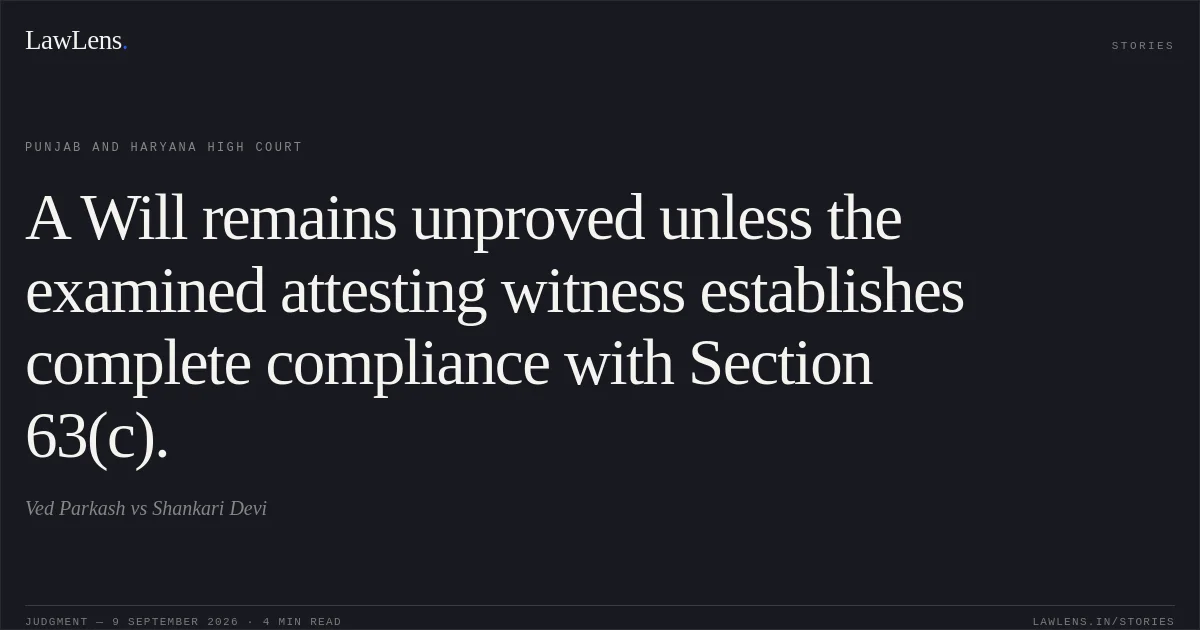
The Court applied Section 63(c) of the Indian Succession Act, 1925, which requires an unprivileged Will to be attested by at least two witnesses, each of whom must have seen the testator sign or received the testator’s personal acknowledgment of the signature, and each of whom must sign the Will in the testator’s presence.
Source reference: p.5–7Section 68 of the Indian Evidence Act, 1872 permits proof of an attested document through one attesting witness, but the witness examined must establish the complete statutory execution of the Will, including attestation by both witnesses.
Source reference: p.8–10Relying on Meena Pradhan v. Kamla Pradhan, 2013 INSC 847, the Court reiterated that the propounder must prove execution, testamentary capacity, and the Will’s status as the last Will, and must remove legitimate suspicious circumstances.
Source reference: p.6–10It also relied on Janki Narayan Bhoir v. Narayan Namdeo Kadam, (2003) 2 SCC 91, holding that proof of the testator’s signature alone does not establish valid execution; the evidence must satisfy all requirements of Section 63(c).
Source reference: p.6–10The Court further applied the principle that concurrent findings of fact will not be disturbed in second appeal absent illegality or perversity.
Source reference: p.12Reasoning
The defendants examined only DW-2, Mohinderjit Singh, as an attesting witness. Although he identified the signatures of Ishwari Devi, the deed writer, and the other attesting witness, he did not state that Ishwari Devi signed or affixed her thumb impression in his presence, that he signed in her presence, or that the other attesting witness signed in the manner required by Section 63(c).
Source reference: p.10Consequently, his testimony established neither the complete attestation of the Will nor its due execution. Section 68 could reduce the number of witnesses required to be examined in court, but it could not dispense with the statutory requirement that the Will itself be attested by two witnesses.
Source reference: p.10–11The Court also found unresolved suspicious circumstances: the Will was drafted in Urdu although Ishwari Devi was a Hindi-knowing woman; the defendants had no close family relationship with her; the Will gave no reason for excluding the alleged natural heirs; and the plaintiffs’ evidence indicated that Ishwari Devi had suffered from weak mental capacity for approximately 10–15 years before her death.
Source reference: p.10–11The defendants, who bore the burden of dispelling these circumstances, failed to provide a cogent explanation.
Source reference: p.10–11Since the Will was not duly proved and Mutation No. 1176 rested solely upon it, the mutation was likewise unsustainable.
Source reference: p.11–12The concurrent factual findings of the courts below were neither illegal nor perverse.
Source reference: p.11–12Holding
The Court held that the defendants failed to prove the valid execution of Will No. 186 dated 31 May 1980 in compliance with Section 63(c) of the Indian Succession Act, 1925.
The sole attesting witness did not establish the statutory execution and attestation requirements, and the suspicious circumstances surrounding the Will remained unexplained.
Source reference: p.10–11Mutation No. 1176, being founded on the invalid Will, was declared unsustainable.
Source reference: p.12The regular second appeal was dismissed, and the concurrent judgments and decrees of the Trial Court and First Appellate Court were upheld.
Source reference: p.12Pending miscellaneous applications, if any, were also disposed of.
Source reference: p.12Acts & Sections Cited
1 provisions across 1 statute referred to in this judgment. Each provision opens on LawLens.
Indian Succession Act, 19251
Original Court PDF
Ved ParkashvsShankari Devi
Click to open original judgment
Original judgment, available to read, download and summarize on LawLens.in