Facts
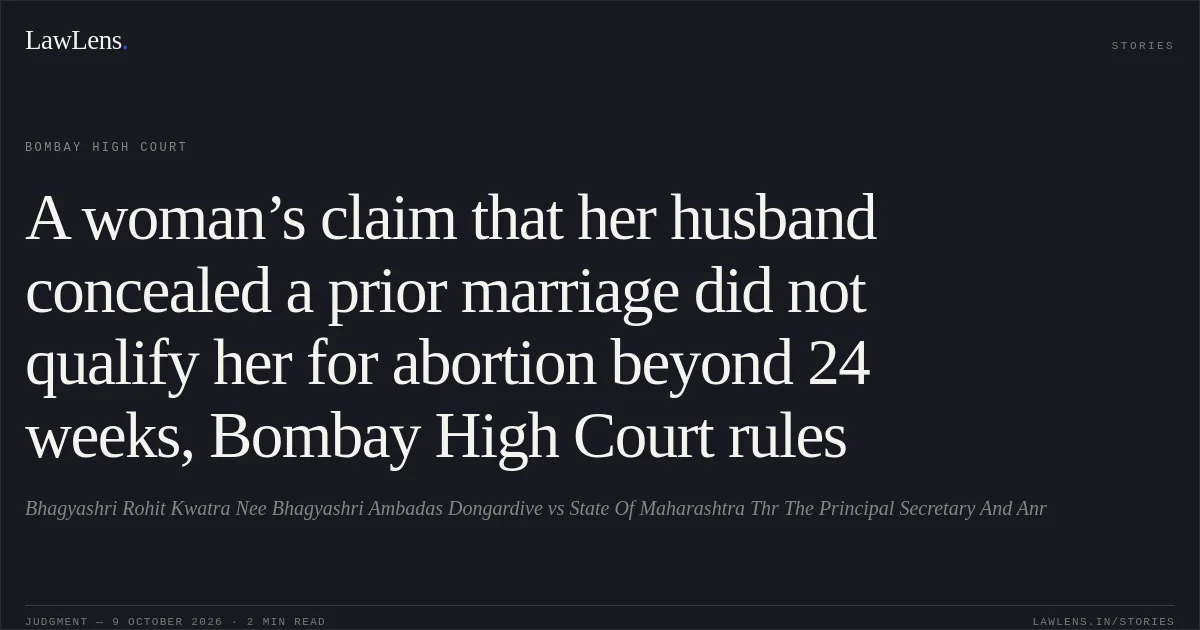
The Petitioner, aged 33, alleged that Respondent No. 2 concealed his prior marriage before marrying her on 16 February 2025, and that she later discovered information suggesting the concealment.
Source reference: p. 2She also alleged mental and physical harassment and stated that she left the matrimonial home.
Source reference: p. 2After a sonography on 26 July 2026, she learned that she was pregnant; her petition, filed on 10 August 2026, initially referred to a gestational age of 13 weeks and 2 days.
Source reference: p. 2At the hearing on 6 October 2026, counsel submitted that the pregnancy was approximately 24 weeks and sought referral to a Medical Board and permission to terminate it, relying on the alleged deception and resulting mental trauma.
Source reference: pp. 3–4The Court directed that the Petitioner’s name be anonymised.
Source reference: p. 1Issues
Whether, on the facts presented, the Petitioner could be permitted to terminate her pregnancy under the Medical Termination of Pregnancy Act, 1971 and the Rules framed under it.
Source reference: p. 4Whether the alleged deception and resulting mental trauma brought the Petitioner within an applicable statutory ground or eligibility category for termination.
Source reference: pp. 4, 7Law Applied
Section 3(2) of the Medical Termination of Pregnancy Act, 1971 permits termination within the prescribed gestational limit where continuation of the pregnancy involves a risk to the pregnant woman’s life, grave injury to her physical or mental health, or a substantial risk of serious physical or mental abnormality in the child if born.
Source reference: p. 5The statutory explanations deem specified anguish—including anguish from a pregnancy alleged to have been caused by rape, or from contraceptive failure—to constitute grave injury to mental health.
Source reference: p. 5Section 3(2-B) disapplies the gestational limit where termination is necessitated by substantial foetal abnormalities diagnosed by a Medical Board.
Source reference: p. 6Rule 3-B of the Medical Termination of Pregnancy Rules, 2003 identifies categories of women eligible for termination under Section 3(2)(b) up to 24 weeks, including survivors of sexual assault, rape or incest; minors; women whose marital status changes during pregnancy by widowhood or divorce; and the other specified categories.
Source reference: pp. 6–7The Court stated that relief could not exceed the statute’s scope.
Source reference: p. 7Reasoning
The Court found that the Petitioner had neither pleaded nor contended that her marital status had changed by widowhood or divorce, and that she did not fall within any other category listed in Rule 3-B.
Source reference: p. 7Her case rested on alleged fraud by her husband and the resulting mental trauma; the Court noted that the alleged fraud had not been judicially established.
Source reference: p. 7It also observed that the case did not involve a foetal abnormality and concluded that Section 3 read with Rule 3-B did not provide an applicable category for the circumstances presented.
Source reference: p. 7Although it empathised with the Petitioner, the Court held that it could not grant relief beyond the statutory framework.
Source reference: p. 7Holding
The Court held that the Petitioner was not eligible for termination under the MTP Act and Rules on the grounds advanced.
It rejected the prayers, dismissed the writ petition and discharged the Rule.
Source reference: p. 8Acts & Sections Cited
1 provisions across 1 statute referred to in this judgment. Each provision opens on LawLens.
Medical Termination of Pregnancy Act, 19711
Original Court PDF
Bhagyashri Rohit Kwatra Nee Bhagyashri Ambadas DongardivevsState Of Maharashtra Thr The Principal Secretary And Anr
Click to open original judgment
Original judgment, available to read, download and summarize on LawLens.in