01Facts
The petitioner and the private respondents were co-sharers in ancestral agricultural holdings in village Badagaon, District Varanasi. The petitioner instituted proceedings under Section 116 of the Uttar Pradesh Revenue Code, 2006 (“the Code”) seeking partition and claiming a one-third share, relying inter alia on a written memorandum of family settlement dated 21 May 2011.
¶ 4–5A preliminary decree determining the parties’ shares was allegedly passed on 17 August 2020, followed by preparation of the kurra/lots and coloured map. A final judgment and decree was thereafter passed by the Sub-Divisional Officer, Pindra, on 22 June 2022.
¶ 5–6The private respondents subsequently filed a restoration/recall application on 28 November 2023. During its pendency, they instituted Revision No. REV/1549/2025 before the Board of Revenue under Section 210 of the Code.
¶ 7By order dated 20 May 2025, the Board summoned the record, entertained the revision, stayed the operation of the final decree, and directed the parties to maintain status quo.
¶ 8The petitioner challenged the Board’s jurisdiction, contending that the final decree was appealable under Section 207 and therefore could not be revised under Section 210.
¶ 10–17The respondents contended that the decree was consensual, ex parte, by default, or obtained through unauthorised appearance and fraud, thereby attracting the exceptions under Sections 209(g) and 209(h), under which no appeal lies.
¶ 18–2902Issues
i.1. Whether the Board of Revenue lacked patent and total jurisdiction under Section 210 of the Code to entertain the revision against the final decree passed under Section 116, on the ground that an appeal ordinarily lay under Section 207?
¶ 30–35, 58–61ii.2. Whether the decree dated 22 June 2022 was in fact passed with the consent of the parties, ex parte, or by default so as to attract the appellate bar under Section 209(g) or Section 209(h), thereby potentially making the revision maintainable under Section 210?
¶ 36–46, 52–57iii.3. Whether the pendency of the restoration/recall application before the court of first instance rendered the revision under Section 210 incompetent?
¶ 6203Law Applied
Section 207 of the Uttar Pradesh Revenue Code, 2006 provides a first appeal against specified final orders and decrees, while Section 208 provides for a second appeal in prescribed circumstances.
¶ 32Section 209, beginning with a non obstante clause, bars appeals against specified orders and decrees notwithstanding Sections 207 and 208; clauses (g) and (h) concern orders or decrees passed with the consent of the parties and orders passed ex parte or by default, respectively.
¶ 36–39The first proviso to Section 209(h) permits an aggrieved person to apply for setting aside an ex parte or default order within thirty days.
¶ 36–39Section 210 confers revisional jurisdiction only over a suit or proceeding “in which no appeal lies” and where the further statutory conditions in clauses (a), (b), or (c) are satisfied.
¶ 33The Court relied on Mohd. Muslim v. State of U.P., 2025 (166) RD 1, for the principle that the absence of an appellate remedy is a jurisdictional condition precedent to revision under Section 210.
¶ 34A writ of prohibition is preventive and is ordinarily issued only where the subordinate authority is proceeding wholly without jurisdiction or proposes to exercise jurisdiction that the law does not confer.
¶ 58–60Provisions in the judgment · 13
U.P. Revenue Code, 2006 13 provisions
Section 116Section 207Section 208Section 209Section 209Section 209Section 209Section 209Section 209Section 209Section 209Section 209Section 21004Reasoning
The Court accepted that the words “in which no appeal lies” in Section 210 constitute a jurisdictional requirement, but held that the petitioner’s argument treated Section 207 in isolation and failed to account for the overriding exceptions in Section 209.
¶ 34–39Although a final decree under Section 116 would ordinarily be appealable under Section 207, the appeal may be barred if the decree was actually passed with the parties’ consent, ex parte, or by default under Section 209(g) or 209(h).
¶ 52–56However, the mere allegation that the decree was ex parte, consensual, fraudulent, or based on an unauthorised Vakalatnama could not conclusively establish the absence of an appellate remedy.
¶ 40–46The parties were in serious factual dispute regarding their appearance, the genuineness of the Vakalatnama, the written statement, alleged consent, preparation of the kurra, and the circumstances in which the decree was passed.
¶ 40–46Those questions could not appropriately be determined by the High Court in a writ petition seeking prohibition.
¶ 54, 59–61The Board was competent to examine the preliminary objection regarding maintainability in the first instance, without the High Court making factual findings on the disputed matters.
¶ 54, 59–61The Court further held that the pendency of the restoration application did not, by itself, establish that the revision was incompetent; the decisive statutory question remained whether an appeal lay against the decree.
¶ 62Since the petitioner had not demonstrated a patent and total absence of jurisdiction, the extraordinary remedy of prohibition was not warranted.
¶ 67–7205Holding
The writ petition was disposed of and the prayer for prohibiting the Board of Revenue from proceeding with Revision No. REV/1549/2025 was rejected.
¶ 74(i)The Court did not finally hold that the revision was maintainable.
¶ 68–72, 74(ii)–(iv)Instead, it directed the Board to independently decide the objection regarding maintainability by examining Sections 207, 209(g), 209(h), and 210 of the Code.
¶ 68–72, 74(ii)–(iv)The Board must determine, on the record, whether the decree was appealable or was actually passed with the consent of the parties, ex parte, or by default.
¶ 68–72, 74(ii)–(iv)No finding was recorded regarding fraud, unauthorised appearance, genuineness of the Vakalatnama or written statement, validity of the family settlement, or legality of the kurra/lots.
¶ 74(v)–(vii)If the revision is found maintainable, the Board must decide it in accordance with law, after hearing all concerned parties, within six months from production of the certified copy of the judgment.
¶ 74(viii)Original Court PDF
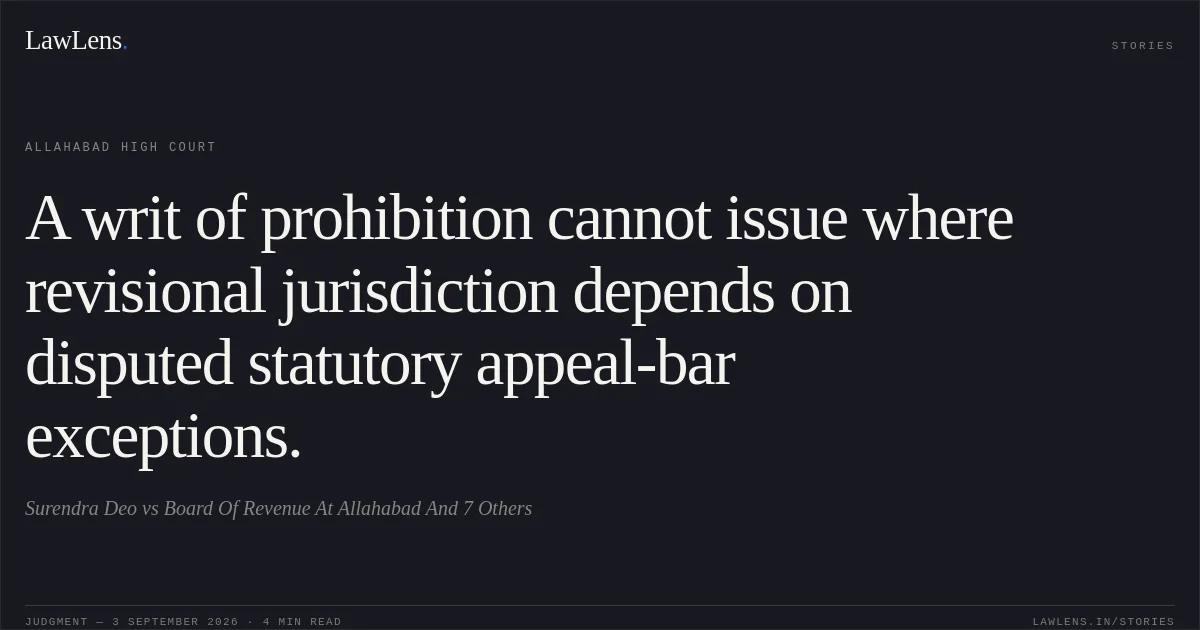
Surendra DeovsBoard Of Revenue At Allahabad And 7 Others
Click to open original judgment
Original judgment, available to read, download and summarize on LawLens.in