Facts
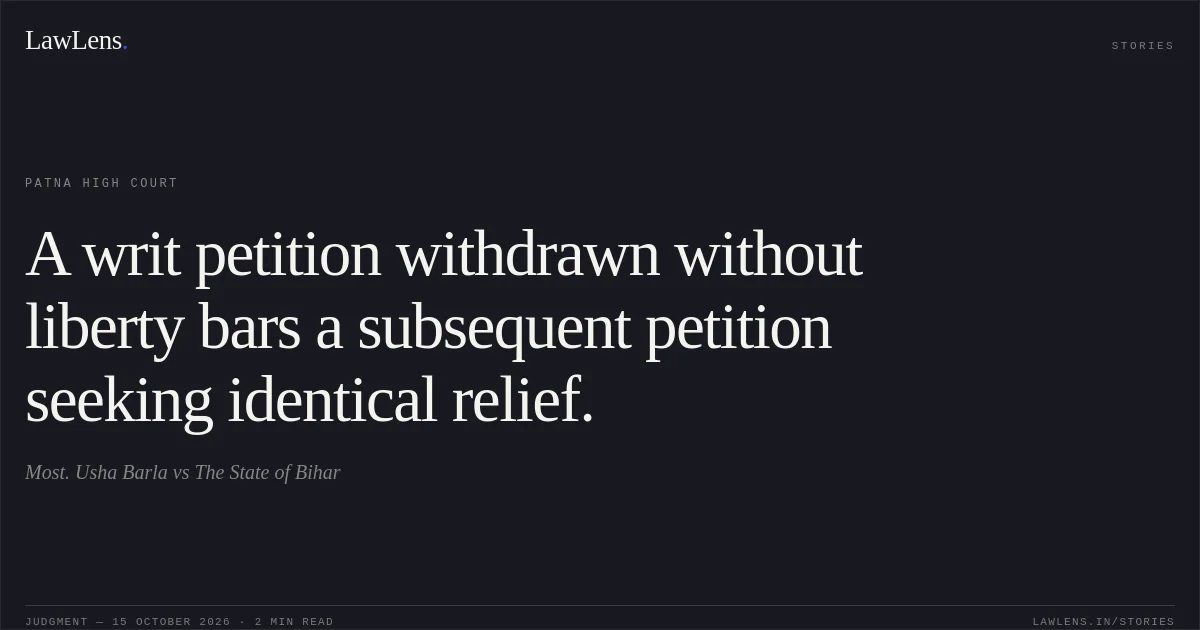
The appellant’s husband, a retired government school Principal, had pursued several proceedings concerning his service, pay fixation and retiral benefits. Earlier proceedings resulted in orders concerning consequential benefits, time-bound promotion and interest; a later writ petition seeking substantially the same reliefs as the present petition was withdrawn in 2017 without liberty to file afresh.
Source reference: p. 3–12, 21–28After her husband’s death, the appellant filed CWJC No. 15574 of 2022 seeking revised pay, salary arrears, revised pension and other benefits, including further interest.
Source reference: p. 13–16The Single Judge dismissed the writ petition on the ground of gross delay and laches, and the appellant challenged that dismissal in this appeal.
Source reference: p. 2, 16Issues
1. Whether the appellant’s 2022 writ petition was barred by constructive res judicata because substantially identical reliefs had been sought in the earlier writ petition, which was withdrawn without liberty to institute a fresh petition.
Source reference: p. 21–282. Whether the appellant could reopen claims concerning interest and provident fund benefits that had been addressed in earlier proceedings, and whether the Single Judge’s dismissal for gross delay and laches warranted appellate interference.
Source reference: p. 18–21, 28Law Applied
Section 11 CPC embodies res judicata, including constructive res judicata: a matter that might and ought to have been raised in earlier proceedings may be treated as having been in issue, barring its subsequent pursuit.
Source reference: p. 22–24Order II Rule 2 CPC requires a claimant to include the whole claim and all available reliefs arising from the same cause of action; omitted reliefs may not later be pursued, subject to the rule’s terms.
Source reference: p. 23–24The Court stated that these general principles apply to writ proceedings, relying on Direct Recruit Class II Engineering Officers’ Association v. State of Maharashtra, Devilal Modi v. Sales Tax Officer, M. Nagabhushana v. State of Karnataka, and Bharat Amritlal Kothari v. Dosukhan Samadkhan Sindhi.
Source reference: p. 24–26The Court also treated the earlier order granting simple interest at 5% per annum, followed by dismissal of the related contempt proceeding after payment, as having concluded the interest claim.
Source reference: p. 19–21Reasoning
The Division Bench found that the reliefs in CWJC No. 15574 of 2022 were substantially identical to those sought in CWJC No. 13119 of 2016, which had been withdrawn without permission to bring a fresh petition.
Source reference: p. 27–28It held that the appellant could not revive those claims in a subsequent writ petition and that claims omitted in earlier proceedings were barred by constructive res judicata.
Source reference: p. 26–28It also found that the interest issue had already been addressed by the Jharkhand High Court and that the related contempt proceeding had been dismissed following payment; any unresolved provident fund grievance arising from the Jharkhand High Court’s orders was to be pursued before that Court.
Source reference: p. 18–21The Bench further agreed with the Single Judge’s conclusion that the 2022 petition was grossly delayed.
Source reference: p. 2, 28Holding
The Court held that the appeal lacked merit. It found no infirmity in the Single Judge’s order dismissing CWJC No. 15574 of 2022 for gross delay and laches, and concluded that the subsequent writ petition was also barred by constructive res judicata.
The Letters Patent Appeal was dismissed.
Source reference: p. 28Acts & Sections Cited
2 provisions across 1 statute referred to in this judgment. Each provision opens on LawLens.
Code of Civil Procedure, 19082
Original Court PDF
Most. Usha BarlavsThe State of Bihar
Click to open original judgment
Original judgment, available to read, download and summarize on LawLens.in