Facts
The plaintiff claimed to be a tenant in the suit property and to have operated a welding business, “Durai Engineering Works,” there for over ten years. He alleged that the first defendant and his men trespassed into the property on 6 December 1989 and damaged trees, and sought a permanent injunction restraining his dispossession except through due process of law.
Source reference: paras. 4–4.4; pp. 4–5The first defendant denied the tenancy and asserted ownership, contending that his brother, Sidhanandam, had only been permitted to run a petty shop and had unauthorisedly inducted the plaintiff.
Source reference: paras. 5–5.3; pp. 5–6The Trial Court found that the plaintiff was in settled possession and decreed the suit.
Source reference: para. 10; p. 8The First Appellate Court reversed that decree, holding that the plaintiff was in wrongful possession and was not entitled to equitable relief, relying on Administrative Officer, Arulmighu Vembadi Vinayagar Temple v. Vasantha Kamatchi, 2001 (2) TLNJ 279.
Source reference: para. 11; pp. 8–9During the second appeal, the original plaintiff died and his legal representatives were brought on record.
Source reference: para. 2; p. 3Issues
1. Whether a person in possession is entitled to protection by permanent injunction even against the true owner.
Source reference: substantial question of law no. 1, para. 12; p. 92. Whether a person in possession can be evicted or dispossessed otherwise than by recourse to due process of law.
Source reference: substantial question of law no. 2, para. 12; p. 93. Whether the title of the first defendant stood concluded by the prior litigation concerning the same property, including the finding that he had perfected title by adverse possession.
Source reference: substantial question of law no. 3, paras. 17–19; pp. 15–174. Whether the defendants’ alleged admission of the plaintiff’s occupation prevented them from removing him except through lawful procedure.
Source reference: substantial question of law no. 4, paras. 12 and 21; pp. 9, 185. Whether the alleged landlord–tenant relationship was relevant to the plaintiff’s claim for permanent injunction against the defendants.
Source reference: substantial question of law no. 5, para. 12 and para. 21; pp. 9, 18Law Applied
The Court exercised jurisdiction under Section 100 of the Code of Civil Procedure, 1908, on the substantial questions of law framed in the second appeal.
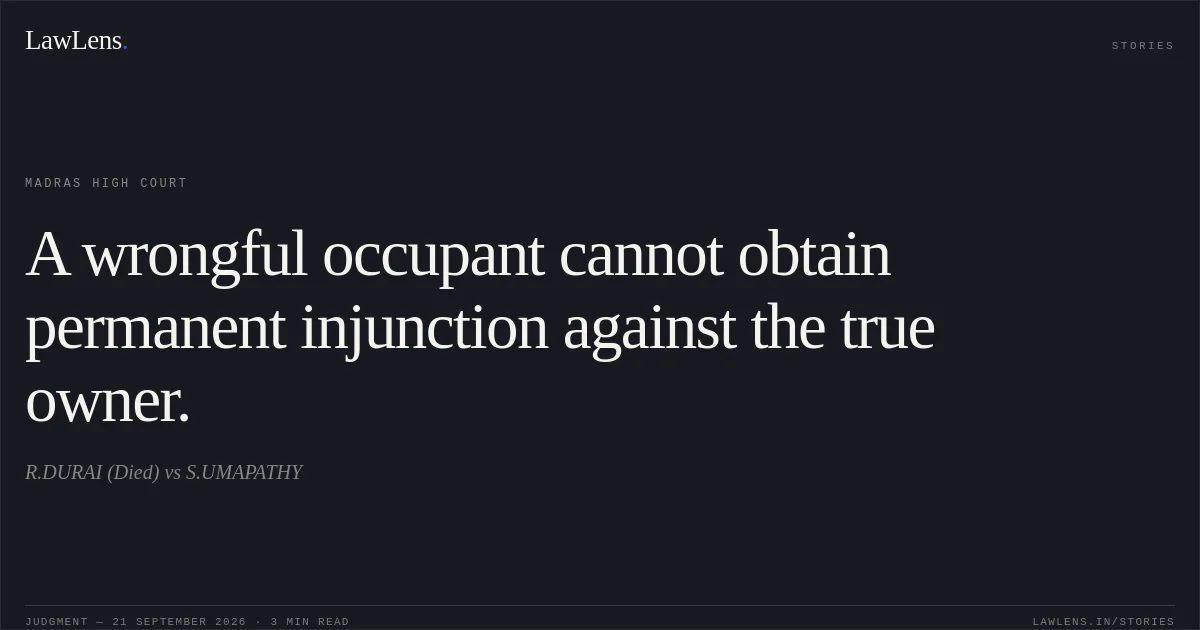
Source reference: para. 12; p. 9It applied the principle that a person in settled possession ordinarily cannot be dispossessed except through due process of law, but held, on the facts of this case, that an unlawful occupant could not obtain an injunction against the true owner.
Source reference: no citationThe Court relied on Administrative Officer, Arulmighu Vembadi Vinayagar Temple v. Vasantha Kamatchi, 2001 (2) TLNJ 279, for the proposition that a wrongful occupant is not entitled to the equitable relief of permanent injunction against the true owner.
Source reference: paras. 11 and 23; pp. 8–9, 19It also applied the binding effect of the earlier litigation, in which the first defendant’s title to the substantially identical property had been upheld on the basis of adverse possession and confirmed up to the High Court.
Source reference: paras. 17–19; pp. 15–17The Court further treated the unregistered rental agreement as insufficient to establish a valid tenancy with the true owner and emphasised the absence of proof of rent payment, attornment, or authority in Sidhanandam to create the alleged tenancy.
Source reference: paras. 20–21; pp. 17–18Reasoning
The Court held that the plaintiff failed to establish a bona fide tenancy or lawful possession.
Source reference: no citationThe alleged rental agreement was executed by Sidhanandam, not by the first defendant, concerned only an area measuring 18 feet by 13 feet, and was not supported by evidence that rent had ever been paid; Sidhanandam was also not examined to prove the agreement or the alleged tenancy.
Source reference: para. 20; p. 17The plaintiff neither pleaded material particulars such as the period of tenancy and rate of rent nor deposited rent after institution of the suit.
Source reference: para. 20; p. 17In contrast, the first defendant’s title had already been conclusively recognised in the earlier proceedings concerning the same property, notwithstanding a minor difference in the stated extent.
Source reference: paras. 17–19; pp. 15–17The Court also found that the first defendant had issued notice requiring the plaintiff either to pay rent or surrender possession, thereby demonstrating an attempt to proceed through lawful means; the plaintiff did neither.
Source reference: para. 21; p. 18Consequently, the plaintiff was treated as an unauthorised occupant who could not invoke the equitable remedy of injunction against the true owner.
Source reference: paras. 21–23; pp. 18–19Holding
The Court answered the substantial questions against the plaintiff.
It held that the plaintiff was neither a lawful tenant nor a bona fide occupant, that the first defendant was the owner of the suit property, and that the plaintiff was not entitled to permanent injunction against him.
Source reference: paras. 19–23; pp. 16–19The Second Appeal was dismissed, the First Appellate Court’s judgment and decree dismissing the suit were confirmed, and there was no order as to costs. The connected Civil Miscellaneous Petition was closed.
Source reference: para. 24; p. 20Acts & Sections Cited
1 provisions across 1 statute referred to in this judgment. Each provision opens on LawLens.
Code of Civil Procedure, 19081
Original Court PDF
R.DURAI (Died)vsS.UMAPATHY
Click to open original judgment
Original judgment, available to read, download and summarize on LawLens.in