Facts
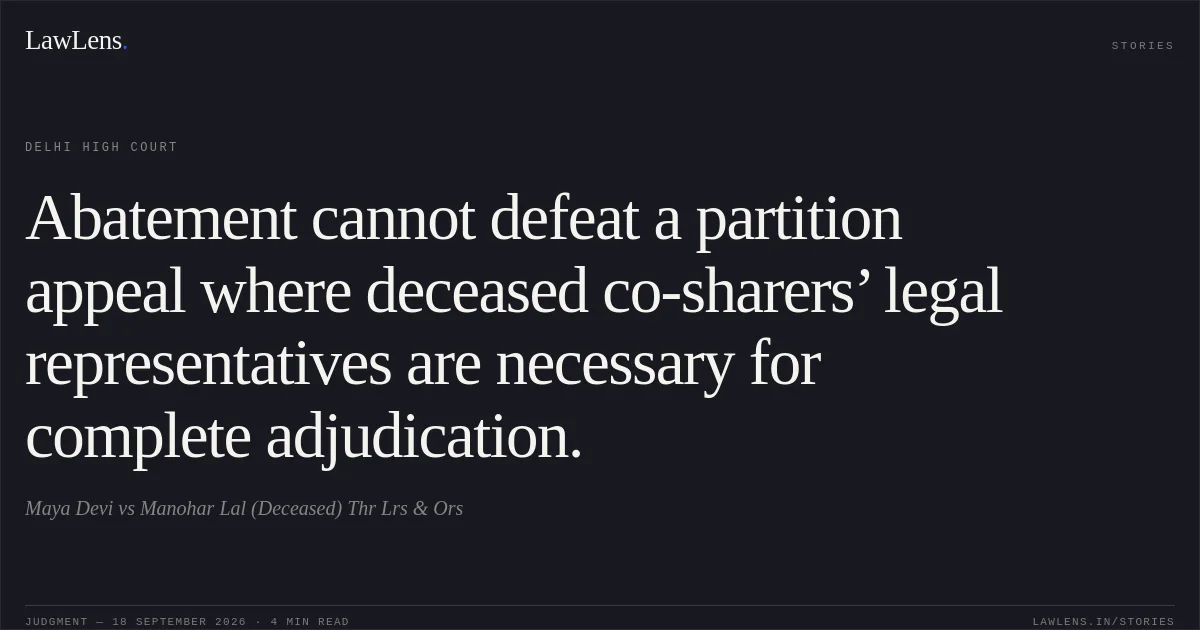
The appellant, an original plaintiff, and other co-sharers instituted a partition suit concerning Shop No. 204/13, Teliwara, Delhi. The suit was initially dismissed as not maintainable, but the appellate court set aside that finding and remanded the matter. The remand order was upheld by the High Court, after which the Trial Court again dismissed the suit. The plaintiffs filed RCA No. 61518/2016 against that dismissal.
Source reference: pp. 1–2During the pendency of the appeal, respondent No. 1, Manohar Lal, died on 1 May 2016; respondent No. 5, Babita, died on 25 September 2016; and Lekhraj, the legal representative of appellant No. 3, died on 20 January 2017. On 30 January 2018, the appellant filed an application under Order XXII Rules 3, 4 and 9 CPC for setting aside abatement and bringing the legal representatives of the deceased parties on record.
Source reference: p. 2The learned ADJ dismissed the application, holding that sufficient cause had not been shown for the delay, and directed the appeal to be listed for final arguments. The appellant challenged that order before the High Court.
Source reference: pp. 2–3The High Court separately condoned the 12-day delay in filing the present appeal.
Source reference: p. 1Issues
Whether an appeal arising from a partition suit can proceed against the surviving parties after abatement qua a deceased co-sharer, or whether the absence of the deceased co-sharer’s legal representatives renders the appeal incapable of effective adjudication?
Source reference: pp. 4–8Whether the appellant had shown sufficient cause for condoning the delay, setting aside the abatement, and bringing the legal representatives of the deceased parties on record under Order XXII Rules 3, 4 and 9 CPC?
Source reference: pp. 8–11Law Applied
The Court applied Order XXII Rules 3, 4 and 9 CPC, which govern substitution of the legal representatives of deceased parties, the consequences of abatement, and setting aside abatement.
Source reference: pp. 4–6It applied the principle in State of Punjab v. Nathu Ram, that where an appeal involves a joint and indivisible decree, the appeal cannot proceed against the surviving parties if it has abated against a necessary party, since this may result in inconsistent decrees.
Source reference: pp. 4–6Relying on Sardar Amarjit Singh Kalra v. Pramod Gupta and Venigalla Koteswaramma v. Malampati Suryamba, the Court held that the effect of abatement depends on the nature of the decree and the possibility of inconsistent adjudications; in partition proceedings, the legal representatives of deceased co-sharers are necessary for complete adjudication.
Source reference: pp. 4–8For condonation of delay and setting aside abatement, the Court applied the principles in Perumon Bhagvathy Devaswom v. Bhargavi Amma and Om Prakash Gupta alias Lalloowa v. Satish Chandra, namely that “sufficient cause” should receive a liberal, pragmatic and justice-oriented interpretation, particularly where the delay is neither deliberate nor mala fide and substantive rights in immovable property are involved.
Source reference: pp. 9–11The Court also applied the principle that procedure is the handmaid of justice, as recognised in Sital Prasad Saxena v. Union of India and Bhagwan Swaroop v. Moolchand.
Source reference: p. 11Reasoning
The Court held that the deceased parties were co-sharers or represented branches of the family having an interest in the partition property. Their legal representatives were therefore necessary parties for determining the respective shares and for passing an effective and complete decree.
Source reference: pp. 7–8If the appeal proceeded only against the surviving parties, the result could be inconsistent decrees concerning the same property; accordingly, the appeal could not be treated as having abated only against Lekhraj while continuing against the remaining parties.
Source reference: pp. 7–8On delay, the Court accepted that the appellant was an illiterate woman, had no direct contact with the legal representatives of the deceased parties, and faced difficulty in obtaining their particulars.
Source reference: p. 9The fact that Savita, widow of deceased Lekhraj, had herself approached the Court through the DSLSA for impleadment with her minor children also supported the explanation.
Source reference: p. 9Given that the dispute concerned substantive rights in immovable property, had remained pending for more than three decades, and did not disclose deliberate inaction or mala fides, the Court preferred adjudication on merits over termination of the proceedings on a procedural default.
Source reference: pp. 9–11Holding
The High Court allowed the appeal and set aside the ADJ’s order dated 11 February 2019.
It held that the appeal could not effectively proceed in the absence of the legal representatives of the deceased co-sharers.
Source reference: pp. 11–12The abatement of RCA No. 61518/2016 was set aside, and the legal representatives identified in the application dated 30 January 2018 were brought on record. The underlying appeal was directed to be adjudicated on merits.
Source reference: pp. 11–12Acts & Sections Cited
1 provisions across 1 statute referred to in this judgment. Each provision opens on LawLens.
Limitation Act, 19631
Original Court PDF
Maya DevivsManohar Lal (Deceased) Thr Lrs & Ors
Click to open original judgment
Original judgment, available to read, download and summarize on LawLens.in