Facts
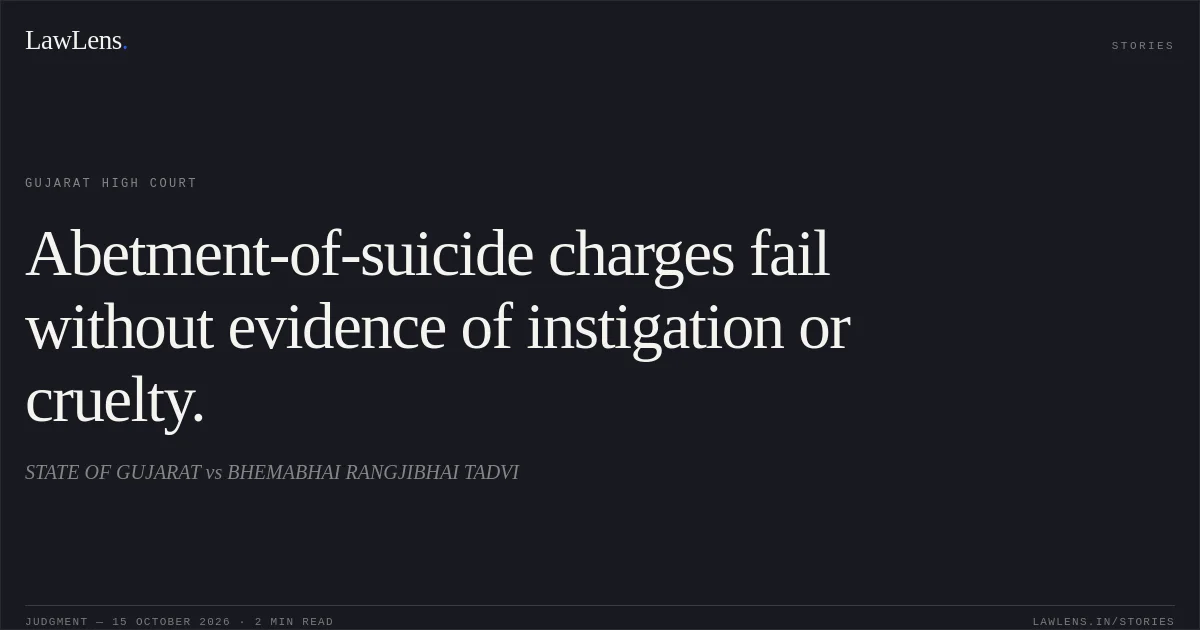
Ushaben, who had been married to respondent no. 2 for about eight years and had two young children, was found dead with her children in two wells at village Balaiya.
Source reference: para. 1–2, 5–6Her father alleged that harassment and cruelty by the accused had led her to take her own life and that of the children.
Source reference: para. 1–2, 5–6The trial court acquitted the accused of offences under Sections 498A, 306 and 114 of the Indian Penal Code (IPC); the State appealed under Section 378 of the Code of Criminal Procedure, 1973 (CrPC).
Source reference: para. 1–2, 5–6On appeal, the High Court noted that the complainant had not described any prior complaint of cruelty, that the complaint was prepared at the Sarpanch’s behest, and that the prosecution had not established how the deceased and children travelled to Balaiya or presented eyewitness evidence of the deaths.
Source reference: para. 12–14Issues
Whether the trial court was justified in acquitting the accused on the evidence presented.
Source reference: para. 10Whether the trial court properly appreciated the prosecution evidence, and whether its judgment disclosed illegality, irregularity or perversity warranting appellate interference.
Source reference: para. 10Law Applied
Sections 498A and 306 IPC require proof of the respective offences’ ingredients; for abetment under Section 306, the prosecution must establish abetment within the meaning of Section 107 IPC, including instigation, provocation or incitement.
Source reference: para. 14In an appeal against acquittal under Section 378 CrPC, the appellate court may review and reappreciate the evidence, but the accused benefit from a double presumption of innocence; where two reasonable views are possible, the acquittal should not be disturbed.
Source reference: para. 18–20The court relied on Chandrappa v. State of Karnataka, (2007) 4 SCC 415, and subsequent authorities on appellate review of acquittals.
Source reference: para. 20–21It also referred to Section 113B of the Evidence Act and decisions concerning abetment and cruelty.
Source reference: para. 15–16Reasoning
The evidence did not establish any specific past incident or history of cruelty, nor did it show that the accused instigated or otherwise abetted the deceased’s alleged suicide.
Source reference: para. 13–14The prosecution also failed to establish the circumstances in which the deceased and children reached Balaiya or whether their deaths were suicidal or accidental; no witness had seen the incident.
Source reference: para. 13–14In those circumstances, the evidence did not prove the charges beyond reasonable doubt.
Source reference: para. 17, 22–23The trial court’s assessment was a reasonable view of the record, and the High Court found no perversity or manifest error justifying reversal of the acquittal.
Source reference: para. 17, 22–23Holding
The High Court answered the issues against the State, holding that the trial court had committed no material error in acquitting the accused and that the prosecution had failed to prove the charges beyond reasonable doubt.
The appeal was dismissed, the acquittal was confirmed, the bail bonds were cancelled, and the record and proceedings were directed to be returned to the trial court.
Source reference: para. 24Acts & Sections Cited
5 provisions across 2 statutes referred to in this judgment. Each provision opens on LawLens.
Code of Criminal Procedure, 19732
Indian Penal Code, 18603
Original Court PDF
STATE OF GUJARATvsBHEMABHAI RANGJIBHAI TADVI
Click to open original judgment
Original judgment, available to read, download and summarize on LawLens.in