Facts
The deceased, Chetnaben, married the respondent Manojbhai and resided with her husband and father-in-law.
Source reference: para 2, 8.3On 09.01.2007, she allegedly cut her wrist and committed suicide by self-immolation using kerosene
Source reference: para 2, 8.3Before her death, she filed a complaint (Exh-32) and gave a dying declaration (Exh-15) alleging that her mother-in-law and other relatives (who lived separately) harassed her regarding household work and taunted her by accusing her of stealing money and consuming food meant for her daughters
Source reference: para 8.2, 8.12The State filed an appeal against the judgment dated 03.03.2010 passed by the Additional Sessions Judge, Ahmedabad, which acquitted the respondents of charges under Sections 306, 498(A), 114 of the IPC and Section 31 of the Domestic Violence Act
Source reference: para 1, 2Issues
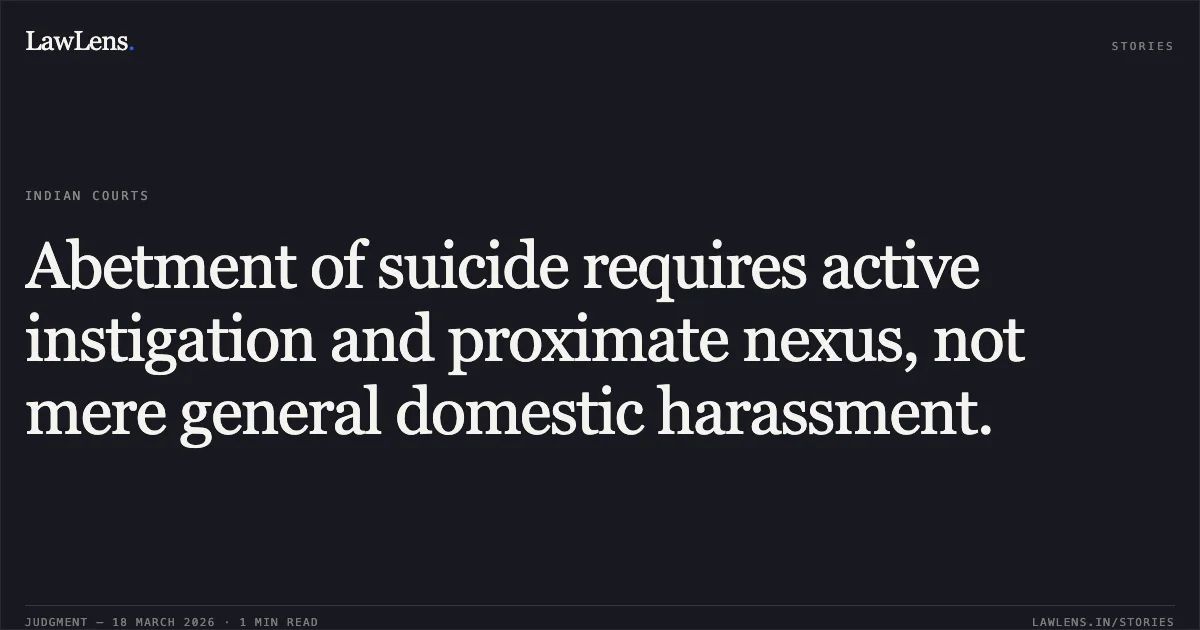
1. Whether the allegations of taunting and domestic disagreements constitute "instigation" or "abetment" under Section 306 read with Section 107 of the IPC
Source reference: para 9.3, 9.42. Whether the prosecution established a proximate and direct causal link between the conduct of the accused and the deceased’s decision to commit suicide
Source reference: para 9.6, 10.43. Whether there exists any patent perversity in the Trial Court's order of acquittal warranting interference by the High Court under Section 378 of the CrPC
Source reference: para 18Law Applied
The Court primarily applied Section 306 (Abetment of suicide) and Section 498(A) (Cruelty) of the IPC.
Source reference: para 9.4, 10It relied on Section 107 IPC to define abetment as requiring instigation, conspiracy, or intentional aiding, emphasizing that "instigation" requires a provocative act or omission that leaves the victim with no other option
Source reference: para 9.4, 10The Court further applied the principles from Amalendu Pal v. State of West Bengal, which mandates proof of direct or indirect incitement proximate to the time of the incident
Source reference: para 10.2Chandrappa v. State of Karnataka, which establishes that an appellate court should not disturb an acquittal if two reasonable views are possible
Source reference: para 17Reasoning
The Court observed that the deceased lived with her husband and father-in-law, against whom no allegations were made, while the accused relatives lived separately
Source reference: para 8.11, 8.12It noted significant discrepancies between the FIR and the dying declaration; in the latter, the deceased failed to name all the accused, mentioning only the mother-in-law and "samovadiya"
Source reference: para 8.4The Court reasoned that the allegations regarding quarrels over household work and taunts about milk and money were general in nature and did not meet the legal threshold of "instigation"
Source reference: para 8.13, 9.5Furthermore, the deceased’s own statement indicated she acted because she "got excited" or "lost her temper," suggesting a subjective reaction rather than objective incitement by the accused
Source reference: para 8.3, 8.15There was no evidence of any "proximate act" immediately preceding the suicide that compelled the fatal step
Source reference: para 9.7, 9.8The Court concluded that routine domestic friction does not ipso facto amount to abetment without clear mens rea and a live nexus
Source reference: para 9.5, 9.6Holding
The High Court dismissed the appeal and confirmed the Trial Court’s order of acquittal
The Court held that the prosecution failed to prove the foundational elements of abetment under Section 306 IPC, as there was no evidence of active provocation or intentional aiding by the accused proximate to the occurrence
Source reference: para 9.1, 9.8Since the Trial Court’s view was reasonable and not perverse, the presumption of innocence was reinforced, and no interference was warranted
Source reference: para 18, 20Acts & Sections Cited
7 provisions across 3 statutes referred to in this judgment. Each provision opens on LawLens.
Indian Penal Code, 18604
Protection of Women from Domestic Violence Act, 20051
Code of Criminal Procedure, 19732
Original Court PDF
STATE OF GUJARATvsMANOJBHAI RASIKBHAI MAKWANA
Click to open original judgment
Original judgment, available to read, download and summarize on LawLens.in