01Facts
The deceased, Sarlaben, was married to accused no. 1 about four months before her death. Accused nos. 2 and 3 are her parents-in-law.
The complainant alleged that the accused taunted her about jewellery and her failure to perform household work, and said they intended to bring another daughter-in-law and did not want her in the family.
p. 2, para 2.1On 13.08.2014 she died by hanging at her matrimonial home. Her brother lodged a complaint the same day, registered as I-C.R. No. 60 of 2014 under Sections 498A and 306 IPC.
pp. 2–3, para 2.1After investigation, the case was committed to the Sessions Court, Dahod, as Sessions Case No. 16/2015.
p. 3, para 2.2The prosecution examined 14 witnesses and produced 5 documents. The accused were questioned under Section 313 CrPC, denied the evidence, and led no defence evidence.
p. 4, para 2.4The Trial Court acquitted all accused on 22.09.2016, giving them the benefit of doubt. The State appealed under Section 378 CrPC.
p. 1, para 1 · p. 5, para 3Medical evidence (PW1, Exh. 7; Exh. 9) recorded a ligature mark on the neck, no other external injuries, and asphyxia due to hanging as the cause of death.
¶ 9.1 · pp. 9–10PW2 (brother/complainant) alleged that the deceased disclosed harassment to her mother during a Raksha Bandhan visit. On cross-examination, he admitted that the bridegroom's family customarily pays "Dava"; that his family received Rs. 85,000 as Dava and Rs. 2,00,000 towards jewellery; that the groom's credentials were verified; that the deceased appeared happy on visits and never complained during her lifetime; and that the community elders decided the complaint's contents.
¶ 9.2 · pp. 10–12PW3 (sister-in-law) admitted that her advocate told her to depose so that the accused would be convicted, that police never recorded her statement, and that she first alleged harassment in court on her advocate's explanation.
¶ 9.3 · pp. 13–14PW4 (mother), PW5, PW6, PW7, and PW8 (family) admitted that the deceased lived happily, that there was no quarrel, that Dava and silver were received, that the groom's family never demanded anything during the Raksha Bandhan visit, and that no complaint was ever made.
¶ 9.4–9.8 · pp. 14–17After the death, community elders decided on Rs. 2,00,000 from the accused. It was paid, a stamp-paper document was executed, and only then was the body released to the accused, who performed the cremation.
¶ 9.8 · pp. 18–19Formal witnesses (PW9–PW13) and the IO (PW14) proved only procedural matters. The IO admitted that no ill-treatment complaint was made, no quarrel was reported, and no injury marks were found.
¶ 9.9–9.10 · pp. 19–2102Issues
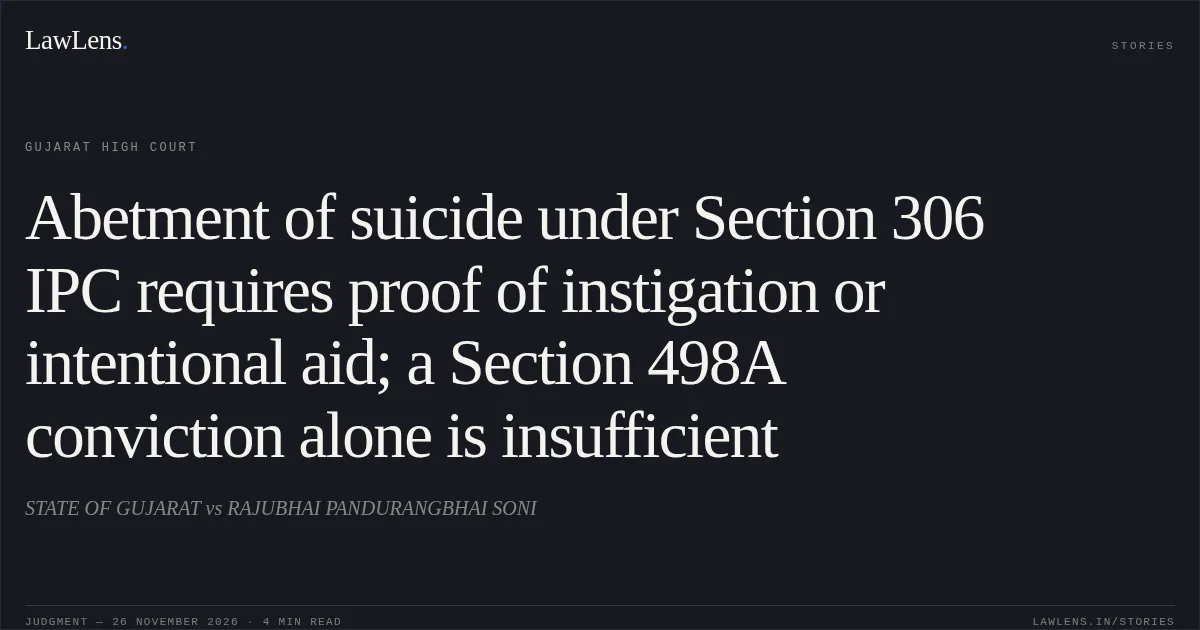
i.1. Whether the prosecution proved, beyond reasonable doubt, that the accused abetted the suicide of the deceased under Section 306 read with Section 107 IPC (and Section 114 IPC), through instigation, conspiracy, or intentional aid.
pp. 21–24, paras 10–12ii.2. Whether the statutory presumption under Section 113A of the Indian Evidence Act, 1872 could be invoked to presume abetment in the absence of proof of cruelty.
p. 27, para 11.4iii.3. Whether the Trial Court's acquittal was perverse or unreasonable, such that the appellate court should interfere in an appeal against acquittal.
pp. 29–30, paras 13–1403Law Applied
Section 107 IPC defines abetment as instigation, conspiracy with an act or omission, or intentional aid by act or omission.
p. 21, para 10Ramesh Kumar v. State of Chhattisgarh, (2001) 9 SCC 618, holds that instigation means to goad, urge, provoke, or incite, that words spoken in anger do not amount to instigation, and that a continuing course of conduct leaving the victim no option may suffice.
pp. 22–23, para 10.1State of West Bengal v. Orilal Jaiswal, (1994) 1 SCC 73, cautions against treating ordinary domestic discord as abetment of a hypersensitive victim's suicide.
pp. 22–23, para 10.1Amalendu Pal v. State of West Bengal, (2010) 1 SCC 707, requires proof of positive, proximate acts of incitement or active facilitation, and holds that mere harassment without such acts is insufficient.
p. 23, para 10.2M. Mohan v. State, (2011) 3 SCC 626, requires a positive act and mens rea to push the deceased into a position where suicide was the only option.
pp. 23–24, para 10.3Section 113A of the Evidence Act is discretionary and rebuttable and cannot be applied mechanically merely because death occurred within seven years of marriage.
p. 27, para 11.4Under Chandrappa v. State of Karnataka, (2007) 4 SCC 415, an appellate court may reappreciate evidence, but where two reasonable views are possible it should not disturb an acquittal, and the presumption of innocence is reinforced by acquittal.
p. 29, para 13Provisions in the judgment · 7 · Linked ones open on LawLens
Code of Criminal Procedure, 1973 Section 378Section 209Section 207Section 313
Indian Penal Code, 1860 Section 306Section 114Section 107
04Reasoning
The Court found that the medical evidence established only the cause and manner of death (hanging), not the accused's involvement.
¶ 9.1 · pp. 9–10The prosecution's central witnesses undermined its own case. PW2 admitted that the deceased never complained during her lifetime, that she appeared happy on her last visit, and that the complaint was drafted under community direction.
¶ 9.2 · pp. 10–12The family's admissions on cross-examination about Dava and jewellery payments undercut the allegation of dowry demands.
¶ 9.2, 9.6, 11.3 · pp. 17, 26–27PW3's admission that her testimony on harassment was shaped by counsel further weakened the prosecution's case.
¶ 9.3 · pp. 13–14Silence during the Raksha Bandhan visit, which was two days before death, was treated as a material circumstance, though not conclusive.
¶ 9.2, 11.2 · p. 12, 26The IO's admissions that no quarrel or cruelty came to light supported this view.
¶ 9.10 · pp. 20–21The Court treated the Rs. 2,00,000 payment after death as a relevant circumstance on the complaint's credibility, but not as an admission of guilt.
¶ 9.8, 11.3 · pp. 18–19, 26–27Applying Ramesh Kumar, Amalendu Pal, and M. Mohan, the Court held that no positive, proximate act of instigation or aid was proved and that the Section 107 requirement was unmet.
¶ 10.4, 11 · pp. 24–26The Court declined to apply Section 113A mechanically, because the foundational facts of cruelty under Section 498A were not established.
¶ 11.4 · p. 27Applying Chandrappa, the Court found that the Trial Court's view was a reasonable and possible one, supported by the record, so there was no basis for interference.
¶ 13–14 · pp. 29–3005Holding
The prosecution failed to establish the essential ingredients of Section 306 IPC, namely any instigation, intentional aid, or proximate positive act by the accused, and the presumption under Section 113A could not be mechanically invoked.
¶ 12 · pp. 28–29 · ¶ 11.4 · p. 27The Trial Court's acquittal was not perverse, and the accused were entitled to the benefit of reasonable doubt.
¶ 14–15 · pp. 29–31The appeal against acquittal is dismissed, and the Trial Court's judgment and order of acquittal in Sessions Case No. 16/2015 dated 22.09.2016 is confirmed.
¶ 15–16 · pp. 30–31The bail bond is cancelled, and the record is to be returned to the Trial Court forthwith.
¶ 17 · p. 31Original Court PDF
STATE OF GUJARATvsPINKESHBHAI BACHUBHAI CHARPOT
Click to open original judgment
Original judgment, available to read, download and summarize on LawLens.in