01Facts
The respondent No.1 (accused) served as a Clerk and later as Octroi Karkoon/Octroi Inspector in Vapi Nagarpanchayat.
The prosecution alleged that during 28/04/1983 to 24/04/1984 he collected octroi of Rs. 2,17,166-91 but deposited only Rs. 1,78,074-69, retaining Rs. 39,092-22.
p. 2For 28/04/1984 to 25/07/1984, it alleged further retention of Rs. 4,000, non-deposit of cash on hand of Rs. 30,094-21, and other shortfalls, totalling Rs. 24,225-80 in addition.
p. 2The shortfalls surfaced during an audit held 27/07/1984 to 29/07/1984. On the auditor's recommendation, the Secretary lodged a complaint, and three chargesheets were filed.
pp. 2–3At trial, the Chief Judicial Magistrate, First Class, Valsad relied on the accused's statements (Exhs. 16 and 17), in which he allegedly admitted misappropriation, and on a handwriting expert's opinion that the receipts were in his hand. He was convicted under Section 408 IPC and sentenced to one year RI and a fine of Rs. 500.
p. 3, para 2.4On appeal, the Sessions Court (2nd Additional Sessions Judge, Valsad, judgment dated 30/03/2007) acquitted him.
p. 3, para 2.5The Municipality filed this revision under Section 397 CrPC.
p. 1The petitioner argued that the admissions were made before an independent officer, were not coerced, and were wrongly discounted.
pp. 3–4The respondent argued that the acquittal was reasoned, and that he had deposited the disputed amount with interest (Rs. 4,46,648-48) by demand draft, showing bona fides.
pp. 4–502Issues
i.1. Whether the first appellate court's acquittal under Section 408 IPC is perverse or otherwise warrants interference in revisional jurisdiction under Section 397 CrPC.
p. 7, para 11 · p. 8, para 13ii.2. Whether the prosecution proved beyond reasonable doubt that the accused received the octroi amounts and dishonestly converted them to his own use.
p. 5, para 6iii.3. Whether the accused's alleged confessional statements (Exhs. 16 and 17) can sustain a conviction.
p. 5, para 7 · p. 6, para 8iv.4. Whether the handwriting expert's opinion establishes the commission of the offence.
p. 5, para 703Law Applied
Section 408 IPC (criminal breach of trust by a clerk or servant) requires proof of entrustment and dishonest misappropriation.
p. 5, para 6Section 27 of the Evidence Act provides that information or confession from an accused is admissible only to the extent it leads to the discovery of a fact relating to the offence; a bare confession without such discovery cannot be used against the accused.
p. 6, para 8The prosecution must establish its case beyond reasonable doubt and cannot rely on weaknesses in the defence.
p. 6, para 9Under Kondapaka Sridhar v. State of Telangana (2026), a conviction cannot rest on confessions elicited from the accused where no substantive corroborating evidence is led.
p. 7, para 10Under Tulasareddi @ Mudakappa v. State of Karnataka (2026 INSC 67), appellate interference with acquittal is confined to exceptional cases where the judgment is perverse, and the presumption of innocence is reinforced by acquittal.
p. 7, para 11Revisional jurisdiction is supervisory and narrower than appellate review; the Court examines only correctness, legality and propriety and does not re-appreciate evidence, per Joseph Stephen v. Santhanasamy (Cr.A. Nos. 90–93 of 2022, decided 25/01/2022) and Kuntegowda v. Thurubaiah (2026 INSC 790).
pp. 7–8, para 12Provisions in the judgment · 3 · Linked ones open on LawLens
Code of Criminal Procedure, 1973 Section 397Section 378
Indian Penal Code, 1860 Section 408
04Reasoning
The Court first held that the prosecution had not shown entrustment and dishonest conversion. Holding the post of Octroi Inspector and noticing audit discrepancies were insufficient on their own.
p. 5, para 6The Exh. 16 and 17 confessions were not legally reliable. The Magistrate had relied on them without examining their admissibility and evidentiary value.
pp. 5–6, para 7Applying Section 27, the Court noted that the accused made a bare confession, with no discovery of any fact connecting him to the circumstances of the misappropriation, so the statements could not be used against him.
p. 6, para 8The handwriting opinion was treated as insufficient to establish the offence on its own.
p. 5, para 7No independent witness was examined, so the conviction rested solely on the accused's admission.
p. 6, para 9Under Kondapaka, this uncorroborated confession could not sustain conviction.
p. 7, para 10The Court treated the acquittal as a plausible view of the evidence. Because it was not perverse, the High Court in revision would not re-weigh the evidence or substitute its own view.
pp. 7–8, paras 11–12The respondent's deposit of the amount with interest was relied on in argument but not treated as a determinative ground.
pp. 4–5, para 5.105Holding
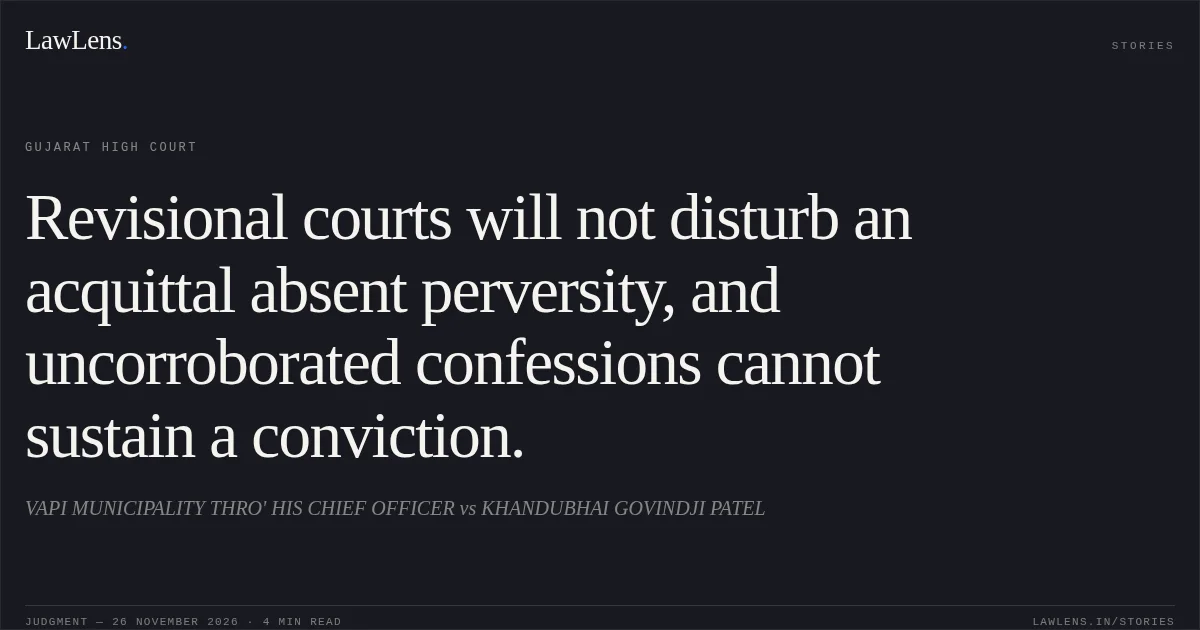
The prosecution failed to prove beyond reasonable doubt that the accused dishonestly misappropriated the amounts. The confessions and handwriting opinion did not sustain conviction, and the Sessions Court's acquittal was not perverse.
p. 8, para 13The Court found no glaring procedural defect, manifest error of law, or perversity.
p. 8, para 13All three revision applications were dismissed, and the record was ordered remitted to the trial court.
pp. 8, paras 14–15Original Court PDF
VAPI MUNICIPALITY THRO' HIS CHIEF OFFICERvsKHANDUBHAI GOVINDJI PATEL
Click to open original judgment
Original judgment, available to read, download and summarize on LawLens.in