01Facts
The deceased, Kirtiben, was married to accused No. 1 for over ten years. Accused Nos. 2 and 3 are her parents-in-law
p. 2The prosecution alleged that from about two years after the marriage, all three accused subjected her to physical and mental cruelty and failed to provide sufficient household money
p. 2On 14.12.2005, she allegedly poured kerosene on herself in the toilet of the rented premises and set herself alight
p. 2Her brother, Vijaybhai (PW-6), lodged complaint I-C.R. No. 259 of 2015 at Limbayat Police Station under Sections 498A, 306 and 114 IPC
pp. 2–3After investigation, the case was committed to the Sessions Court, Surat, as Sessions Case No. 63 of 2016
p. 3The prosecution examined 13 oral and 7 documentary witnesses
p. 3The accused denied the charge, did not lead evidence, and were not examined as witnesses
p. 3The trial court acquitted all accused under Section 306 IPC, giving benefit of doubt under Section 235(1) Cr.P.C., but convicted them under Section 498A IPC and sentenced each to three years' rigorous imprisonment and a fine of ₹2,000
pp. 1, 3–4The State appealed only the Section 306 acquittal, contending that the witnesses supported the prosecution and the trial court relied on minor contradictions
pp. 4–5Jail remarks show that all accused have completed their Section 498A sentences and been released
p. 1602Issues
i.1. Whether the prosecution proved beyond reasonable doubt that the accused abetted the deceased's suicide under Section 306 IPC, so as to warrant reversal of the acquittal
p. 7 · ¶ 9 · p. 17 · ¶ 13ii.2. Whether the appellate court may interfere with a considered acquittal where the trial court's view is a reasonable and possible one
pp. 5–7 · ¶ 7–8iii.3. Whether the accused's conviction under Section 498A IPC and completion of its sentence can establish the ingredients of abetment under Section 306 IPC
p. 16 · ¶ 1203Law Applied
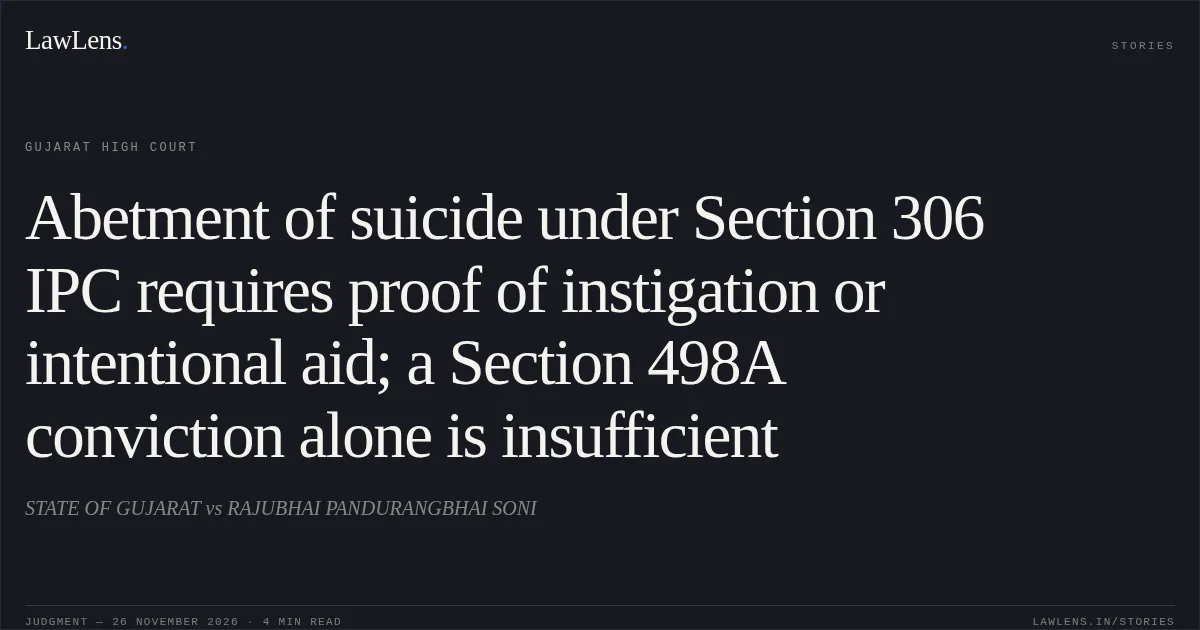
The Court relied on Section 306 IPC read with Section 107 IPC, under which abetment requires instigation, conspiracy or intentional aid, and mere cruelty or suicide is insufficient without proof of such conduct
p. 7 · ¶ 9It applied the principles in Chandrappa v. State of Karnataka, (2007) 4 SCC 415, which permit full re-appreciation of evidence in acquittal appeals, but require the appellate court to respect the double presumption of innocence and not disturb a reasonable and plausible acquittal where two conclusions are possible
pp. 5–7 · ¶ 7–8It relied on Ramesh Kumar v. State of Chhattisgarh, (2001) 9 SCC 618, which holds that instigation requires reasonable certainty of incitement and that Sections 498A and 306 IPC are distinct offences, so a 498A conviction does not automatically establish abetment
pp. 14–15 · ¶ 10It also applied Geo Varghese v. State of Rajasthan, (2021) 19 SCC 144, which requires a direct or indirect act of incitement with proximity to the suicide, and caution where the deceased was hypersensitive
p. 15 · ¶ 10.1Provisions in the judgment · 8 · Linked ones open on LawLens
Code of Criminal Procedure, 1973 Section 378Section 235Section 209Section 207Section 313
Indian Penal Code, 1860 Section 306Section 114Section 107
04Reasoning
The Court accepted that the death by self-immolation (approx. 81% burns) was undisputed, but held that suicide alone does not establish abetment
p. 7 · ¶ 9Re-appreciating the evidence, it found that the relatives' testimony did not identify any specific instigating act: PW-5 admitted that the accused never restrained the deceased from visiting her parents and that accused No. 1 was not addicted to liquor or gambling
p. 8 · ¶ 9.1PW-6 had visited only four to five times, witnessed no quarrels, and admitted that the deceased never complained to anyone
p. 9 · ¶ 9.2PW-7 admitted he never saw accused Nos. 2 and 3 instigating anything and that his statement was written by his sons
pp. 9–10 · ¶ 9.3PW-8 had no personal knowledge of the accused
p. 10 · ¶ 9.4The landlord, PW-9, did not support the prosecution
pp. 10–11 · ¶ 9.5The minor daughter, PW-10, admitted she never saw any physical assault
p. 11 · ¶ 9.6The medical officer, PW-11, found no injuries suggestive of assault and no kerosene trace
pp. 11–12 · ¶ 9.7The Investigating Officer, PW-12, admitted that no harassment was found, no eyewitness existed, and the accelerant was not seized
p. 12 · ¶ 9.8Applying Ramesh Kumar and Geo Varghese, the Court held that no proximate instigation or intentional aid was shown, and that ordinary matrimonial discord is insufficient
p. 13, 15 · ¶ 9.9–10.1, 11On the 498A point, the Court held that the completed 498A sentence cannot substitute for independent proof of abetment
p. 16 · ¶ 12Because the trial court's acquittal was a reasonable and possible view on the evidence, and the presumption of innocence was reinforced, the Court found no ground for interference
pp. 6–7 · ¶ 8 · p. 17 · ¶ 1305Holding
The prosecution failed to prove the essential ingredients of abetment under Section 306 IPC beyond reasonable doubt against any accused
pp. 17–18 · ¶ 13–14The acquittal was therefore upheld, and the benefit of doubt went to the accused
pp. 17–18 · ¶ 13–14The State's appeal is dismissed and the impugned acquittal is confirmed
p. 18 · ¶ 14The bail bonds are cancelled, and the records are returned to the trial court
p. 18 · ¶ 15The Section 498A conviction was not challenged in this appeal and is not disturbed by this judgment
Original Court PDF
STATE OF GUJARATvsRAJUBHAI PANDURANGBHAI SONI
Click to open original judgment
Original judgment, available to read, download and summarize on LawLens.in