Facts
The University of Delhi engaged the National Testing Agency (NTA) to conduct computer-based examinations for recruitment to various non-teaching posts. Pursuant to the advertisement dated 23 February 2021, the respondents applied for the posts of Laboratory Attendant and Library Attendant. The examination was conducted from 18–21 March 2023 across 87 centres in 36 cities, and the NTA declared 151 candidates selected for Laboratory Attendant and 108 for Library Attendant on 4 July 2023.
Source reference: paras. 5–6; para. 16.1–16.2The University issued offers of appointment on 18 August 2023. After nine selected Laboratory Attendants reported for joining on 24 August 2023, University officials allegedly noticed a disparity between their apparent basic knowledge and their exceptionally high examination scores. The University consequently issued Notifications dated 25 and 29 August 2023, keeping the joining of the selected candidates on hold pending examination of the selection process.
Source reference: paras. 7–8The respondents filed writ petitions seeking quashing of the Notifications and directions to complete their appointments. The learned Single Judge allowed the writ petitions, quashed the Notifications, and directed the University to complete document verification, appoint the respondents, and permit them to join with consequential benefits.
Source reference: paras. 9–12, 26In appeal, the University relied on Committee reports identifying disproportionate concentration of selected candidates at certain centres, unusually high scores despite negative marking, similarity in correct and incorrect answers, and other statistical indicators of possible malpractice.
Source reference: paras. 14.10–14.13The NTA and respondents denied malpractice, relying on the extensive security protocols adopted during the examination.
Source reference: paras. 15.16–15.17; paras. 16.3–16.6Issues
Whether the University was justified in keeping the joining of the selected candidates on hold after receiving material suggesting that the NTA-conducted examination may have been compromised by unfair means?
Source reference: paras. 27–31, 58, 66–67Whether the Committee’s analysis of centre-wise concentration, unusually high scores, matching response patterns and common incorrect answers constituted relevant and cogent material for questioning the integrity of the examination process?
Source reference: paras. 29–34, 38–41, 66Whether the learned Single Judge exceeded the permissible limits of judicial review by reassessing the sufficiency and reliability of the material relied upon by the University?
Source reference: paras. 28, 69–73Whether the selected candidates had an enforceable or indefeasible right to appointment and joining merely because their names appeared in the merit list and offers of appointment had been issued?
Source reference: paras. 65, 67–68Law Applied
The Court applied the principles governing judicial review of public examination and recruitment processes under Tata Cellular v. Union of India, Chairman, All India Railway Recruitment Board v. K. Shyam Kumar, Sachin Kumar v. DSSSB, Vanshika Yadav v. Union of India, Union of India v. Rajesh P.U., Inderpreet Singh Kahlon v. State of Punjab and State of Tamil Nadu v. A. Kalaimani: judicial review examines the decision-making process, not the sufficiency of evidence as an appellate court; interference is warranted only for arbitrariness, mala fides, perversity, irrationality, procedural impropriety or disproportionality.
Source reference: para. 17Cancellation or suspension of an examination process may be justified where systemic or widespread irregularities affect its integrity and tainted candidates cannot reasonably be segregated from untainted candidates.
Source reference: paras. 17, 28The Court also relied on Manish Dabas v. University of Delhi and Varun Bharadwaj v. State Bank of India for the principle that direct evidence of copying is not indispensable where expert or statistical analysis reveals unusual and recurring similarities, including matching incorrect answers, from which unfair means may reasonably be inferred.
Source reference: paras. 14.21–14.24; para. 69Under Shankarsan Dash v. Union of India, inclusion in a select list or issuance of an appointment offer does not create an indefeasible right to appointment.
Source reference: paras. 14.26, 65, 68State of Assam v. Arabinda Rabha and Sachin Kumar further support corrective action by a public employer where relevant material indicates that irregularities affect the legitimacy of the recruitment process and larger public interest requires protection of its purity.
Source reference: paras. 14.25, 14.27; paras. 70–71The Court additionally referred to the broad statutory conception of “unfair means” under Section 3 of the Public Examination (Prevention of Unfair Means) Act, 2024, including unauthorised assistance, tampering with computer systems, deliberate violation of security measures and manipulation of seating or allocation arrangements.
Source reference: paras. 53–57Reasoning
The Division Bench held that the University’s decision was founded on more than the isolated interaction with nine candidates. That interaction merely triggered a subsequent inquiry into whether the examination results reflected genuine merit.
Source reference: paras. 45–48The University Committees identified several cumulative indicators: disproportionate clustering of successful candidates at particular examination centres, concentration of selected candidates from limited geographical belts, exceptionally high scores despite negative marking, absence of unattempted questions, and repeated similarities in both correct and incorrect responses.
Source reference: paras. 29–31, 35–41The Court held that focusing on selected candidates from centres exhibiting abnormal concentrations was not impermissibly selective, because the inquiry was directed at the specific merit pattern that generated the University’s concern.
Source reference: paras. 32–34The NTA’s reliance on CCTV, biometric verification, randomisation and other safeguards did not conclusively establish that the examination was incapable of being compromised; such protocols could not displace post-examination data showing abnormal and recurring response patterns.
Source reference: paras. 42–44, 59–60Applying Manish Dabas and Varun Bharadwaj, the Court held that direct evidence of the precise method of cheating was unnecessary where statistical and comparative analysis reasonably indicated conduct inconsistent with ordinary examination behaviour.
Source reference: para. 69The University therefore acted within its authority and duty to pause the appointments, particularly since appointment offers did not confer an indefeasible right and the integrity of public recruitment constituted a compelling public interest.
Source reference: paras. 61, 65, 67–71Holding
The Court allowed the Letters Patent Appeal and held that the University’s Notifications dated 25 and 29 August 2023, keeping the selected candidates’ joining in abeyance pending examination of the recruitment process, were neither illegal nor arbitrary.
The directions of the learned Single Judge requiring document verification, appointment, joining and consequential benefits were set aside, and the respondents’ writ petitions were rejected.
Source reference: para. 74The pending applications were disposed of and there was no order as to costs.
Source reference: para. 75Original Court PDF
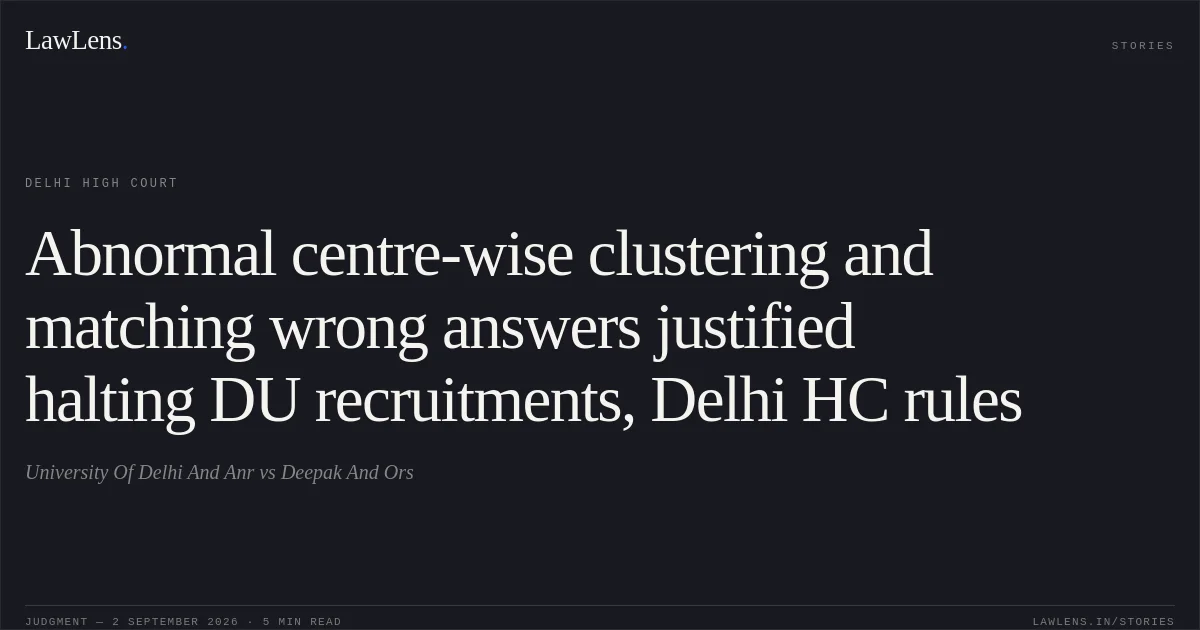
University Of Delhi And AnrvsDeepak And Ors
Click to open original judgment
Original judgment, available to read, download and summarize on LawLens.in