Facts
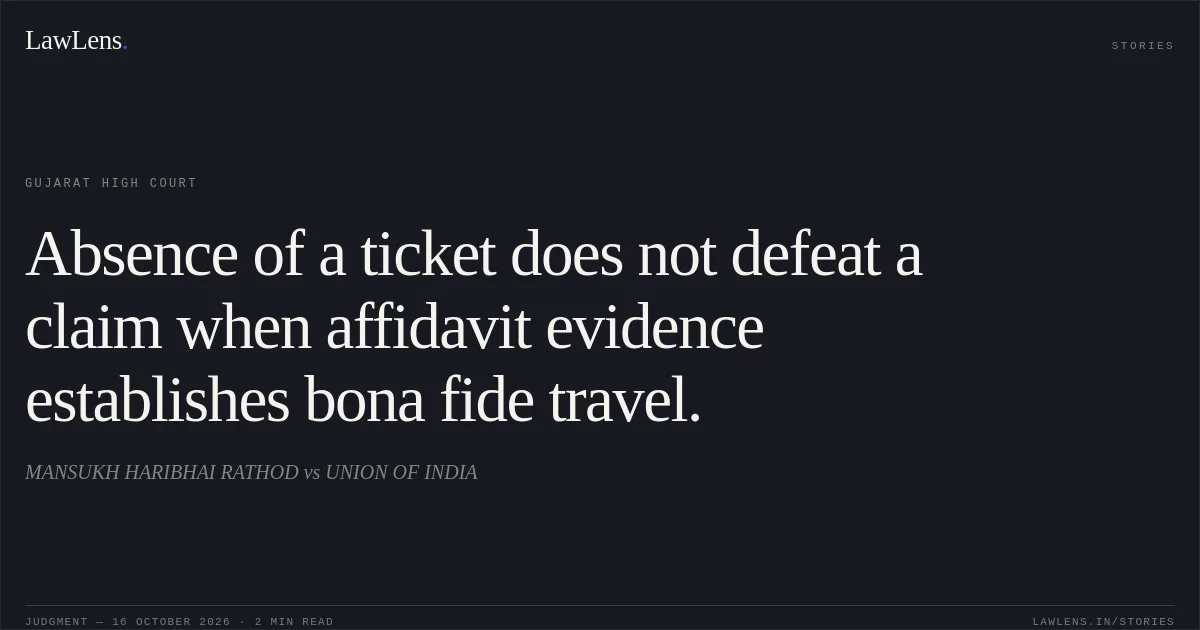
The deceased, Manish Mansukhbhai Rathod, was travelling with friends on a train from Mumbai Central towards Wankaner when he fell from the train and died on 9 August 2024.
Source reference: para. 2.1His family claimed that he had travelled with a valid ticket, which was lost in the incident.
Source reference: para. 2.1The Railway Claims Tribunal dismissed their claim, finding that the deceased was not a bona fide passenger and that the incident was not an “untoward incident.”
Source reference: paras. 6–7The claimants appealed.
Source reference: paras. 6–7They relied on the affidavit of the first claimant and testimony from a co-passenger that tickets had been purchased; the Railways relied on UTS and DRM reports but did not examine a witness to prove them.
Source reference: paras. 5, 15–18Issues
Whether the claimants established that the deceased was a bona fide passenger despite the absence of a recovered ticket.
Source reference: paras. 15–21Whether the deceased’s death resulted from an “untoward incident” within Section 123(c)(2) of the Railways Act, 1989.
Source reference: paras. 4, 14–15, 23–26Whether the Tribunal’s dismissal of the compensation claim should be set aside.
Source reference: paras. 6–7, 26–27Law Applied
Section 123(b) of the Railways Act defines “dependant,” while Section 123(c)(2) includes accidental falling of a passenger from a train within “untoward incident.”
Source reference: para. 4Under Union of India v. Rina Devi, absence of a ticket on the deceased does not, by itself, disprove bona fide passenger status: the claimant initially bears the burden, which may be discharged by an affidavit, after which the burden shifts to the Railways to establish otherwise on the facts and circumstances.
Source reference: para. 19The Court also relied on Lata v. Union of India & Anr., which reiterated that an affidavit may discharge that initial burden where the ticket is unavailable.
Source reference: para. 20Under the Railway Passengers (Manner of Investigation of Untoward Incidents) Rules, 2020, the investigation report was required within 60 days; the Court relied on Sukhabhai Nanjibhai Makwana v. Union of India for the principle that an unexplained delayed report should not be used to defeat a claim.
Source reference: para. 22Reasoning
The claimant’s affidavit and the co-passenger’s testimony supported the assertion that tickets had been purchased and were lost with the deceased’s belongings.
Source reference: paras. 15–18The Court held that this evidence discharged the claimants’ initial burden; the Railways did not rebut it through oral evidence, and the Tribunal had placed undue weight on unproved UTS material.
Source reference: paras. 15–18, 21The DRM report was prepared well beyond the 60-day period and was not supported by an explanation for the delay, so it could not sustain the Railways’ defence.
Source reference: para. 22The Court rejected the argument that the condition of the body disproved an accidental fall, noting that the record itself supported the occurrence of the incident, and distinguished Kamrunnissa and Omkar on their facts.
Source reference: paras. 23–25Holding
The High Court held that the finding that the deceased was not a bona fide passenger was unsustainable and allowed the appeal, setting aside the Tribunal’s judgment.
It awarded the claimants ₹8,00,000, with interest at 9% per annum from the date of the incident until realization, and directed the Railways to deposit the amount within eight weeks.
Source reference: para. 27The Tribunal was directed to disburse it to the claimants after verification through RTGS/NEFT.
Source reference: para. 27Acts & Sections Cited
1 provisions across 1 statute referred to in this judgment. Each provision opens on LawLens.
Railways Act, 19891
Original Court PDF
MANSUKH HARIBHAI RATHODvsUNION OF INDIA
Click to open original judgment
Original judgment, available to read, download and summarize on LawLens.in