Facts
The petitioner applied for an arms licence for an N.P. Bore pistol/revolver, citing his employment-related travel to warehouses and depots during the day and at night and his concern for personal and family safety.
Source reference: p.1–2After his application remained pending, he filed an earlier writ petition; the Court directed the competent authority to consider his demand notice and decide it in accordance with law.
Source reference: p.1–2Following a hearing, the authority rejected the application on 22 October 2024, finding no specific danger from any person or group and no sufficient justification for granting the licence.
Source reference: p.1–2The petitioner’s subsequent contempt petition was disposed of after the Court found that the earlier direction had been complied with.
Source reference: p.3He challenged the rejection, relying principally on Sections 13 and 14 of the Arms Act, 1959, the absence of criminal antecedents, and Sunil Kumar Jeevtani v. State of M.P. and Others.
Source reference: p.3–4Issues
1. Whether the order rejecting the arms-licence application suffered from illegality, arbitrariness, perversity, or non-application of mind warranting interference under Article 226 of the Constitution
Source reference: p.42. Whether the absence of a specific threat could, in the circumstances, support rejection of the application, and whether the petitioner’s lack of criminal antecedents entitled him to a licence
Source reference: p.5–7Law Applied
Sections 13 and 14 of the Arms Act, 1959 govern the grant and refusal of arms licences: the licensing authority must consider the application, obtain the police report and make any necessary inquiry; under Section 13(3)(b), it must be satisfied that the applicant has a good reason for seeking a licence; and Section 14 specifies grounds for refusal and requires reasons to be recorded in writing.
Source reference: p.4Under Sunil Kumar Jeevtani v. State of M.P. and Others, an application must be assessed within this statutory framework, and an extraneous policy consideration cannot replace the statutory requirements; however, that decision does not create an automatic entitlement to a licence whenever no specific threat or adverse record is shown.
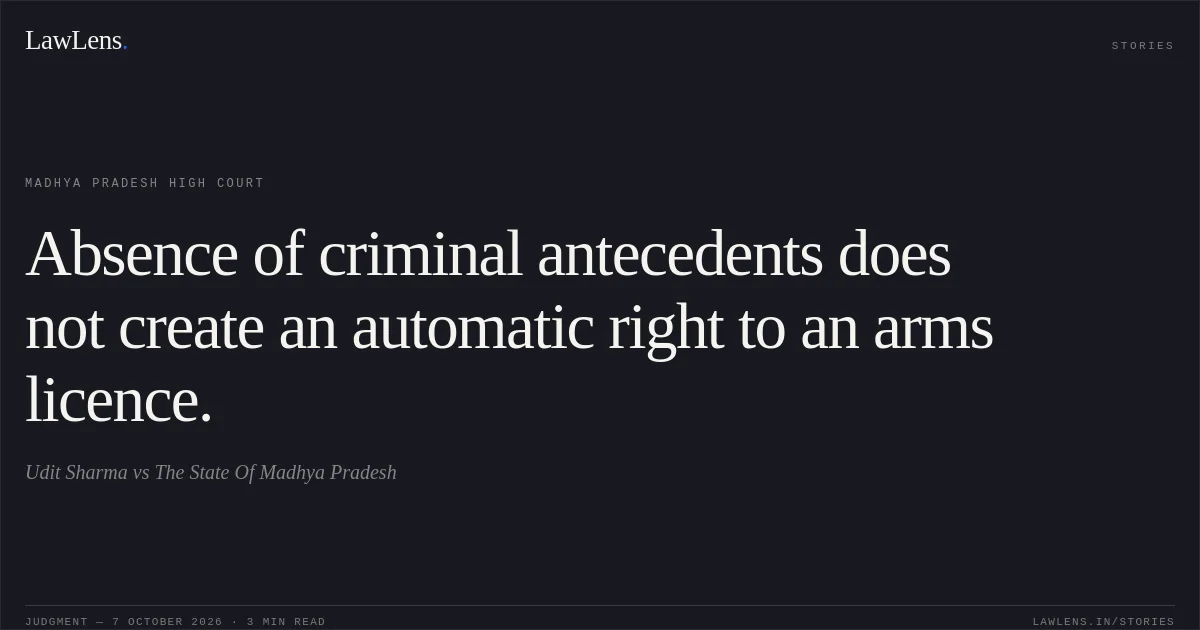
Source reference: p.5–6The absence of criminal antecedents is relevant but does not itself establish a right to a licence.
Source reference: p.7Sunil Kumar Pathak v. State of M.P. and Others recognises consideration of the statutory scheme and applicable executive instructions, but does not permit executive instructions to override the Act.
Source reference: p.7Judicial review under Article 226 ordinarily examines the legality of the decision-making process and does not substitute the Court’s satisfaction for that of the competent authority where relevant material has been considered.
Source reference: p.8Reasoning
The Court accepted that absence of a specific threat is not, by itself, an independent statutory ground for refusal.
Source reference: p.5–6It nevertheless held that the authority could assess whether the petitioner had shown a “good reason” for seeking a licence.
Source reference: p.5–6The petitioner’s employment, travel requirements and stated safety concerns were considered at the hearing, along with the reports of the District Magistrate and Superintendent of Police; the authority was not satisfied that the material justified granting the requested licence.
Source reference: p.5–6The case was distinguishable from Sunil Kumar Jeevtani, where the statutory provisions had not been properly considered and the rejection rested on the absence of a specific threat and a new policy despite favourable recommendations.
Source reference: p.6The petitioner’s clean record did not compel a different outcome, and he did not establish that the authority ignored relevant material, relied on irrelevant considerations, or breached natural justice.
Source reference: p.7–9Holding
The Court held that the petitioner had not shown a legally recognised basis for interference under Article 226 and dismissed the writ petition.
It rejected the prayers for an arms licence, compensation and costs, while clarifying that the petitioner could make a fresh application if a fresh material circumstance or legally sustainable ground arose; any such application must be considered independently under the Arms Act and applicable Rules.
Source reference: p.10Acts & Sections Cited
2 provisions across 1 statute referred to in this judgment. Each provision opens on LawLens.
Arms Act, 19592
Original Court PDF
Udit SharmavsThe State Of Madhya Pradesh
Click to open original judgment
Original judgment, available to read, download and summarize on LawLens.in