Facts
On 13 April 2023, at approximately 8:00 p.m., Khemchand Kosre was travelling home on his motorcycle when, according to the claimants, respondent No. 1 negligently drove motorcycle No. CG-07/BX-2634 into his motorcycle from behind. Khemchand fell, sustained grievous injuries, and died during treatment the same day. His wife and parents filed a claim under Section 166 of the Motor Vehicles Act, 1988, seeking compensation of ₹1,39,40,000.
Source reference: para. 2The driver-owner denied negligence and alleged that the deceased had driven rashly and collided with his motorcycle. The insurer pleaded breach of policy conditions on the ground that respondent No. 1 did not possess a valid driving licence.
Source reference: paras. 3–4The Motor Accident Claims Tribunal dismissed the claim principally because the alleged eyewitness, Laxminarayan Mahipal, was not examined and negligence was therefore not proved.
Source reference: para. 5The Tribunal nevertheless found that there was no breach of the insurance policy, that respondent No. 1 held a valid driving licence, and that the deceased’s annual income was ₹5,00,000.
Source reference: paras. 11–12The claimants challenged the dismissal under Section 173 of the Motor Vehicles Act, relying on the FIR, charge-sheet, merg intimation, and the principle that negligence in motor accident claims is to be determined on the basis of preponderance of probabilities.
Source reference: paras. 1, 6–8Issues
1. Whether the claim could be dismissed solely because the alleged eyewitness to the accident was not examined, despite the existence of police records including the FIR, charge-sheet, and merg intimation?
Source reference: paras. 5–10, 132. Whether the Tribunal applied the correct civil standard of proof—preponderance of probabilities—in determining rash and negligent driving under Section 166 of the Motor Vehicles Act?
Source reference: paras. 6–7, 133. Whether the Tribunal was required to determine the compensation payable after having found the deceased’s annual income to be ₹5,00,000, rather than dismissing the claim outright?
Source reference: para. 12Law Applied
The Court applied Sections 166 and 173 of the Motor Vehicles Act, 1988: a claim for compensation arising from a motor accident is adjudicated on the civil standard of preponderance of probabilities, and an appeal lies against the Tribunal’s award.
Source reference: no citationRelying on Mangla Ram v. Oriental Insurance Co. Ltd., the Court held that police records, including the FIR and charge-sheet, may constitute prima facie evidence of the accident and the involvement of the offending vehicle, shifting the evidentiary burden to the driver, owner, or insurer to disprove the allegations.
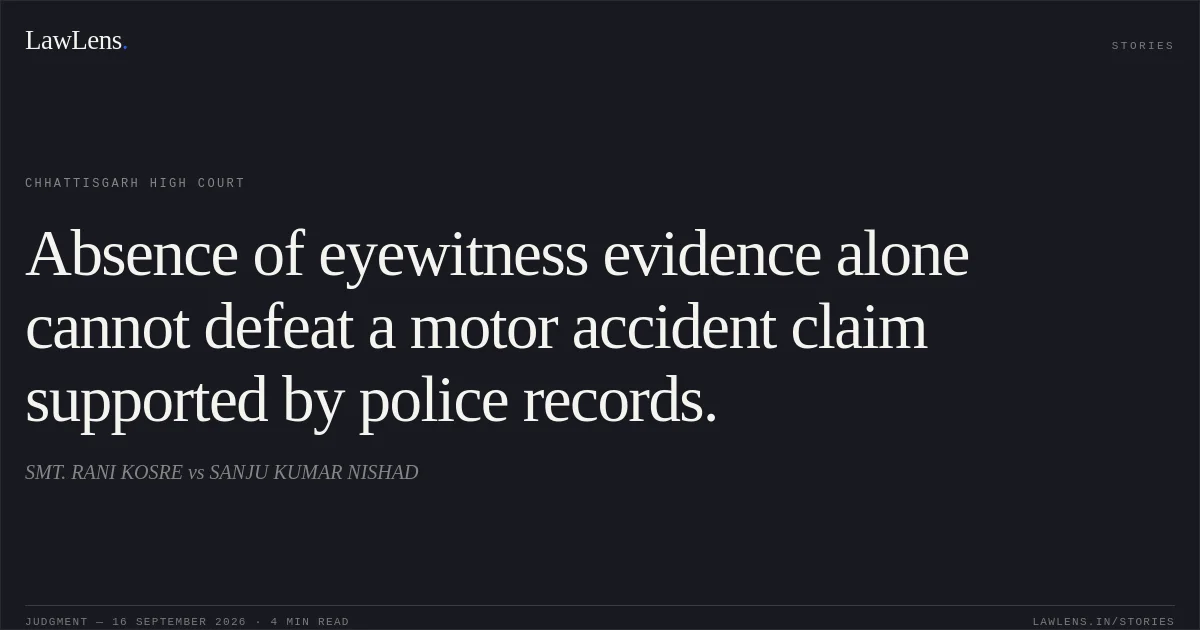
Source reference: para. 6Following Meera Bai v. ICICI Lombard General Insurance Co. Ltd., the Court reiterated that the absence of an eyewitness is not, by itself, sufficient to reject a motor accident claim where negligence can reasonably be established through official records.
Source reference: para. 6The Court also relied on Geeta Dubey v. United India Insurance Co. Ltd. for the principle that motor accident claims are not to be tested by the criminal-law standard of proof beyond reasonable doubt, but by preponderance of probabilities.
Source reference: para. 7Reasoning
The Tribunal treated the non-examination of Laxminarayan Mahipal as fatal and concluded that the claimants had failed to prove that respondent No. 1’s motorcycle had struck the deceased’s motorcycle negligently.
Source reference: paras. 5, 10The High Court held that this approach failed to account adequately for the FIR, charge-sheet, merg intimation, and other police records forming part of the record.
Source reference: para. 13Under the principles in Meera Bai and Mangla Ram, the absence of direct eyewitness testimony could not automatically defeat the claim, particularly when the documentary record provided prima facie support for the accident and the involvement of the offending vehicle.
Source reference: no citationThe Tribunal also failed to apply the civil standard of preponderance of probabilities and, despite accepting the deceased’s annual income at ₹5,00,000, did not undertake a computation of compensation.
Source reference: para. 12Accordingly, the findings on negligence and the consequential issues relating to income and compensation required reconsideration.
Source reference: no citationThe finding that there was no breach of the insurance policy and that respondent No. 1 possessed a valid driving licence was not disturbed.
Source reference: para. 11Holding
The High Court held that the Tribunal’s findings on Issues Nos. 1, 3, 4, and 5 could not be sustained because the claim had been rejected on an erroneous approach to the evidentiary value of police records and the applicable standard of proof.
Those findings were set aside, and the matter was remitted to the Tribunal for fresh adjudication in accordance with the principles laid down by the Supreme Court.
Source reference: para. 13The Tribunal was directed to decide the relevant issues afresh without recording additional evidence.
Source reference: para. 14The parties were directed to appear before the Tribunal on 5 October 2026 at 11:00 a.m.; the appeal was accordingly disposed of.
Source reference: paras. 15–16Acts & Sections Cited
2 provisions across 1 statute referred to in this judgment. Each provision opens on LawLens.
Motor Vehicles Act, 19882
Original Court PDF
SMT. RANI KOSREvsSANJU KUMAR NISHAD
Click to open original judgment
Original judgment, available to read, download and summarize on LawLens.in