Facts
The appellant challenged the Railway Claims Tribunal’s judgment dated 6 September 2019 dismissing her claim for compensation following the death of her son, Gaurav Garg, in Claim Application No. OA/II(u)/126/2018.
Source reference: p.2The deceased was allegedly travelling from Delhi Shahdara to Modi Nagar on 27 April 2018 with a valid railway ticket when he accidentally fell from a train near Vivek Vihar Railway Station and sustained fatal injuries. His body was found near the railway line, and a railway ticket bearing No. 83896344 was recovered during investigation and subsequently verified by the Railways as having been issued for the Delhi Shahdara–Modi Nagar journey on the relevant date.
Source reference: p.2; p.5The Tribunal rejected the claim principally because the ticket was not mentioned in the inquest report, the recovery memo did not record the time of preparation, there was no eyewitness, and the particular train from which the deceased allegedly fell could not be identified.
Source reference: p.3The appellant also sought condonation of a 380-day delay in filing the appeal, which the High Court allowed after considering her economic and social circumstances and the beneficial nature of the legislation.
Source reference: pp.1–2Issues
1. Whether the appellant had shown sufficient cause for condonation of the 380-day delay in filing the appeal.
Source reference: pp.1–22. Whether the deceased was established to be a bona fide passenger under the Railways Act, 1989 despite the omission of the ticket from the inquest report and the procedural deficiencies in the recovery memo.
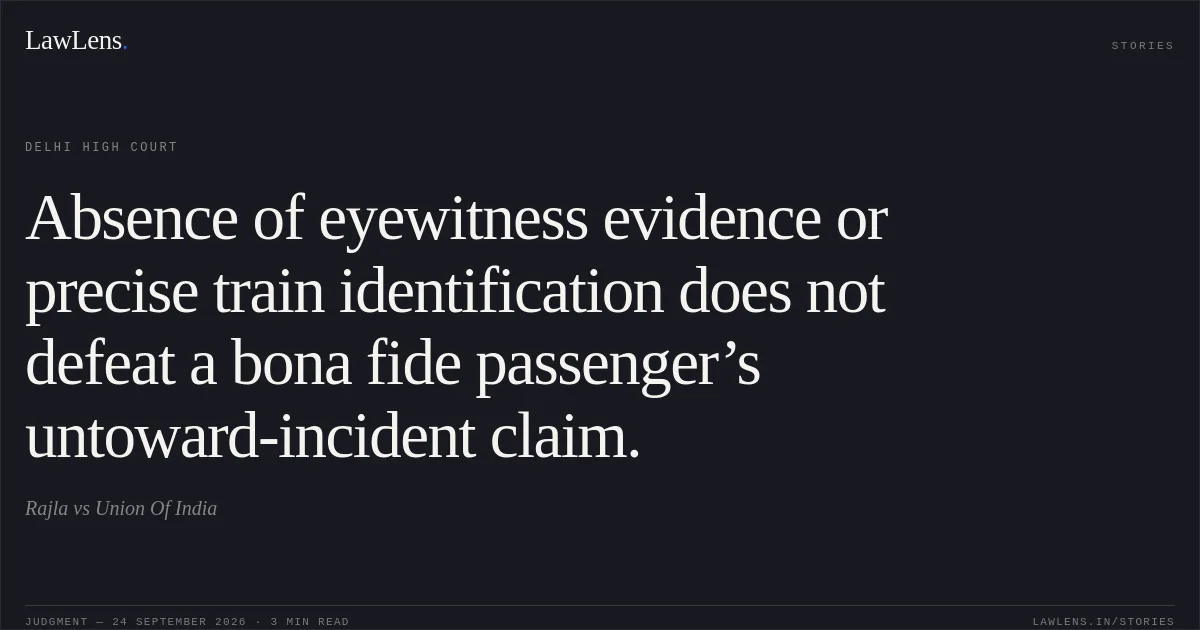
Source reference: pp.4–63. Whether the deceased’s death fell within the statutory definition of an “untoward incident” under Section 123(c)(2) of the Railways Act, 1989, notwithstanding the absence of an eyewitness and the inability to identify the particular train.
Source reference: pp.6–7Law Applied
The Court applied Sections 2(29), 123(c)(2), and 124-A of the Railways Act, 1989. Section 2(29) defines a “passenger” as a person travelling with a valid pass or ticket, while Section 123(c)(2) includes the accidental falling of a passenger from a passenger train within the expression “untoward incident”.
Source reference: p.4Under the beneficial scheme of Section 124-A, mere non-recovery or absence of a ticket does not by itself defeat a claim; the claimant may establish bona fide passenger status through relevant facts and surrounding circumstances, after which the burden shifts to the Railways to rebut the claim, as held in Union of India v. Rina Devi, (2019) 3 SCC 572, and reiterated in Lata v. Union of India, 2026 SCC OnLine SC 1350.
Source reference: pp.4–5The Court also relied on Jameela & Ors. v. Union of India, (2010) 12 SCC 443, for the principle that an unwitnessed railway accident cannot be rejected merely on the basis of speculative reconstruction or absence of direct evidence regarding the precise manner of occurrence.
Source reference: p.6Reasoning
The Court held that the deceased’s bona fide passenger status was supported not merely by the appellant’s assertion but by the recovery and subsequent verification of the railway ticket, which connected the deceased with the relevant journey.
Source reference: p.5The ticket’s omission from the inquest report was treated as a circumstance requiring consideration, but not as positive evidence that the ticket had not been recovered, particularly where the Railways themselves had verified it.
Source reference: pp.5–6The absence of an eyewitness and the inability to identify the exact train created uncertainty regarding the precise manner of the fall, but did not establish an alternative version such as unauthorised crossing of the railway line.
Source reference: p.6The investigating officer had found no material suggesting that the deceased was crossing the railway line, and the Tribunal impermissibly converted evidentiary gaps into a finding against the appellant.
Source reference: pp.6–7Applying the beneficial statutory scheme and the principles in Rina Devi, Lata, and Jameela, the Court concluded that the deceased was a bona fide passenger and that the circumstances sufficiently brought his death within Section 123(c)(2).
Source reference: p.7Holding
The Court condoned the 380-day delay in filing the appeal.
On the merits, it held that the deceased was a bona fide passenger and that his death constituted an “untoward incident” under Section 123(c)(2) of the Railways Act, 1989.
Source reference: p.7The Tribunal’s judgment was set aside, and the matter was remanded to the Tribunal to assess the compensation payable and direct its disbursement within two months of receiving the High Court’s order. The matter was directed to be listed before the Tribunal on 28 October 2026.
Source reference: p.7Acts & Sections Cited
3 provisions across 2 statutes referred to in this judgment. Each provision opens on LawLens.
Railway Claims Tribunal Act, 19871
Railways Act, 19892
Original Court PDF
RajlavsUnion Of India
Click to open original judgment
Original judgment, available to read, download and summarize on LawLens.in