Facts
The appellant was convicted by the Additional Sessions Judge-cum-Special Judge (POCSO), Morigaon, in POCSO Case No. 22/2022 arising from Laharighat P.S. Case No. 90/2021, for aggravated penetrative sexual assault under Sections 5(m) and 6 of the Protection of Children from Sexual Offences Act, 2012 (“POCSO Act”), and sentenced to 20 years’ rigorous imprisonment with a fine of ₹20,000.
Source reference: p.2, para. 2The prosecution alleged that the appellant, a neighbour of the five-year-old victim, gave her money, took her to his toilet, removed her undergarment and inserted his finger into her vagina.
Source reference: p.5, para. 8; p.6, para. 12The victim disclosed the incident to her mother shortly thereafter, and her statement was later recorded under Section 164 Cr.P.C.
Source reference: p.7, para. 13; p.10, para. 20Although the victim was first taken to Laharighat Hospital, she was medically examined at Morigaon Civil Hospital on the following day; the medical examination found no injury, redness or swelling, and the hymen was intact.
Source reference: p.10, para. 21The appellant contended that the prosecution was fabricated due to a land dispute and that the absence of medical findings contradicted the allegation.
Source reference: no citationIssues
1. Whether the absence of injury, redness, swelling or hymenal rupture in the medical examination disproved the victim’s allegation that the appellant had inserted his finger into her private parts.
Source reference: pp.17–19, paras. 39–412. Whether the alleged filing of an earlier, unregistered FIR and the subsequent FIR lodged by the victim’s mother rendered the prosecution case unreliable or prejudicial to the appellant.
Source reference: p.19, paras. 42–433. Whether the testimony of the five-year-old victim was reliable and sufficient to establish aggravated penetrative sexual assault under Sections 5(m) and 6 of the POCSO Act.
Source reference: pp.15–21, paras. 34–464. Whether the appellant established that the prosecution was falsely instituted because of a land or boundary dispute between the parties.
Source reference: pp.16–17, paras. 35–38Law Applied
The Court applied Section 5(m) of the POCSO Act, which treats penetrative sexual assault upon a child below twelve years as aggravated penetrative sexual assault, and Section 6, which prescribes the punishment for such offence.
Source reference: pp.5, 19, paras. 8–10, 39Section 29 of the POCSO Act was applied to raise a presumption of guilt after the prosecution established the foundational facts of the offence.
Source reference: p.21, para. 46The Court relied on Ranjit Hazarika v. State of Assam, (1998) 8 SCC 635, for the principle that an intact hymen or absence of injuries does not, by itself, discredit otherwise trustworthy testimony of a sexual-assault victim.
Source reference: p.4, para. 5It further relied on Nawabuddin v. State of Uttarakhand, (2022) 5 SCC 419, concerning digital penetration of a young child’s vagina, and Lokmal @ Loku v. State of Uttar Pradesh, (2025) 4 SCC 470, for the rule that absence of injuries is not invariably fatal to a prosecution for rape or penetrative sexual assault.
Source reference: pp.4–5, paras. 5–6; p.18, paras. 39–40At the same time, following Raju v. State of Madhya Pradesh, (2008) 15 SCC 133, the Court held that although the testimony of a sexual-assault victim is to be assessed with the significance accorded to an injured witness, it cannot automatically be treated as infallible.
Source reference: p.16, para. 36The Court also applied the principles governing minor discrepancies in testimony and the effect of an unregistered or subsequent FIR.
Source reference: p.15, para. 34; p.19, para. 42Reasoning
The Court found the victim’s testimony consistent on the material particulars: the appellant was known to her, gave her money, took her to his toilet, inserted his finger into her private parts, caused pain and thereafter released her.
Source reference: p.6, para. 12Her immediate disclosure to her mother while crying, the mother’s contemporaneous conduct, the Section 164 Cr.P.C. statement and the seizure of coins provided corroborative circumstances.
Source reference: pp.7–10, paras. 13–16, 20; p.20, para. 44The discrepancy as to whether the victim found her mother at home or at a shop was treated as minor and not affecting the core prosecution case.
Source reference: p.15, para. 34The absence of medical injury was not regarded as inconsistent with digital penetration, particularly because the examination occurred a day later and injury or swelling need not occur in every instance of finger insertion.
Source reference: pp.18–19, para. 41The Court rejected the land-dispute theory because the defence produced no particulars or documentary proof of such dispute, while the appellant himself referred in his Section 313 statement only to a quarrel concerning use of tube-well water.
Source reference: pp.16–17, paras. 37–38The appellant’s inconsistent alibi and admission that the victim had taken money from him further supported the prosecution’s account.
Source reference: p.20, paras. 44–45Having found the victim competent and trustworthy, the Court held that the foundational facts were proved and that the appellant failed to rebut the statutory presumption under Section 29.
Source reference: p.21, para. 46Holding
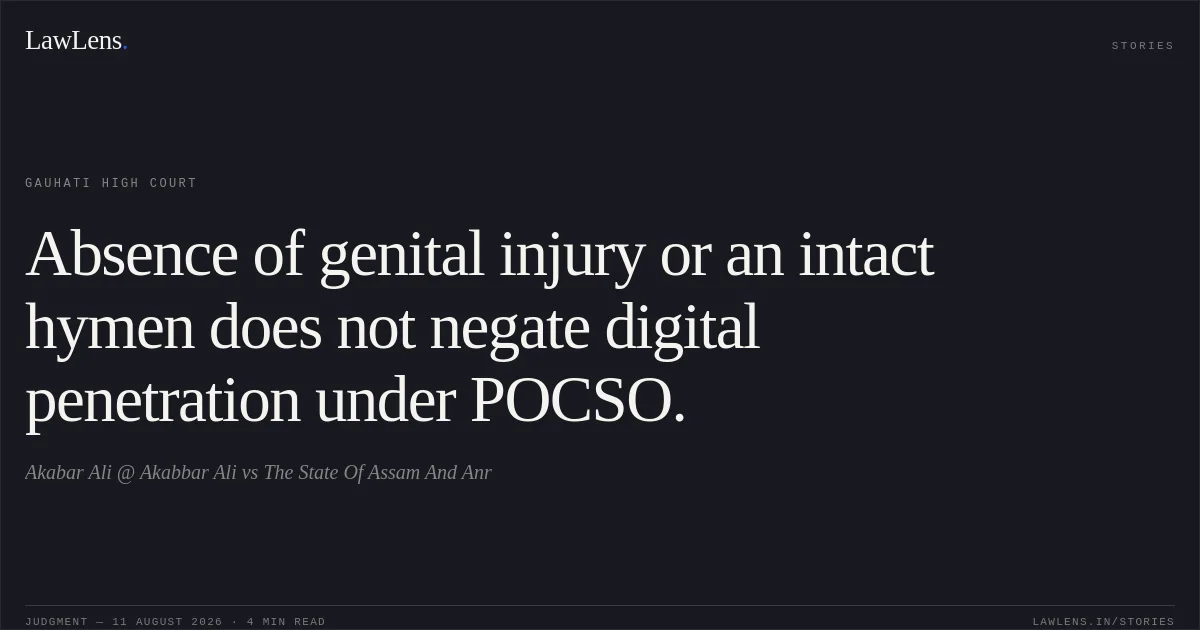
The High Court held that the victim’s credible and corroborated testimony established that the appellant had committed aggravated penetrative sexual assault under Section 5(m) of the POCSO Act.
The absence of injury or hymenal rupture, the subsequent FIR and the alleged land dispute did not create a reasonable basis for acquittal.
Source reference: pp.18–21, paras. 41–46The conviction and sentence imposed by the Trial Court under Section 6 of the POCSO Act were affirmed, and the criminal appeal was dismissed.
Source reference: p.21, para. 47The Trial Court record was directed to be returned, and the Legal Aid Counsel’s fees were directed to be paid by the Gauhati High Court Legal Services Committee.
Source reference: p.21, para. 48; p.22, para. 49Acts & Sections Cited
6 provisions across 2 statutes referred to in this judgment. Each provision opens on LawLens.
Protection of Children from Sexual Offences Act, 20124
Code of Criminal Procedure, 19732
Original Court PDF
Akabar Ali @ Akabbar AlivsThe State Of Assam And Anr
Click to open original judgment
Original judgment, available to read, download and summarize on LawLens.in