Facts
The petitioner joined the Himachal Pradesh Police as a Constable in 1997 and was promoted as Head Constable in 2011. An FIR under Sections 20 and 29 of the NDPS Act was registered against him in 2016, following which he was arrested and departmental proceedings were initiated. The departmental inquiry was kept in abeyance pending the criminal trial.
Source reference: paras. 2(i)–2(iii), pp. 1–4After the trial court convicted and sentenced him to fourteen years’ rigorous imprisonment, the respondents dismissed him from service under Rule 16.2 of the Punjab Police Rules, 1934, as applicable in Himachal Pradesh, and simultaneously closed the departmental inquiry.
Source reference: paras. 2(i)–2(iii), pp. 1–4The High Court, in appeal, subsequently set aside the conviction and sentence, holding that the prosecution had failed to prove its case beyond reasonable doubt. The Supreme Court dismissed the State’s Special Leave Petition on 28 July 2025, thereby giving finality to the acquittal.
Source reference: paras. 2(iv), 3, pp. 4–6The petitioner thereafter sought reinstatement. His representation was rejected on 7 August 2025 on the ground that the departmental inquiry had independently established his involvement in drug trafficking and that his acquittal was merely on technical grounds.
Source reference: para. 4(i), pp. 6–9Issues
Whether the respondents could reject the petitioner’s claim for reinstatement by relying on an alleged departmental inquiry when the record showed that the inquiry had been kept in abeyance and expressly closed at the time of his dismissal?
Source reference: paras. 4(ii)–4(iii), pp. 9–15Whether the petitioner was entitled to reinstatement after the criminal conviction forming the sole basis of his dismissal had been set aside in appeal and the acquittal had attained finality?
Source reference: paras. 4(iii)–4(v), pp. 12–23Whether the petitioner was entitled to consequential service benefits and back wages following reinstatement?
Source reference: para. 5, p. 24Law Applied
The Court applied Rule 16.2(2) of the Punjab Police Rules, 1934, under which a police officer convicted and sentenced to imprisonment is ordinarily liable to dismissal, subject to review if the conviction is set aside in appeal or revision.
Source reference: p. 13Rule 16.3 permits departmental action after judicial acquittal only in specified circumstances, such as acquittal on technical grounds, witness intimidation, findings that an offence was committed, discovery of an independent charge, or availability of additional admissible evidence.
Source reference: pp. 13–14Relying on Deputy Inspector General of Police v. S. Samuthiram, S. Bhaskar Reddy v. Superintendent of Police, and Ram Lal v. State of Rajasthan, the Court held that the substance of the acquittal must be examined and that expressions such as “benefit of doubt” or “honourable acquittal” are not conclusive labels.
Source reference: pp. 15–16, 20–22The Court also relied on Narender Singh v. State of Himachal Pradesh, where acquittal after consideration of the entire prosecution evidence was treated as sufficient for reinstatement.
Source reference: pp. 16–18Further, relying on State Bank of India v. Mohammed Abdul Rahim, the Court held that appellate acquittal relates back and obliterates the conviction forming the substratum of the dismissal.
Source reference: pp. 23–24Reasoning
The Court found that the rejection order dated 7 August 2025 was based on a non-existent departmental record. The inquiry had been kept in abeyance in 2017 and expressly closed by the dismissal order dated 10/12 July 2018; no departmental evidence had been recorded and no independent finding of misconduct existed.
Source reference: para. 4(ii), pp. 9–12Therefore, the authority could not retrospectively assert that the inquiry had independently established the petitioner’s involvement in drug trafficking.
Source reference: para. 4(ii), pp. 9–12The dismissal was founded solely on the trial-court conviction, and once that conviction was set aside after full consideration of the prosecution evidence, the factual and legal basis of the dismissal disappeared.
Source reference: paras. 4(iii)–4(iv), pp. 12–23The State could not invoke Rule 16.3 after having closed the departmental proceedings, particularly after the lapse of nearly eight years from the dismissal.
Source reference: paras. 4(iii)–4(v), pp. 12–23The appellate judgment did not constitute a merely technical acquittal; it held that the prosecution had failed to prove the case beyond reasonable doubt, and the acquittal was affirmed by the Supreme Court.
Source reference: paras. 2(iv), 3, 4(iii)–4(v), pp. 4–6, 12–23Holding
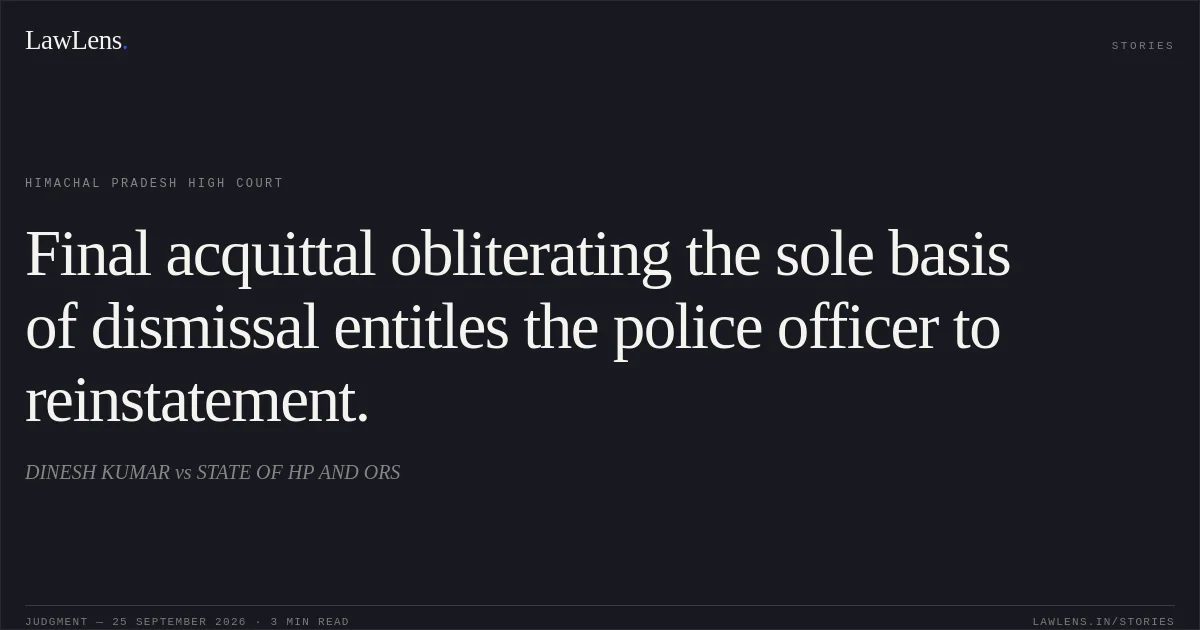
The High Court quashed the order dated 7 August 2025 rejecting the petitioner’s representation and held that the petitioner was entitled to reinstatement because his dismissal was based solely on a conviction that had subsequently been set aside.
The respondents were directed to reinstate him with all consequential benefits, including seniority, notional promotions, salary fixation and other service benefits.
Source reference: para. 5, p. 24The Court awarded 50% of the back wages and directed compliance within four weeks.
Source reference: para. 5, p. 24Acts & Sections Cited
4 provisions across 3 statutes referred to in this judgment. Each provision opens on LawLens.
Narcotic Drugs and Psychotropic Substances Act, 19852
Code of Criminal Procedure, 19731
Indian Penal Code, 18601
Original Court PDF
DINESH KUMARvsSTATE OF HP AND ORS
Click to open original judgment
Original judgment, available to read, download and summarize on LawLens.in