Facts
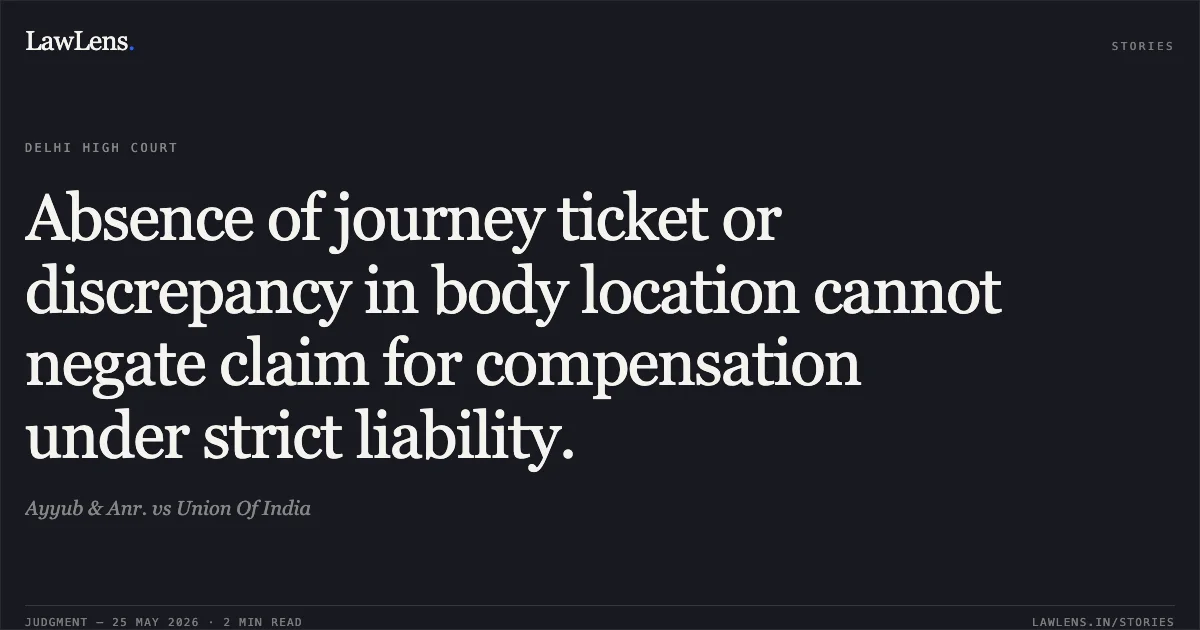
The appellants challenged an order dated 10.05.2024 by the Railway Claims Tribunal, Delhi, which dismissed their claim for compensation following the death of Mohd. Manshad.
Source reference: p. 1The deceased allegedly fell from the Yoga Express on 02.08.2022 due to a "heavy rush" while traveling from Muzaffarnagar to Delhi.
Source reference: p. 2His body was recovered near Line No. 1 between Sahibabad and Ghaziabad stations.
Source reference: p. 2The Tribunal dismissed the claim because: (a) no journey ticket was found (only a platform ticket issued at Ghaziabad); (b) the body was found near Line No. 1, whereas the train reportedly passed on Line No. 4; and (c) contradictions existed between the testimonies of the father (AW-1) and brother (AW-2) regarding ownership of a motorcycle.
Source reference: p. 2-3Issues
1. Whether the deceased was a bona fide passenger despite the non-recovery of a journey ticket and the presence of a platform ticket.
Source reference: p. 3-4 / para. 9-112. Whether the death of the deceased constituted an "untoward incident" under the Railways Act, 1989.
Source reference: p. 4-5 / para. 13Law Applied
Section 124-A of the Railways Act, 1989, which imposes "strict liability" on the Railways for compensation for "untoward incidents," regardless of fault, unless statutory exceptions apply.
Source reference: p. 5The court relied on Union of India v. Rina Devi (2019) 3 SCC 572, established that the mere absence of a ticket does not preclude a claimant from being a bona fide passenger.
Source reference: p. 3The court cited Union of India v. Prabhakaran Vijaya Kumar (2008) 9 SCC 527, reinforcing that once an "untoward incident" is established, the liability of the Railways is absolute.
Source reference: p. 5Reasoning
The Court found the Tribunal’s reasoning flawed on multiple grounds and held that the brother's (AW-2) testimony regarding the purchase of the ticket and onboarding should not have been discarded over trivial discrepancies about motorcycle ownership.
Source reference: p. 3-4The Court noted that the platform ticket recovered was issued at Ghaziabad at 17:36 hours, while the Yoga Express arrived much later at 20:56 hours; this temporal inconsistency rendered the platform ticket irrelevant to the claim of unauthorized travel from the origin.
Source reference: p. 4The Court observed there was no evidentiary support (documentary or oral) to prove that the Yoga Express passed on Line No. 4 specifically, making the "distance from the track" argument baseless.
Source reference: p. 4Since no statutory exceptions (like suicide or self-inflicted injury) were pleaded by the respondent, the strict liability framework applied.
Source reference: p. 5Holding
The Court answered both issues in the affirmative, holding that the deceased was a bona fide passenger and the death was an "untoward incident".
The High Court set aside the Tribunal’s judgment and remanded the matter to the Railway Claims Tribunal to assess and disburse the compensation amount within two months.
Source reference: p. 5The parties were directed to appear before the Tribunal on 29.05.2026.
Source reference: p. 5Acts & Sections Cited
1 provisions across 1 statute referred to in this judgment. Linked provisions open on LawLens.
Railways Act, 19891
Original Court PDF
Ayyub & Anr.vsUnion Of India
Click to open original judgment
Original judgment, available to read, download and summarize on LawLens.in