Facts
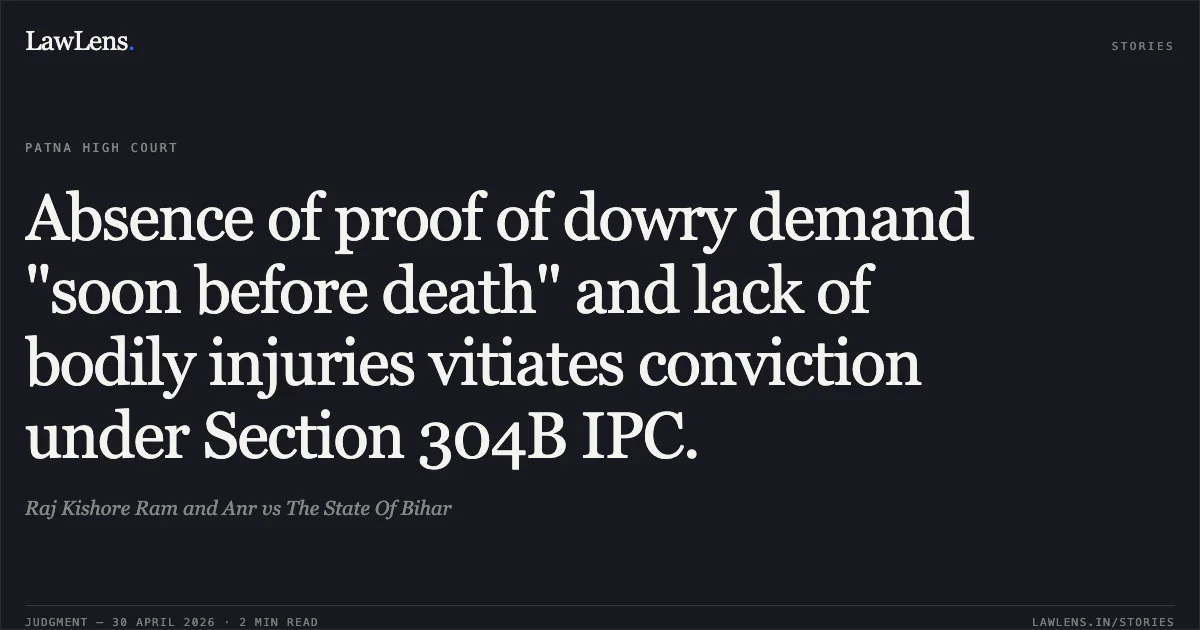
The appellants (husband and brother-in-law of the deceased) challenged their conviction under Sections 304B, 201, and 34 of the Indian Penal Code (IPC).
Source reference: p. 1-2The informant alleged that his daughter, Seema Devi, was married to Appellant No. 1 in 2006 and was subsequently subjected to torture and demands for Rs. 40,000.
Source reference: p. 2On 04.03.2012, the informant found his daughter missing from her matrimonial home and suspected she had been killed for dowry.
Source reference: p. 3The trial court convicted the appellants, sentencing Appellant No. 1 to 10 years and Appellant No. 2 to 8 years of rigorous imprisonment.
Source reference: p. 1-2Issues
1. Whether the prosecution established the essential ingredients of "dowry death" under Section 304B of the IPC beyond reasonable doubt.
Source reference: p. 4/72. Whether the presumption under Section 113B of the Indian Evidence Act could be invoked against the appellants in the absence of evidence regarding cruelty "soon before death".
Source reference: p. 7Law Applied
The court applied Section 304B of the IPC, which requires three ingredients for conviction: death by burns or bodily injury under non-normal circumstances, occurrence within seven years of marriage, and evidence that the woman was subjected to cruelty/harassment in connection with dowry "soon before her death".
Source reference: p. 4Section 113B of the Indian Evidence Act, noting that the legal presumption of dowry death only operates once the prosecution proves the foundational ingredients.
Source reference: p. 7The court also relied on the principle of circumstantial evidence, requiring a "complete chain" to establish guilt.
Source reference: p. 8Reasoning
The court found that the prosecution failed to provide any documentary or oral evidence of dowry demands or "Panchayati" meetings regarding the same.
Source reference: p. 4-5Notably, the post-mortem report (P.W. 6) revealed no external injuries on the deceased, contradicting the allegation of a brutal assault.
Source reference: p. 5/7The court observed material contradictions: the informant (P.W. 5) claimed in the FIR that the deceased called him alleging assault, but admitted during cross-examination that Appellant No. 2 had called to report her missing.
Source reference: p. 5Furthermore, the brother of the deceased (P.W. 4) testified to having a cordial relationship with the in-laws, making the allegations of torture after six years of marriage highly doubtful.
Source reference: p. 5-6Since the prosecution failed to prove "cruelty soon before death" or a non-natural cause of death, the burden of proof did not shift to the accused under Section 113B.
Source reference: p. 7-8Holding
The court held that the prosecution failed to establish the charges beyond reasonable doubt as the essential ingredients of Section 304B IPC were absent.
The High Court allowed the appeal, set aside the judgment of conviction dated 16.12.2015 and the order of sentence dated 18.12.2015, and acquitted both appellants of all charges.
Source reference: p. 8-9Acts & Sections Cited
2 provisions across 1 statute referred to in this judgment. Each provision opens on LawLens.
Indian Penal Code, 18602
Original Court PDF
Raj Kishore Ram and AnrvsThe State Of Bihar
Click to open original judgment
Original judgment, available to read, download and summarize on LawLens.in