Facts
The appellants, Jhabboo and Jhinkoo (now deceased), were accused of kidnapping the prosecutrix, Munni, on 28.11.1975. The prosecution alleged that a co-accused, Smt. Kadora, lured the prosecutrix to a field, from where the appellants took her to Gorakhpur, confined her, and repeatedly raped her at knife-point.
Source reference: para. 3The Trial Court framed charges only under Section 366 of the IPC (kidnapping/abduction to compel marriage/illicit intercourse), notably omitting Section 376 IPC (rape) despite the prosecutrix’s testimony.
Source reference: para. 4On 28.03.1984, the 6th Additional Sessions Judge, Basti, convicted Jhabboo and sentenced him to five years of rigorous imprisonment.
Source reference: para. 2Issues
1. Whether the delay in lodging the FIR and lack of a specific date of occurrence affected the credibility of the prosecution case
Source reference: para. 18(a)2. Whether the age of the prosecutrix and the element of "taking" or "enticement" essential for Section 361/366 IPC were established beyond reasonable doubt
Source reference: para. 18(b) & (c)3. Whether the omission of a rape charge (Sec. 376 IPC) and the non-prosecution of co-accused Smt. Kadora created a fatal gap in the prosecution’s narrative
Source reference: para. 18(d)Law Applied
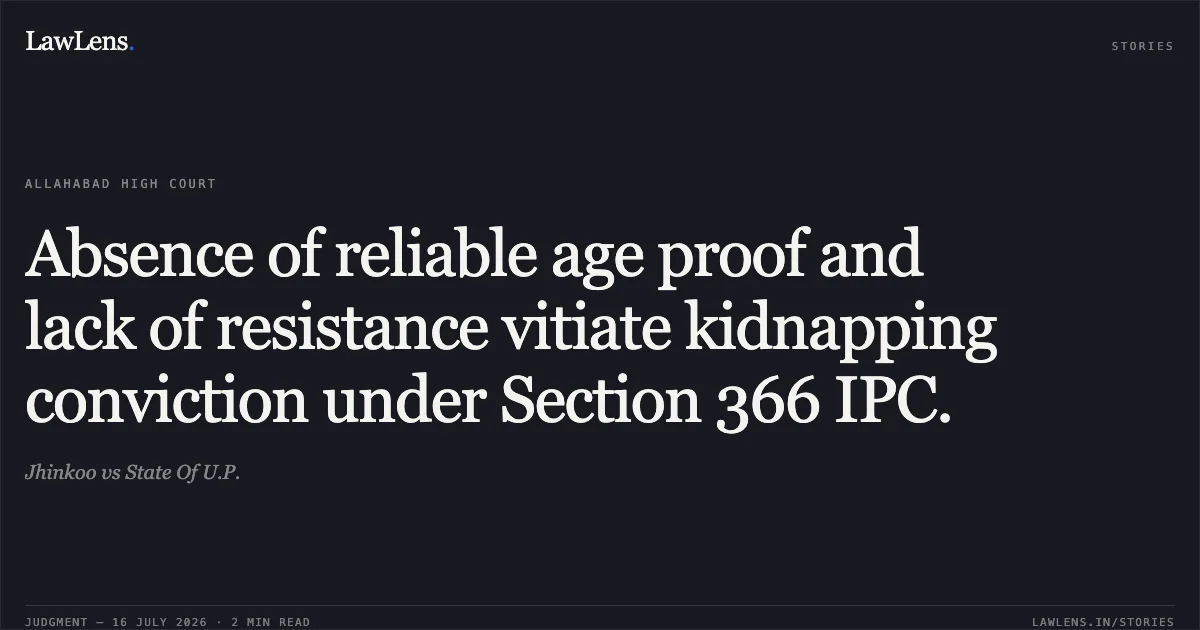
The Court applied Section 361 IPC defining kidnapping from lawful guardianship (requiring proof of being under 18 or lack of consent) and Section 366 IPC regarding kidnapping for illicit intercourse.
Source reference: para. 22, 24It relied on Babloo Pasi v. State of Jharkhand for the necessity of ossification tests/documentary proof for age determination.
Source reference: para. 21It applied S. Varadarajan v. State of Madras and Thakorlal D. Vadgama v. State of Gujarat, holding that "taking" requires active participation by the accused rather than a minor leaving of her own volition.
Source reference: para. 22It also noted the principle from Khujji v. State of M.P. that while hostile witnesses' evidence isn't totally effaced, it must be tested with extreme care.
Source reference: para. 29Reasoning
The Court found the prosecution case fundamentally flawed due to a lack of objective evidence regarding the prosecutrix's age, relying solely on oral testimony to claim she was a minor.
Source reference: para. 21Crucially, the prosecutrix failed to raise an alarm during multiple bus journeys and a multi-day stay in Gorakhpur.
Source reference: para. 16, 23The Court reasoned that her voluntary departure at the suggestion of Smt. Kadora (who was never tried) did not constitute "taking" or "enticement" by the appellants under Section 361.
Source reference: para. 23, 32Furthermore, the prosecution’s failure to frame charges for rape (Sec. 376) despite her explicit testimony made the reliance on that testimony to prove "intent for illicit intercourse" under Section 366 legally untenable.
Source reference: para. 25, 28The hostility of all independent "last seen" witnesses (PW-1 and PW-2) broke the corroborative link between the accused and the alleged abduction.
Source reference: para. 29, 30Holding
The Court answered the issues in the affirmative for the appellant, holding that the prosecution failed to prove the essential ingredients of Section 366 IPC beyond reasonable doubt.
The High Court set aside the judgment dated 28.03.1984, allowed the appeal, and acquitted Jhabboo of all charges. The Court ordered his immediate release and the discharge of his bail bonds.
Source reference: para. 34-36Acts & Sections Cited
5 provisions across 2 statutes referred to in this judgment. Each provision opens on LawLens.
Code of Criminal Procedure, 19731
Indian Penal Code, 18604
Original Court PDF
JhinkoovsState Of U.P.
Click to open original judgment
Original judgment, available to read, download and summarize on LawLens.in