Facts
The Agarwallas (Plaintiffs in CS/124) owned M/s Bhoomi Minerals, which had a sponge iron unit and significant debt with Indian Overseas Bank (IOB)
Source reference: p. 2They entered into a Memorandum of Understanding (MOU) on 20/09/2010 with the Kanodias (Plaintiffs in CS/264) to transfer the company for ₹28.01 crores
Source reference: p. 3The Kanodias paid ₹1 crore as advance/earnest money
Source reference: p. 5Subsequently, the Agarwallas proposed an amended MOU modifying share transfer security clauses, which the Kanodias refused
Source reference: p. 7On 24/09/2010, the Kanodias terminated the contract via SMS, claiming anticipatory breach and suppression of the fact that the unit was mortgaged to the bank
Source reference: p. 8-9The Agarwallas eventually sold the unit to a third party for ₹22.5 crores and sued for the loss of ₹5.51 crores
Source reference: p. 5-6The Kanodias sued for the refund of the ₹1 crore advance
Source reference: p. 12Issues
1. Whether the MOU dated September 20, 2010, was legal, valid, and binding upon the parties.
Source reference: p. 182. Whether the Agarwallas committed an anticipatory breach of contract by proposing amendments to the MOU.
Source reference: p. 243. Whether the Agarwallas are entitled to damages and the forfeiture of the ₹1 crore earnest money in the absence of an explicit forfeiture clause.
Source reference: p. 20, 28Law Applied
Section 39 of the Indian Contract Act, 1872, regarding the refusal of a party to perform a promise in its entirety (anticipatory breach)
Source reference: p. 24Manindra Chandra Nandy v. Aswini Kumar Acharjya, establishing that anticipatory breach requires an unqualified refusal that destroys the contract's root
Source reference: p. 19, 25Section 73, following the principle in Maharashtra State Electricity Distribution Co. Ltd. v. Datar Switchgear Ltd., to place the injured party in the position they would have been in had the contract been performed
Source reference: p. 27Section 74 and principles from Fateh Chand v. Balkishan Dass and Satish Batra v. Sudhir Rawal, holding that earnest money cannot be forfeited without an express contractual clause
Source reference: p. 28-29Reasoning
The court found the original MOU valid, noting that the Kanodias were aware of the bank liabilities and mortgages through due diligence
Source reference: p. 21-23On the issue of anticipatory breach, the court held that the Agarwallas' proposed amendments did not constitute a "refusal to perform in entirety" under Section 39; they merely proposed a novation which, when rejected, left the original MOU subsisting
Source reference: p. 26Consequently, the Kanodias' sudden termination on 24/09/2010 constituted a breach of contract
Source reference: p. 27Regarding damages, the court accepted the Agarwallas' loss of ₹5.51 crores (the difference between the MOU price and the third-party sale price) as the Kanodias failed to rebut the evidence of loss
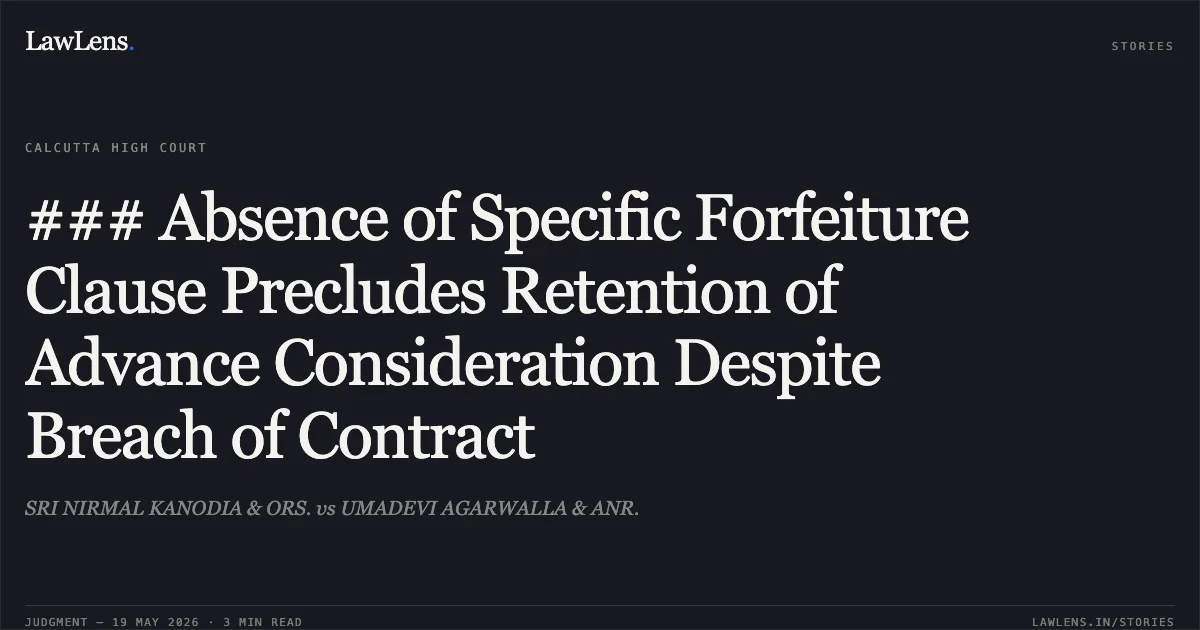
Source reference: p. 27-28Regarding the ₹1 crore advance, the court observed that the MOU lacked a specific forfeiture clause. Under Supreme Court precedent, earnest money or part-payments cannot be forfeited as a penalty unless the contract explicitly provides for it
Source reference: p. 29Holding
The court held that the Kanodias committed a breach of contract but the Agarwallas could not forfeit the advance payment without a specific clause.
CS 124/2011: Decreed in favor of the Agarwallas for ₹5.51 crores as damages with 7% interest; CS 264/2012: Decreed in favor of the Kanodias for the refund of ₹1 crore with 7% interest; The Agarwallas were granted liberty to set off the ₹1 crore (plus interest) from the ₹5.51 crore (plus interest) award before execution.
Source reference: p. 30Acts & Sections Cited
5 provisions across 3 statutes referred to in this judgment. Each provision opens on LawLens.
Securitisation and Reconstruction of Financial Assets and Enforcement of Security Interest Act, 20021
Indian Contract Act, 18723
Interest Act, 19781
Original Court PDF
SRI NIRMAL KANODIA & ORS.vsUMADEVI AGARWALLA & ANR.
Click to open original judgment
Original judgment, available to read, download and summarize on LawLens.in