Facts
The appellant’s daughter committed suicide by hanging on June 27, 2016
Source reference: para. 2The prosecution alleged that the accused pressured the deceased to marry him and had previously attempted to outrage her modesty, thereby abetting her suicide
Source reference: para. 6Following an investigation and trial, the Second Additional Sessions Judge, Mauganj, acquitted the accused of charges under Section 306 of the Indian Penal Code (IPC) on September 8, 2017
Source reference: para. 1The appellant filed this appeal challenging the acquittal, contending that the testimonies of the family members (PW-1 to PW-4) and medical evidence sufficiently established the accused’s guilt
Source reference: para. 6Issues
1. Whether the prosecution established the essential ingredients of "abetment" under Section 107 of the IPC to sustain a conviction under Section 306 for suicide
Source reference: para. 8-92. Whether the appellate court should interfere with a trial court’s judgment of acquittal when the view taken by the trial court is a legally plausible one based on the evidence
Source reference: para. 24-28Law Applied
The court primarily applied Section 306 of the IPC regarding abetment of suicide and Section 107 of the IPC, which defines abetment as instigation, conspiracy, or intentional aid
Source reference: para. 8-9It relied on S.S. Cheena v. Vijay Kumar Mahajan, establishing that conviction requires clear mens rea and an active act that leaves the deceased no other option but suicide
Source reference: para. 11The court further applied the principles for reviewing acquittals from H.D. Sundara v. State of Karnataka and Mallappa v. State of Karnataka, which mandate that if two reasonable views are possible, the view favoring the accused must be followed, and interference is only warranted in cases of patent perversity or illegality
Source reference: para. 24, 28Reasoning
The court found that while the deceased's family members supported the prosecution, their testimonies lacked independent corroboration and were subject to strict scrutiny
Source reference: para. 16-17Evidence revealed that the relationship between the families had been severed 5-6 months prior to the incident, making the claim of active instigation or pressure unconvincing
Source reference: para. 18-19The court noted the absence of any prior police complaints regarding the alleged harassment or modesty outrages
Source reference: para. 20Furthermore, testimonies suggested potential alternative causes for the suicide, such as a recent quarrel between the accused and the deceased's brother-in-law or the deceased being distressed by restrictions placed on her movement by her own family
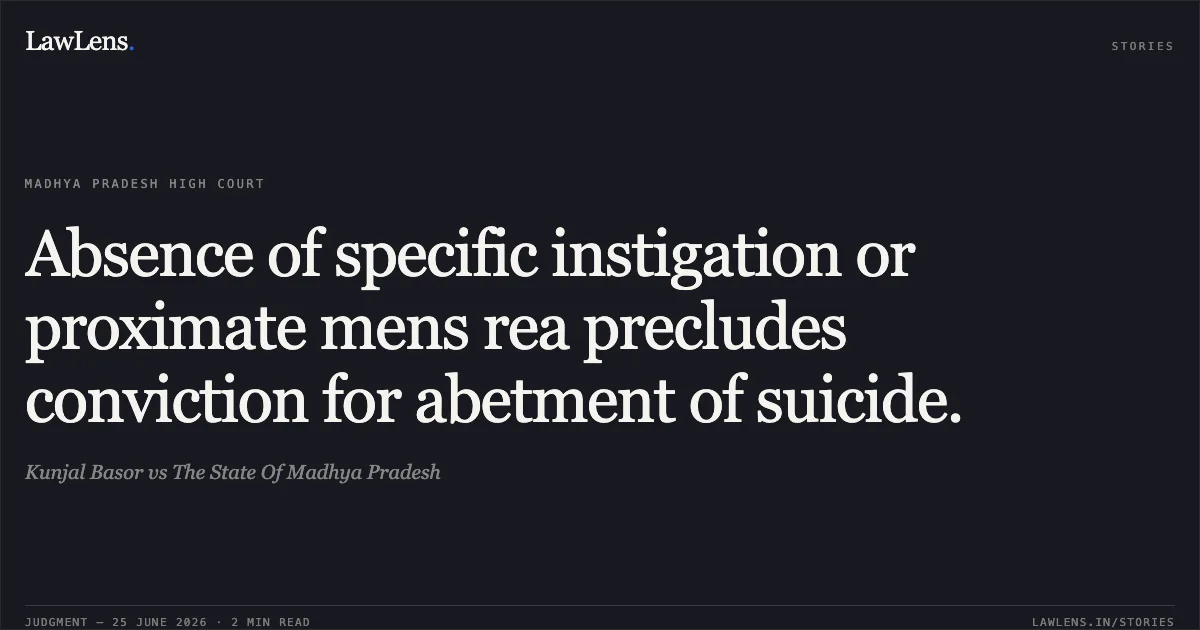
Source reference: para. 21-22Consequently, the court reasoned that the prosecution failed to prove a direct or indirect act of instigation in close proximity to the suicide
Source reference: para. 23, 29Holding
The court answered the issues in the negative, holding that the prosecution failed to establish the essential ingredients of abetment under Section 107 read with Section 306 of the IPC
The court held that the trial court's view was plausible and did not suffer from perversity
Source reference: para. 29The High Court affirmed the judgment of acquittal and dismissed the appeal as being without merit
Source reference: para. 30Acts & Sections Cited
4 provisions across 2 statutes referred to in this judgment. Each provision opens on LawLens.
Code of Criminal Procedure, 19732
Indian Penal Code, 18602
Original Court PDF
Kunjal BasorvsThe State Of Madhya Pradesh
Click to open original judgment
Original judgment, available to read, download and summarize on LawLens.in