01Facts
On 27 December 1999, the prosecutrix alleged that while she was sleeping at home, the appellant forcibly entered her room, lifted her clothes and attempted to rape her.
p. 1 · ¶ 3–5On her alarm, her mother and neighbours arrived, and the appellant fled.
p. 1 · ¶ 3–5The prosecutrix claimed that she subsequently informed village persons and lodged a written report on 31 December 1999, resulting in registration of Chakulia P.S. Case No. 53 of 1999 under Sections 376/511 and 452 of the Indian Penal Code (IPC).
p. 1 · ¶ 3–5During trial, the prosecution examined ten witnesses.
pp. 4–6 · ¶ 14The prosecutrix was examined as PW-9; the other witnesses principally stated that they heard her alarm, saw the appellant fleeing, and were told by her that he had attempted rape.
pp. 4–6 · ¶ 14The Trial Court convicted the appellant under Sections 376/511 and 452 IPC and sentenced him to four years’ rigorous imprisonment.
p. 3 · ¶ 8–902Issues
i.Whether the evidence established the offence of attempt to commit rape under Sections 376/511 IPC, or only an assault intended or likely to outrage the prosecutrix’s modesty under Section 354 IPC?
pp. 7–8 · ¶ 15–17ii.Whether the conviction under Section 452 IPC was sustainable on the evidence on record?
p. 8 · ¶ 17iii.Whether the alleged delay in lodging the FIR, non-examination of the Investigating Officer and other evidentiary deficiencies caused prejudice warranting appellate interference?
pp. 3–4 · ¶ 10 · p. 4 · ¶ 1303Law Applied
The Court applied Section 376 read with Section 511 IPC, under which conviction for attempted rape requires proof of an overt act sufficiently proximate to the commission of rape, and not merely an intention or preliminary act.
pp. 7–8 · ¶ 15–16It applied Section 354 IPC, which criminalises assault or criminal force against a woman with the intention of outraging, or knowledge of the likelihood of outraging, her modesty.
pp. 7–8 · ¶ 15–16The Court also upheld the conviction under Section 452 IPC concerning house-trespass after preparation for causing hurt, assault or wrongful restraint.
p. 8 · ¶ 17The Court further exercised appellate sentencing discretion, considering the appellant’s status as a first-time offender, the period already undergone and the passage of more than twenty-six years since the occurrence.
pp. 7–8 · ¶ 15–18No judicial precedent was cited or relied upon.
Provisions in the judgment · 4 · Linked ones open on LawLens
Indian Penal Code, 1860 Section 376Section 511Section 452Section 354
04Reasoning
The Court found that the prosecutrix’s evidence established that the appellant entered the house, caught hold of her and lifted her clothes, but did not disclose any specific act sufficiently proximate to sexual intercourse or to the commission of rape.
p. 7 · ¶ 15The witnesses who arrived after the alarm did not see the alleged assault; they only saw the appellant fleeing and repeated the prosecutrix’s immediate account.
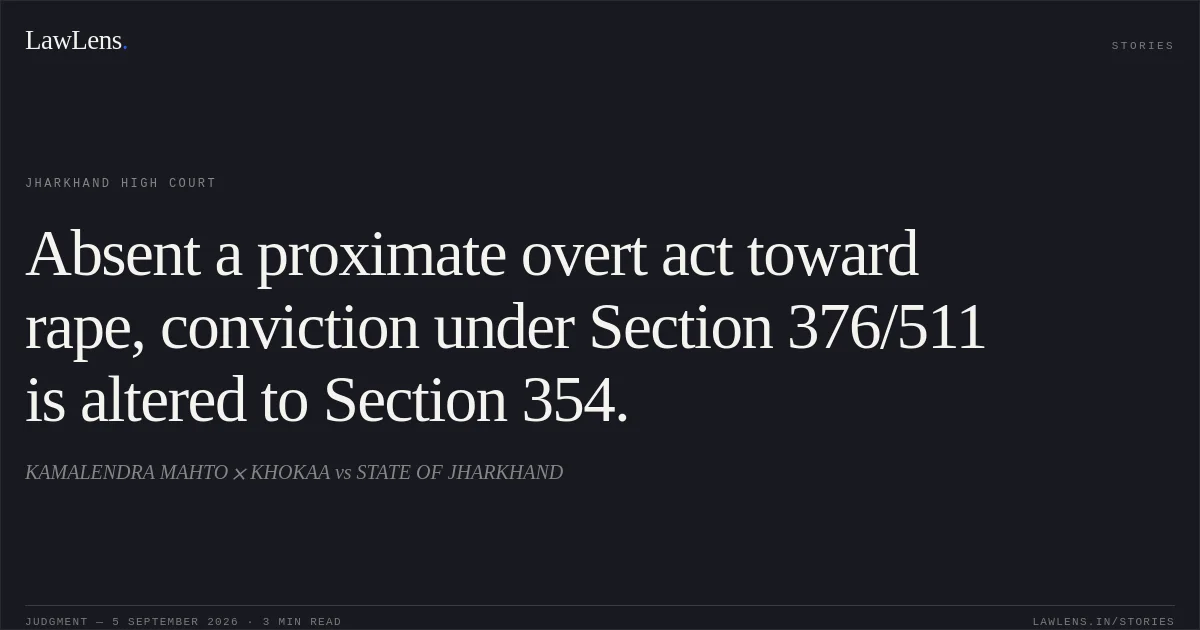
pp. 4–6 · ¶ 14Accordingly, the evidence proved an indecent assault intended to outrage, or likely to outrage, the prosecutrix’s modesty, but fell short of proving an attempt to commit rape under Sections 376/511 IPC.
pp. 7–8 · ¶ 15–16The Court therefore altered the conviction to Section 354 IPC while maintaining the conviction under Section 452 IPC.
p. 8 · ¶ 17In sentencing, it relied on the appellant’s first-offender status, antecedents, age and the substantial lapse of time, and reduced the effective sentence to the period already undergone, stated to be approximately eight months.
p. 8 · ¶ 1805Holding
The appeal was dismissed on merits with modification of the conviction.
pp. 8–9 · ¶ 17–20The conviction under Sections 376/511 IPC was altered to Section 354 IPC, while the conviction under Section 452 IPC was affirmed.
pp. 8–9 · ¶ 17–20The appellant was sentenced to imprisonment for the period already undergone, approximately eight months, and was discharged from the liability of his bail bond and sureties.
pp. 8–9 · ¶ 17–20Pending interlocutory applications, if any, were disposed of, and the Trial Court Record was directed to be returned to the concerned court.
p. 9 · ¶ 21–22Original Court PDF
KAMALENDRA MAHTO KHOKAAvsSTATE OF JHARKHAND
Click to open original judgment
Original judgment, available to read, download and summarize on LawLens.in