Facts
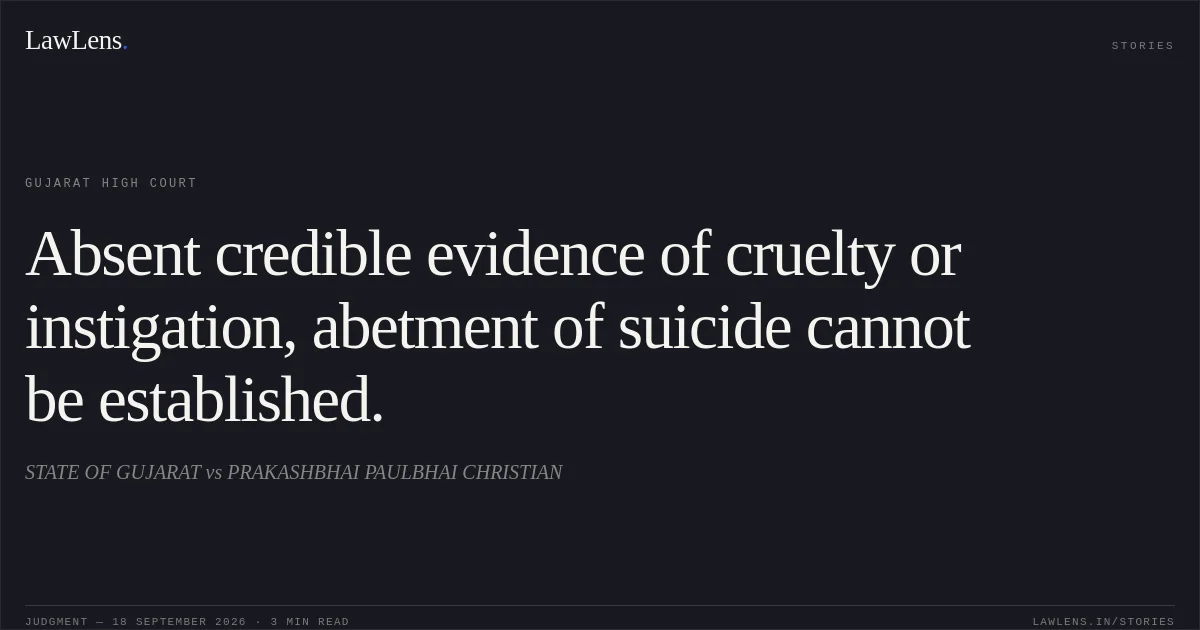
Ripkaben, the complainant’s daughter, married the respondent approximately two months before the incident. The prosecution alleged that the respondent consumed liquor, spoke to an unknown woman on his mobile phone, and subjected Ripkaben to mental and physical cruelty, following which she died by hanging on 1 August 2011.
Source reference: p.1, para.2An accidental-death inquiry was initially registered, and the police conducted the inquest, scene panchnama, post-mortem, and investigation. The complainant lodged the FIR two days after the incident, alleging harassment and cruelty by the respondent.
Source reference: p.6–8, paras.10–11The respondent was charged, inter alia, under Section 306 of the Indian Penal Code. After examining twelve witnesses, including the deceased’s relatives, police officers, a doctor, and panch witnesses, the Sessions Court acquitted him in Sessions Case No. 212 of 2011 by judgment dated 31 August 2012.
Source reference: p.2, paras.3–5The State preferred an appeal against acquittal under Section 378(1) and (3) of the Code of Criminal Procedure, 1973.
Source reference: p.1, para.1Issues
Whether the prosecution proved beyond reasonable doubt that the respondent subjected Ripkaben to cruelty or harassment and thereby abetted her suicide under Sections 306 and 107 of the IPC.
Source reference: p.9, para.12Whether the presumptions under Sections 113A and 113B of the Indian Evidence Act, 1872 could be invoked on the evidence available on record.
Source reference: p.4, para.8.4; p.9, para.12Whether the trial Court’s order of acquittal disclosed any perversity, manifest illegality, or misappreciation of evidence warranting appellate interference.
Source reference: p.9–10, paras.13–16Law Applied
The Court applied Section 306 read with Section 107 of the IPC, requiring proof of abetment—instigation, provocation, intentional aid, or conduct sufficiently connected with the suicide.
Source reference: p.9, para.12It considered Sections 113A and 113B of the Indian Evidence Act, noting that the statutory presumptions concerning abetment of suicide or dowry death arise only when the foundational facts of cruelty, harassment, or dowry-related conduct are established.
Source reference: p.9, para.12The appeal was governed by Section 378(1) and (3) of the CrPC.
Source reference: p.1, para.1Relying principally on Chandrappa v. State of Karnataka, (2007) 4 SCC 415, as reaffirmed in Rajesh Prasad v. State of Bihar, (2022) 3 SCC 471, Babu Sahebagouda Rudragoudar v. State of Karnataka, (2024) 8 SCC 149, and Ramesh v. State of Karnataka, (2024) 9 SCC 169, the Court held that an appellate court may fully reappreciate evidence in an appeal against acquittal, but must respect the double presumption of innocence; where two reasonable views are possible, the acquittal should not be disturbed.
Source reference: p.10–12, paras.16–17Reasoning
The Court found that the prosecution evidence did not establish persistent cruelty, harassment, or conduct amounting to instigation or abetment.
Source reference: p.8, para.11The deceased had not complained of ill-treatment when she visited her parental home or when family members met her at a marriage function.
Source reference: p.8, para.11Although the prosecution alleged that she had spoken to relatives by telephone about harassment, no details or supporting call records were produced.
Source reference: p.8, para.11The initial accidental-death proceedings also did not contain allegations against the respondent, and the FIR was lodged only after two days, reportedly at the instance of a relative who had formerly served as a police constable.
Source reference: p.7–8, para.11The Court further noted that the Investigating Officer who had substantially investigated the case was not examined.
Source reference: p.8, para.11In the absence of foundational evidence of cruelty or harassment, the presumptions under Sections 113A and 113B could not be invoked.
Source reference: p.9, para.12The evidence also failed to show that the respondent had instigated, provoked, or intentionally aided the suicide.
Source reference: p.9, para.12Since the trial Court’s view was a reasonable one and was not perverse or manifestly illegal, the double presumption supporting the acquittal operated in the respondent’s favour.
Source reference: p.9–12, paras.13–17Holding
The High Court held that the prosecution had failed to prove beyond reasonable doubt that the respondent had abetted Ripkaben’s suicide or subjected her to cruelty or harassment sufficient to attract Sections 306 and 107 of the IPC.
The statutory presumptions under Sections 113A and 113B of the Evidence Act were inapplicable for want of foundational evidence.
Source reference: p.13, paras.18–20Finding no error of law, perversity, or misappreciation of evidence in the trial Court’s judgment, the Court dismissed the State’s appeal and confirmed the order of acquittal dated 31 August 2012.
Source reference: p.13, paras.18–20The respondent’s bail bond was cancelled, and the record and proceedings were directed to be returned to the trial Court.
Source reference: p.13, para.20Acts & Sections Cited
4 provisions across 2 statutes referred to in this judgment. Each provision opens on LawLens.
Code of Criminal Procedure, 19732
Indian Penal Code, 18602
Original Court PDF
STATE OF GUJARATvsPRAKASHBHAI PAULBHAI CHRISTIAN
Click to open original judgment
Original judgment, available to read, download and summarize on LawLens.in