01Facts
The respondent no. 1, H.S. Saini, an Inspector with Delhi Police, investigated FIR No. 144/2003 (P.S. Khajuri Khas) from 18.05.2003 to 05.02.2004.
¶ 2A complaint dated 26.07.2004 alleged bias against the respondent. The Vigilance Department found the allegations unsubstantiated and attributed the complaint to personal dissatisfaction, yet FIR No. 387/2005 (P.S. Bhajanpura) was registered against the respondent on 15.09.2005 under Sections 193/196/120B IPC.
¶ 3–4The police filed a cancellation report, a protest petition was filed, and the Chief Metropolitan Magistrate, North-East, Delhi accepted the cancellation report and dismissed the protest petition on 17.09.2013.
¶ 6–7The respondent retired on 31.07.2008. On the same day, a departmental proceeding was initiated on the same allegations.
¶ 8The Enquiry Officer's report dated 03.05.2012 held the charges proved.
¶ 9The Disciplinary Authority referred the matter to the UPSC on 24.10.2016, and the UPSC advised withholding 20% of monthly pension for five years on 19.09.2017.
¶ 11The respondent's representation against the UPSC advice was received, and the penalty order dated 24.01.2018 imposed the pension cut, stating that the representation was "examined and is found devoid of merits" and that "further comments of the disciplinary authority" had been obtained.
¶ 12–13The Central Administrative Tribunal (CAT), Principal Bench, in O.A. 3820/2018 set aside the penalty order on grounds of non-application of mind and non-supply of comments, relied on Rule 12 of the Delhi Police (Punishment and Appeal) Rules, 1950 and the Larger Bench decision in Sukhdev Singh, and put the matter to quietus with consequential benefits, including restoration of pension with interest.
¶ 14–17The petitioner Commissioner challenged the Tribunal's order.
02Issues
i.1. Whether the acceptance of a cancellation report in the criminal case amounts to an "acquittal" so as to attract the bar under Rule 12 of the Delhi Police (Punishment and Appeal) Rules, 1950 against departmental punishment.
¶ 23–33ii.2. Whether the penalty order dated 24.01.2018 is vitiated for failure to consider and record findings on the respondent's representation against the UPSC advice, as required by Rule 15(4) of the CCS (CCA) Rules, 1965.
¶ 34–40iii.3. Whether the inordinate and unexplained delay in initiating and concluding the disciplinary proceedings justified the Tribunal's decision to quash the penalty and put the matter to quietus rather than remand.
¶ 41–54, 56iv.4. Whether the Tribunal rightly awarded interest on the arrears of pension.
¶ 5703Law Applied
Rule 12 of the Delhi Police (Punishment and Appeal) Rules, 1950, which bars departmental punishment on the same charge after a judicial acquittal, subject to exceptions.
¶ 22–23Section 173 CrPC and Section 173(8) CrPC, under which a cancellation/closure report does not finally exonerate the accused and further investigation remains permissible, as explained in State through CBI v. Hemendhra Reddy (2023) 16 SCC 779.
¶ 26–28Section 232 CrPC, which defines acquittal as a post-trial order.
¶ 29Dayanand v. Commissioner of Police, 2001 SCC OnLine Del 885, holding that a discharge is not an acquittal for Rule 12 purposes.
¶ 32Rule 15(2)–(4) of the CCS (CCA) Rules, 1965, which mandates that the Disciplinary Authority consider the charged officer's representation against the UPSC advice and "record its findings" before proceeding further, as interpreted in Nasimuddin Ansari v. Union of India, 2023 SCC OnLine Del 4623.
¶ 35–38State of A.P. v. N. Radhakishan (1998) 4 SCC 154, under which unexplained, prejudicial delay may vitiate proceedings and the court must balance all relevant factors.
¶ 45The principles summarised in Bhupendra Pal Singh v. Union of India, 2021 SCC OnLine Bom 6073, on delay in disciplinary proceedings.
¶ 46The absence of any delay attributable to the charged officer, relied upon for the award of interest on pension arrears.
¶ 57Provisions in the judgment · 8 · Linked ones open on LawLens
Indian Penal Code, 1860 Section 191Section 192Section 193Section 196
Code of Criminal Procedure, 1973 Section 173Section 190Section 227Section 232
04Reasoning
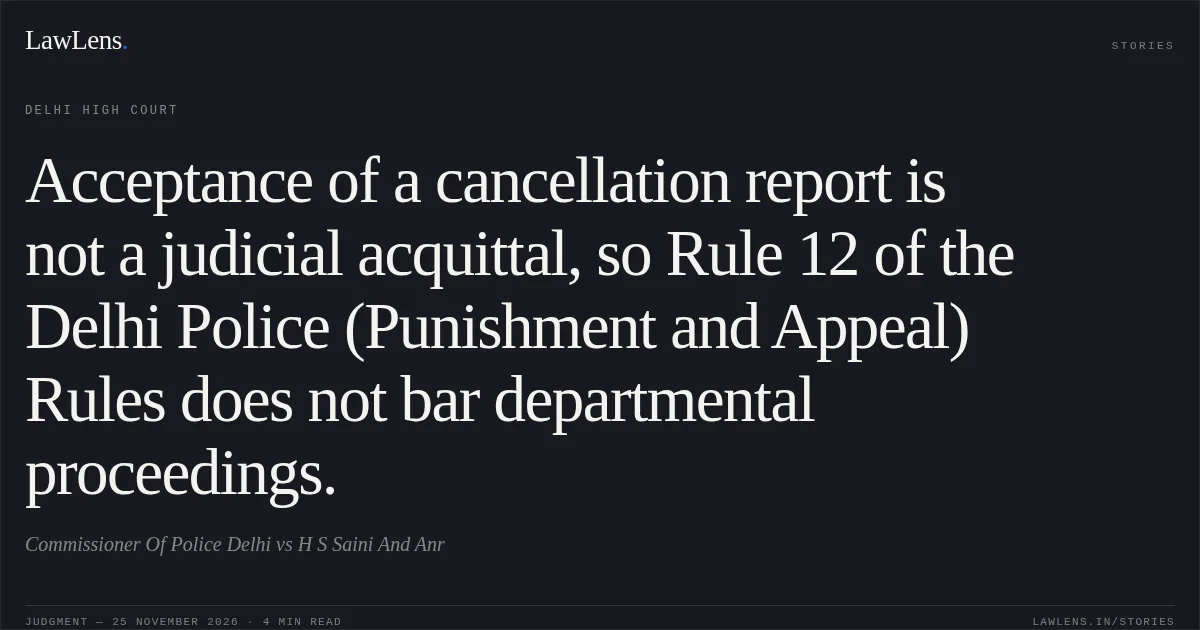
The respondent was neither tried nor acquitted. A cancellation report, which the Magistrate accepted, is not an acquittal and does not bar further investigation or proceedings, so Rule 12 was inapplicable and the Tribunal's reliance on it was misplaced.
¶ 24–25, 33The penalty order was non-speaking. It merely recorded that the representation was "devoid of merits" without addressing its grounds, contrary to the mandatory duty under Rule 15(4).
¶ 39–40Ordinarily this would warrant remand. However, the Court examined the Tribunal's reasons for not remanding, namely the delay and the respondent's age and suffering. The record showed a four-year delay in initiating proceedings after the 2005 FIR, a further four years for the enquiry, about four years and five months before the UPSC reference, and a decade overall, with no explanation offered and no fault attributed to the respondent.
¶ 41–43, 50–53The Court found this delay prejudicial, particularly because the gratuity was withheld for a decade without interest, and on that basis declined to interfere with the Tribunal's quietus.
¶ 54, 56The Court rejected the petitioner's challenge to interest, holding that the delay was not attributable to the respondent.
¶ 55–57The Court did not expressly address the Sukhdev Singh reasoning relied upon by the Tribunal, and did not decide the respondent's plea on non-cross-examination of the complainant.
¶ 19, 34–4005Holding
A cancellation report accepted by a Magistrate is not an acquittal, so Rule 12 of the Delhi Police (Punishment and Appeal) Rules, 1950 does not apply.
¶ 25, 33The penalty order dated 24.01.2018 is non-speaking and violates Rule 15(4) of the CCS (CCA) Rules, 1965.
¶ 39–40Given the unexplained, prejudicial delay of about a decade and the respondent's age and suffering, the Court upheld the Tribunal's decision to put the matter to quietus rather than remand, and upheld the award of interest on the pension arrears.
¶ 56, 41–42, 57The writ petition is dismissed, the stay order dated 13.04.2023 is vacated, and the petitioner is directed to comply with the Tribunal's order within three months.
¶ 58, 60Original Court PDF
Commissioner Of Police DelhivsH S Saini And Anr
Click to open original judgment
Original judgment, available to read, download and summarize on LawLens.in