Facts
The petitioner’s father, a government employee, died in harness on 24 April 2021.
Source reference: no citationThe petitioner thereafter applied for compassionate appointment. His application was forwarded by the department on 10 June 2021.
Source reference: para. 2During the COVID-19 period, the respondents considered his case under the Mukhya Mantri Covid-19 Compassionate Appointment Policy dated 28 May 2021 and, pursuant to the petitioner’s consent, engaged him as an unskilled Peon through an outsourcing agency, M.P. Con. Pvt. Ltd., by order dated 22 October 2021.
Source reference: para. 2; para. 6The petitioner subsequently sought regular compassionate appointment and payment of unpaid wages.
Source reference: para. 2Respondent No. 4 recommended his regular appointment by letter dated 20 January 2025.
Source reference: para. 2During the proceedings, the respondents stated that the claim for regular appointment had been rejected by the competent authority on 15 October 2025.
Source reference: para. 4They further stated that ₹94,851/- towards wages for November 2024 to July 2025 had been sanctioned and paid pursuant to an order dated 28 October 2025, supported by a payment voucher.
Source reference: para. 4; para. 8Issues
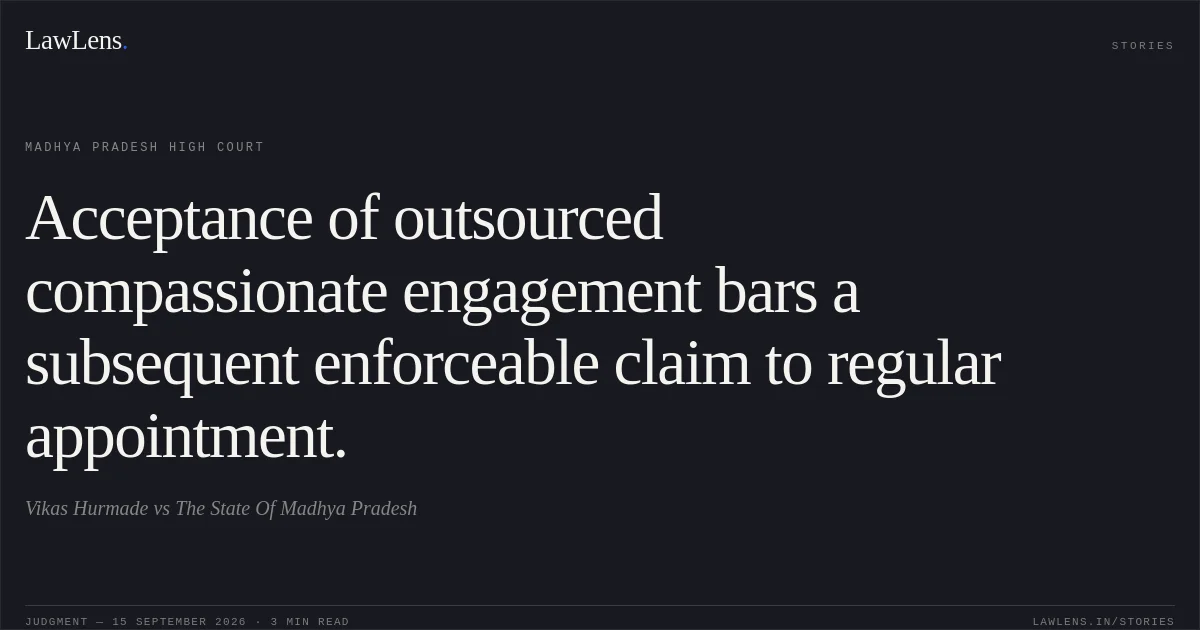
Whether the petitioner, having accepted engagement through an outsourcing agency under the applicable COVID-19 Compassionate Appointment Policy, could claim regular appointment on a sanctioned post as an enforceable legal right?
Source reference: para. 6Whether the petitioner was entitled to a writ directing consideration of his representation for regular compassionate appointment, particularly when his claim had already been rejected by the competent authority?
Source reference: para. 7Whether the petitioner was entitled to a direction for payment of arrears of wages when the respondents had placed material showing payment of ₹94,851/- for the relevant period?
Source reference: para. 8Law Applied
The Court exercised jurisdiction under Article 226 of the Constitution of India, under which a writ of mandamus may issue only upon establishment of a subsisting legal right and a corresponding public duty.
Source reference: paras. 1, 9–10Compassionate appointment is governed by the applicable policy or scheme and its terms; it is not a source of regular recruitment and does not create an indefeasible right merely because an employee died in harness.
Source reference: para. 6Where an applicant accepts the benefit of an applicable scheme and consents to a particular mode of engagement, he cannot subsequently claim regular appointment contrary to that scheme as an enforceable legal right.
Source reference: para. 6A mere adverse administrative decision, without demonstrated patent illegality, arbitrariness, or violation of the governing policy, does not justify a writ of mandamus.
Source reference: para. 7Further, no mandamus can be issued for payment of an amount already released where no legally recoverable balance is established.
Source reference: paras. 8–9Reasoning
The Court held that the petitioner’s case was governed by the COVID-19 Compassionate Appointment Policy dated 28 May 2021, rather than by an automatic entitlement to regular appointment under the earlier policy relied upon by him.
Source reference: para. 6Since the petitioner had consented to engagement through an outsourcing agency and had accepted appointment pursuant to that arrangement, he could not later insist upon regular appointment on a sanctioned post contrary to the terms of the applicable scheme.
Source reference: para. 6The Court also noted that the competent authority had already considered and rejected the petitioner’s claim on 15 October 2025, and that the petitioner had not challenged that decision or established any patent illegality, arbitrariness, or breach of policy.
Source reference: para. 7As to wages, the respondents produced the sanction order and payment voucher evidencing payment of ₹94,851/- for the relevant period.
Source reference: para. 8The petitioner failed to show that any legally recoverable amount remained unpaid.
Source reference: para. 8Consequently, no surviving cause of action for mandamus remained.
Source reference: para. 9Holding
The Court answered the issues against the petitioner.
It held that acceptance of outsourcing engagement under the applicable compassionate appointment policy did not confer an enforceable right to regular appointment; the petitioner’s representation had already been rejected without any demonstrated legal infirmity; and the claimed wages had been paid.
Source reference: paras. 9–11Finding no ground to exercise writ jurisdiction under Article 226, the Court dismissed the writ petition.
Source reference: paras. 9–11Original Court PDF
Vikas HurmadevsThe State Of Madhya Pradesh
Click to open original judgment
Original judgment, available to read, download and summarize on LawLens.in