Facts
The petitioners, retired Junior Telecom Officers of BSNL, opted for voluntary retirement under the BSNL Voluntary Retirement Scheme, 2019, and were relieved with effect from 31 January 2020.
Source reference: para. 1BSNL calculated and paid the benefits under the Scheme, which the petitioners accepted. They subsequently claimed that each had earned an annual service increment during the preceding year, although it became payable on 1 February 2020—the day after their retirement—and that the increment ought to have been included while calculating their Scheme benefits. Their representations were rejected, leading them to institute O.A. No. 653 of 2020 before the Central Administrative Tribunal, Ernakulam Bench. The Tribunal dismissed the Original Application and later rejected the petitioners’ review application. The petitioners therefore approached the Kerala High Court under Article 226/227 of the Constitution through the present Original Petition.
Source reference: paras. 2–3Issues
Whether the annual increment earned by the petitioners during their last year of service, but becoming payable on the day following their voluntary retirement, was required to be included in “salary” for calculating benefits under the BSNL Voluntary Retirement Scheme, 2019
Source reference: paras. 7–12, 20–23Whether inclusion of the accrued increment would impermissibly modify the contractual terms of the Voluntary Retirement Scheme, particularly when the petitioners had accepted the benefits already paid
Source reference: paras. 6–8, 11, 20–22Whether the Tribunal’s dismissal of the Original Application and rejection of the review application were legally sustainable
Source reference: paras. 3, 23Law Applied
Clause 3(j) of the BSNL Voluntary Retirement Scheme, 2019 defines “salary” as “Basic Pay plus Dearness allowance thereon as applicable on the effective date of Voluntary retirement”.
Source reference: paras. 9–10The Court applied the principle in Director (Admn. & HR), KPTCL v. C.P. Mundinamani, Civil Appeal No. 2471 of 2023, that an annual increment is earned upon completion of the requisite period of satisfactory and efficient service and cannot be denied merely because it becomes payable on the day after retirement.
Source reference: paras. 16–18The Court also relied on the reasoning approved in Gopal Singh v. Union of India, that increment forms part of pay and that the date on which it becomes payable is not determinative of the employee’s accrued entitlement.
Source reference: paras. 18–19The decisions in Union of India v. Kulbir Singh and BSNL v. Gulshan Sood were followed insofar as they held that the increment must be reckoned for employees retiring under the BSNL VRS, notwithstanding that their retirement was voluntary rather than on superannuation.
Source reference: paras. 12–15, 23At the same time, relying on A.K. Bindal v. Union of India, the Court accepted that the terms of a voluntary retirement scheme cannot be judicially varied; the inquiry was therefore limited to whether BSNL had correctly applied the existing Scheme.
Source reference: paras. 6–8Reasoning
The Court distinguished between impermissibly altering the Scheme and correctly interpreting and applying it.
Source reference: paras. 7–8Although the increment became payable on 1 February 2020, the petitioners had completed the requisite period of service with satisfactory conduct before their retirement on 31 January 2020; hence, the entitlement to the increment had already crystallised and its subsequent payment date was merely consequential.
Source reference: paras. 18–19Since the Scheme calculated compensation, ex gratia and other benefits on the basis of “salary,” and “salary” included basic pay, the accrued increment necessarily formed part of the salary to be used in the computation.
Source reference: paras. 9–11, 20–21The fact that the petitioners retired under the VRS, rather than on attaining superannuation, did not justify a different result because the increment was linked to service actually rendered, not to the mode of retirement.
Source reference: paras. 12–15Acceptance of the initially calculated benefits could not validate a computation inconsistent with the Scheme itself.
Source reference: para. 11Accordingly, the Tribunal erred in treating the petitioners’ claim as an attempt to modify the Scheme rather than as a challenge to its incorrect implementation.
Source reference: paras. 20–23Holding
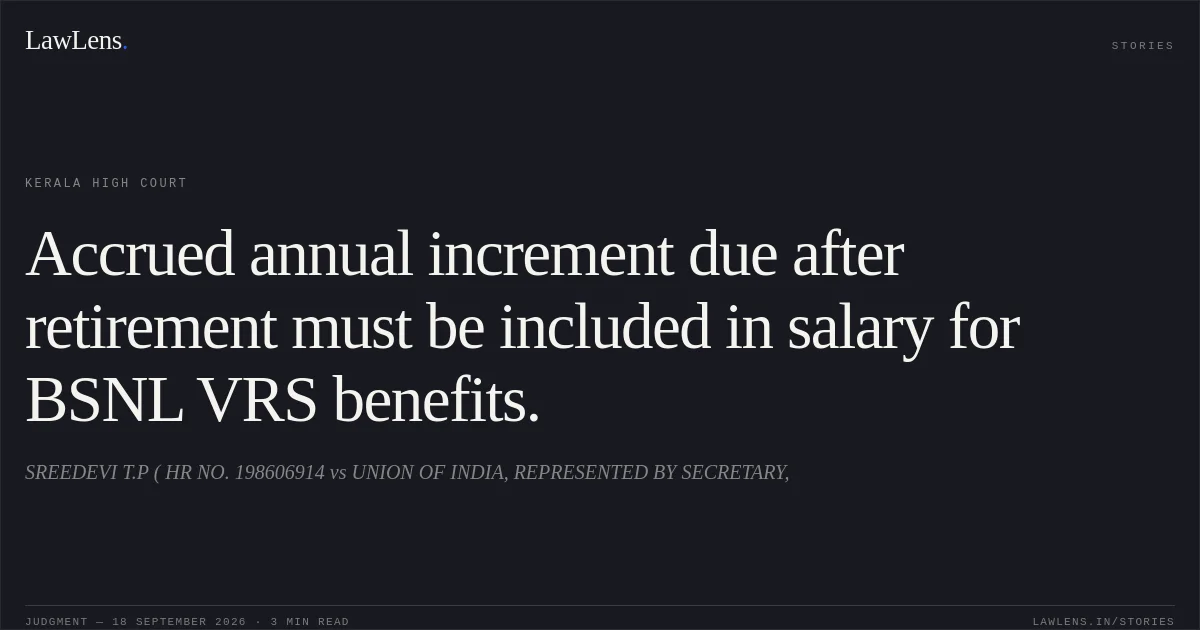
The Kerala High Court held that the annual increment earned by the petitioners during their last year of service, though payable on the day after their retirement, had to be included in their salary for computing benefits under the BSNL Voluntary Retirement Scheme, 2019.
The Court allowed the Original Petition, set aside the Tribunal’s orders in O.A. No. 653 of 2020 and R.A. No. 11 of 2025, and directed the respondents to rework the petitioners’ Scheme benefits in accordance with C.P. Mundinamani and take consequential action within six months from receipt of the judgment.
Source reference: para. 23Original Court PDF
SREEDEVI T.P ( HR NO. 198606914vsUNION OF INDIA, REPRESENTED BY SECRETARY,
Click to open original judgment
Original judgment, available to read, download and summarize on LawLens.in