Facts
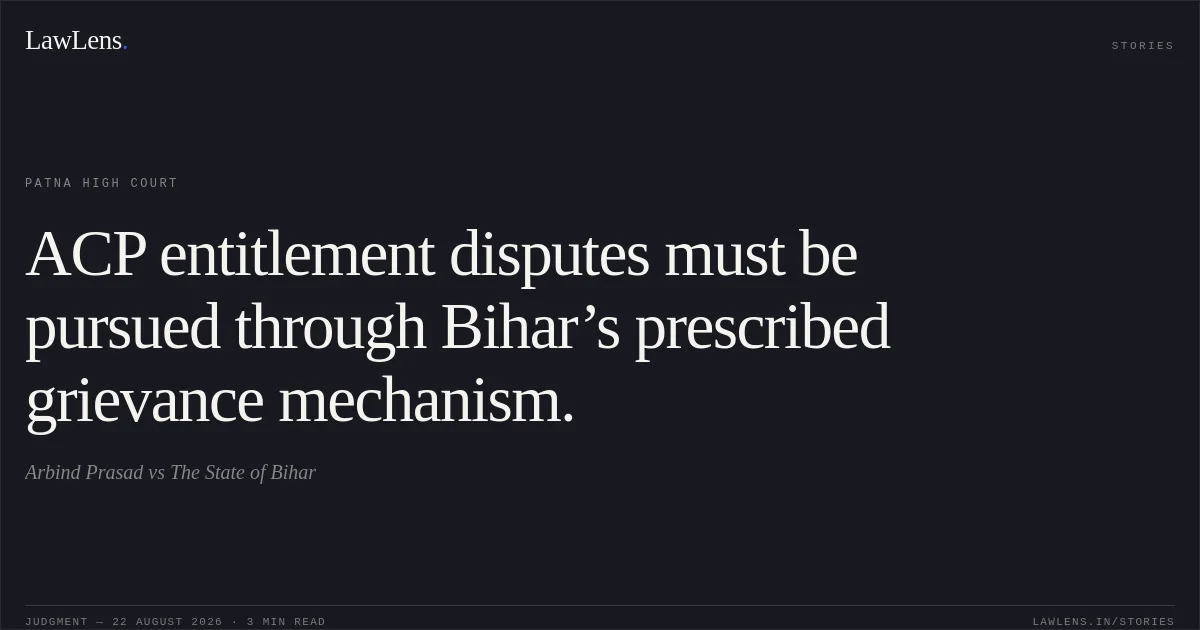
The petitioner, a State Government employee, filed a writ petition seeking payment of salary for the period from 14 October 2016 to 20 April 2017, during which he claimed to have remained without posting for 189 days, and grant of benefits under the Assured Career Progression (“ACP”) Scheme.
Source reference: p.1During the proceedings, the State’s counter-affidavit showed that the arrears of salary for the relevant period had already been paid.
Source reference: p.2The petitioner, however, maintained that he was entitled to ACP benefits and relied upon the Full Bench decision in Kamlanand Thakur v. State of Bihar & Ors., CWJC No. 18727 of 2017 and analogous cases, decided on 28 June 2024 and reported at 2024 (4) BLJ 806.
Source reference: p.2The State disputed the petitioner’s entitlement to ACP and submitted that he could pursue his grievance under the Bihar Government Servant Grievance Redressal Rules, 2019.
Source reference: p.2Issues
Whether the petitioner was entitled to salary for the period from 14 October 2016 to 20 April 2017, notwithstanding the State’s assertion that the arrears had already been paid.
Source reference: pp.1–2Whether the petitioner’s claim for ACP benefits was required to be examined under the Bihar Government Servant Grievance Redressal Rules, 2019, particularly in light of the Full Bench decision in Kamlanand Thakur.
Source reference: pp.2–5Whether the writ petition should be disposed of by directing the petitioner to invoke the statutory grievance-redressal mechanism.
Source reference: p.5Law Applied
The Court applied Rule 2(c) of the Bihar Government Servant Grievance Redressal Rules, 2019, which treats service-related claims concerning promotion, ACP and MACP as “complaints” amenable to the grievance-redressal mechanism.
Source reference: pp.3–4Rule 3 of the 2019 Rules permits serving or retired State employees to file such complaints online and requires separate applications where relief is sought on more than one subject.
Source reference: pp.4–5The Court also permitted the petitioner to rely upon the principles laid down by the Full Bench in Kamlanand Thakur v. State of Bihar & Ors., reported at 2024 (4) BLJ 806, while directing the competent authority to decide the grievance in accordance with the 2019 Rules.
Source reference: p.5Reasoning
Since the salary arrears claimed by the petitioner had already been paid, no surviving adjudication on that aspect was necessary.
Source reference: p.2The remaining ACP claim involved a service-benefit dispute expressly covered by Rule 2(c)(4) of the 2019 Rules.
Source reference: pp.3–4Rather than determine the petitioner’s substantive entitlement to ACP in the writ proceedings, the Court directed him to first invoke the prescribed grievance mechanism.
Source reference: p.5The petitioner was allowed to raise the legal grounds based on Kamlanand Thakur, ensuring that the competent authority would examine his claim in accordance with the applicable law and within the time prescribed by the Rules.
Source reference: p.5Holding
The Court did not grant any separate relief regarding salary because the arrears had already been paid.
With respect to ACP benefits, the petitioner was directed to file a complaint under the Bihar Government Servant Grievance Redressal Rules, 2019 before the concerned authority within 30 days.
Source reference: p.5He was permitted to rely on the Full Bench ruling in Kamlanand Thakur, and the authority was directed to decide the complaint within the timeframe prescribed by the 2019 Rules.
Source reference: p.5The writ petition was accordingly disposed of.
Source reference: p.5Original Court PDF
Arbind PrasadvsThe State of Bihar
Click to open original judgment
Original judgment, available to read, download and summarize on LawLens.in