Facts
The petitioner, a widow who is partially paralyzed, filed eviction petitions under Section 14(1)(e) of the Delhi Rent Control Act (DRCA) for bona fide occupational requirements for herself and her two daughters.
Source reference: p.3The property was originally owned by Smt. Raj Kumari Verma, then gifted to her son Ashok Kumar Verma, who bequeathed it via Will to the petitioner’s husband, Anil Gupta, in 2005.
Source reference: p.3Following Anil Gupta's death, and prior to the filing of the petitions, the property was formally gifted to the petitioner by her husband via a registered Gift Deed dated 18.07.2022.
Source reference: p.3The Rent Controller (RC) dismissed the petitions as non-maintainable, citing the five-year bar under Section 14(6) of the DRCA, reasoning that the petitioner "acquired" the premises by "transfer" (the Gift Deed) less than five years prior to the suit.
Source reference: p.4-6The petitioner challenged these orders via revision petitions.
Source reference: p.2Issues
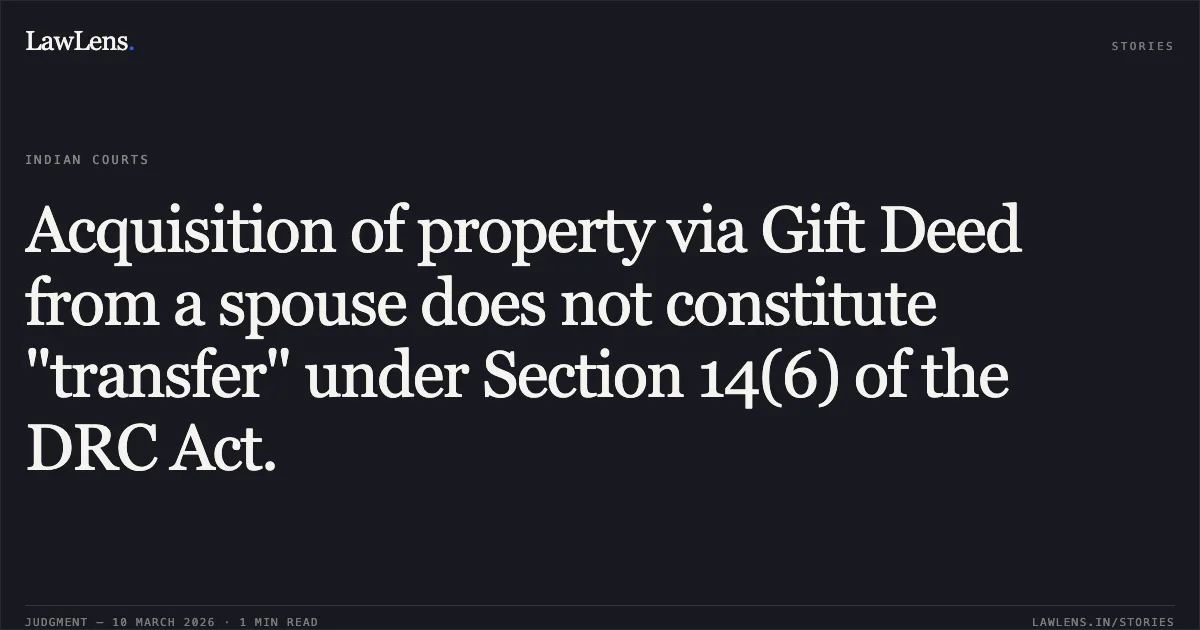
Whether the acquisition of tenanted premises by a wife from her husband via a Gift Deed constitutes a "transfer" within the restrictive meaning of Section 14(6) of the Delhi Rent Control Act, 1958.
Source reference: p.7 / para. 6Whether the five-year statutory bar on filing eviction petitions applies to a legal heir who possessed a pre-existing underlying right in the property through lineage or succession.
Source reference: p.15 / para. 15-18Law Applied
The court primarily applied Section 14(6) of the DRCA, which prohibits a landlord who acquired premises by "transfer" from filing an eviction petition under Section 14(1)(e) until five years have elapsed from the date of acquisition.
Source reference: p.8It relied on the Supreme Court’s interpretation in *V.N. Sarin v. Major Ajit Kumar Poplai*, which established that the object of Section 14(6) is to prevent "strangers" or "purchasers" from using transfers as a device to evict tenants, and does not apply where the landlord had a prior title or interest (e.g., partition).
Source reference: p.9-10It further applied *Dr. R.C. Sakhuja v. R.P. Kholi*, holding that devolution by succession (testamentary or non-testamentary) is not a "transfer" under Section 14(6).
Source reference: p.13-14It further applied *Ajay Kumar Gupta v. Prakash Chand Gupta*, which clarified that documents executed *inter se* family members do not necessarily attract the statutory bar.
Source reference: p.12-13Reasoning
The Court reasoned that Section 14(6) aims to curb mala fide transfers to third parties to circumvent rent protections, not to obstruct genuine devolution within a family.
Source reference: para. 10, 13The Court found that the petitioner was not a "rank outsider" or "stranger" to the property.
Source reference: para. 15As the wife of the previous owner and a Class I legal heir, the petitioner held a vested legal right and interest in the property via lineage and succession laws even prior to the execution of the Gift Deed.
Source reference: para. 15, 18The Court distinguished between a "commercial" transfer to a stranger and a "familial" gift to a legal heir who would have eventually inherited the property by operation of law (intestate or testamentary).
Source reference: para. 17Consequently, the Gift Deed was seen as a formalization of an existing interest rather than an "acquisition by transfer" intended to be barred by the legislature.
Source reference: para. 19Holding
The Court held that a Gift Deed executed in favour of a spouse/legal heir does not fall within the ambit of "transfer" under Section 14(6) of the DRCA.
The High Court set aside the impugned orders dated 28.04.2023 and ruled that the eviction petitions were maintainable despite the Gift Deed being less than five years old.
Source reference: para. 20The petitions were restored and remanded to the Rent Controller for disposal on merits.
Source reference: para. 20Acts & Sections Cited
3 provisions across 3 statutes referred to in this judgment. Each provision opens on LawLens.
Code of Civil Procedure, 19081
Indian Contract Act, 18721
delhi rent control act, 19581
Original Court PDF
Preeti Gupta v. Madan Mohan Pahwa (and connected matters) RC.REV. 306/2023
Click to open original judgment
Original judgment, available to read, download and summarize on LawLens.in