Facts
The complainant, Manjuben Gigabhai Gohil, alleged that on 2 February 2008, while returning on her scooter after appearing for her Standard 12 Hindi examination, she was stopped near a culvert between Pipalnu Patiyu and Lakhanka village by the three accused.
Source reference: pp. 2, 8–10; paras. 2, 11It was alleged that accused Dilipbhai abused her by referring to her caste and caught her arm, accused Rameshbhai touched her face, and accused Nagjibhai used abusive words.
Source reference: pp. 2, 8–10; paras. 2, 11The complainant thereafter informed her brother and made representations to police and other authorities; following intervention by the National Human Rights Commission, an FIR was registered and investigation commenced.
Source reference: pp. 2, 8–10; paras. 2, 11The accused were charged under Sections 354, 504, 506(2) and 114 of the IPC and Section 3(1)(x) of the Scheduled Castes and Scheduled Tribes (Prevention of Atrocities) Act.
Source reference: pp. 1–3; paras. 1, 5–6The trial court acquitted all accused on 28 March 2012 in Special Atrocity Case No. 43 of 2008.
Source reference: pp. 1–3; paras. 1, 5–6The State preferred the present appeal under Section 378(1) and (3) of the CrPC.
Source reference: pp. 1–3; paras. 1, 5–6Issues
1. Whether the trial court was justified in acquitting the accused of the offences alleged against them.
Source reference: p. 8; para. 10(1)2. Whether the trial court properly appreciated the oral and documentary evidence led by the prosecution.
Source reference: p. 8; para. 10(2)3. Whether the impugned judgment of acquittal suffered from any illegality, irregularity, perversity, or other infirmity warranting appellate interference.
Source reference: p. 8; para. 10(3)4. Whether the prosecution proved the essential ingredients of Section 3(1)(x) of the SC/ST (Prevention of Atrocities) Act, including intentional caste-based insult or intimidation in a public place and within public view.
Source reference: p. 11; para. 14Law Applied
The Court considered the offences charged under Sections 354, 504, 506(2) and 114 of the IPC and Section 3(1)(x) of the SC/ST (Prevention of Atrocities) Act, along with the State’s appellate remedy under Section 378(1) and (3) of the CrPC.
Source reference: p. 1; para. 1For Section 3(1)(x), the prosecution was required to establish intentional insult or intimidation of a person belonging to a Scheduled Caste or Scheduled Tribe by reference to caste, occurring in a public place and within public view, with the requisite intention.
Source reference: p. 11; para. 14In an appeal against acquittal, an appellate court has full power to reappreciate the evidence, but must recognize the double presumption of innocence in favour of the accused; where two reasonable views are possible, the acquittal should not ordinarily be disturbed.
Source reference: pp. 12–14; paras. 15–18The Court relied on Chandrappa v. State of Karnataka, (2007) 4 SCC 415; Rajesh Prasad v. State of Bihar, (2022) 3 SCC 471; Babu Sahebagouda Rudragoudar v. State of Karnataka, AIR 2024 SC 2252, (2024) 8 SCC 149; and Ramesh v. State of Karnataka, (2024) 9 SCC 169.
Source reference: paras. 17–18Reasoning
The Court found that the prosecution evidence contained material contradictions regarding the precise place of occurrence, with the complainant, other witnesses, and the scene-of-offence panchnama indicating different locations.
Source reference: pp. 9–10; para. 12Although the alleged incident occurred in broad daylight, no independent witness was examined or even cited during investigation.
Source reference: p. 9; para. 12The prosecution also failed to produce material establishing that the complainant had appeared for the examination on the date and time alleged.
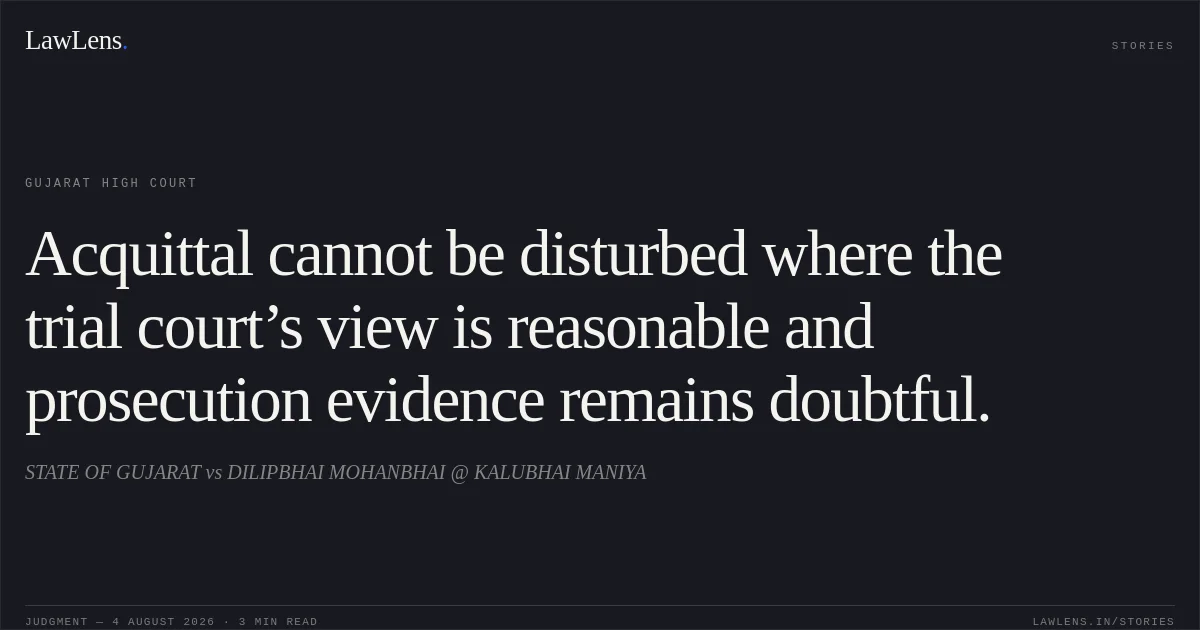
Source reference: p. 10; para. 13These deficiencies undermined the reliability of the prosecution case and supported the trial court’s view that the allegations were not proved beyond reasonable doubt.
Source reference: no citationIndependently, the prosecution failed to prove that the alleged caste-based insult occurred in the presence of members of the public or within public view, an essential requirement of Section 3(1)(x).
Source reference: p. 11; para. 14Applying the restrictive principles governing interference with acquittal, the High Court held that the trial court’s conclusions were reasonably possible and neither perverse nor legally unsustainable.
Source reference: pp. 11–15; paras. 14–20Holding
The High Court answered the issues in favour of the accused.
It held that the prosecution had failed to establish the charged offences beyond reasonable doubt and that the trial court had properly appreciated the evidence.
Source reference: p. 15; paras. 19–21Finding no illegality, perversity, or infirmity warranting appellate interference, the Court dismissed the State’s appeal and confirmed the order of acquittal dated 28 March 2012.
Source reference: p. 15; paras. 19–21The bail bonds were cancelled, and the record and proceedings were directed to be returned to the trial court.
Source reference: p. 15; paras. 19–21Acts & Sections Cited
7 provisions across 3 statutes referred to in this judgment. Each provision opens on LawLens.
Code of Criminal Procedure, 19732
Indian Penal Code, 18604
Scheduled Castes and the Scheduled Tribes (Prevention of Atrocities) Act, 19891
Original Court PDF
STATE OF GUJARATvsDILIPBHAI MOHANBHAI @ KALUBHAI MANIYA
Click to open original judgment
Original judgment, available to read, download and summarize on LawLens.in