Facts
On 29 December 2007, the complainant, Kishorbhai Jagdishbhai Sindhav, allegedly went to a circus at Tiker village with his uncle. Accused No. 4 allegedly taunted him regarding his father’s defeat in the Sarpanch election, abused him, and assaulted him. Other accused persons allegedly arrived carrying sticks, formed an unlawful assembly, assaulted the complainant and his uncle, threatened the complainant, and used caste-related insults. The prosecution invoked Sections 147, 148, 149, 323 and 506(2) of the IPC, Section 135 of the Bombay Police Act, and Section 3(1)(x) of the Scheduled Castes and Scheduled Tribes (Prevention of Atrocities) Act, 1989
Source reference: p.2, para.2The complainant was initially treated at the Community Health Centre, Halvad, and was subsequently referred to C.U. Shah Medical College and Hospital, Surendranagar. The complaint was lodged on 30 December 2007 at approximately 11:30 a.m., whereas the alleged incident occurred at approximately 8:15 p.m. on 29 December 2007. After investigation, a chargesheet was filed and the accused were tried in Special Case No.14 of 2008. The trial Court acquitted all accused by judgment dated 30 September 2009. The State challenged the acquittal under Section 378(1)(3) of the Code of Criminal Procedure, 1973
Source reference: p.1, para.1; p.2, paras.2.1–6; p.7, para.10Issues
Whether the prosecution proved beyond reasonable doubt that the respondents committed the alleged offences under Sections 147, 148, 149, 323 and 506(2) of the IPC, Section 135 of the Bombay Police Act, and Section 3(1)(x) of the SC/ST (Prevention of Atrocities) Act.
Source reference: pp.7–10, paras.10–15Whether the trial Court’s appreciation of the evidence and acquittal of the accused were perverse, illegal, or otherwise warranted interference by the High Court in an appeal against acquittal.
Source reference: pp.11–14, paras.16–21Law Applied
The Court considered the offences alleged under Sections 147, 148, 149, 323 and 506(2) of the IPC, Section 135 of the Bombay Police Act, and Section 3(1)(x) of the SC/ST (Prevention of Atrocities) Act. The State’s appellate remedy was examined under Section 378(1)(3) of the CrPC.
Source reference: p.1, para.1An appellate Court has full power to review, reappreciate and reconsider evidence in an appeal against acquittal; however, an acquitted accused benefits from a double presumption of innocence, and where two reasonable conclusions are possible, the appellate Court should ordinarily not disturb the acquittal. The Court relied on Chandrappa v. State of Karnataka, (2007) 4 SCC 415; Rajesh Prasad v. State of Bihar, (2022) 3 SCC 471; Babu Sahebagouda Rudragoudar v. State of Karnataka, (2024) 8 SCC 149; and Ramesh v. State of Karnataka, (2024) 9 SCC 169, for the principles governing appellate interference with acquittals.
Source reference: p.12, para.18; pp.12–14, para.19Reasoning
The High Court found material contradictions among the complainant, his uncle, and the eyewitness regarding who gave the medical history and whether the names of all accused were disclosed. The first treating doctor testified that the complainant was conscious and had named only “Vijaybhai,” without providing further identifying details.
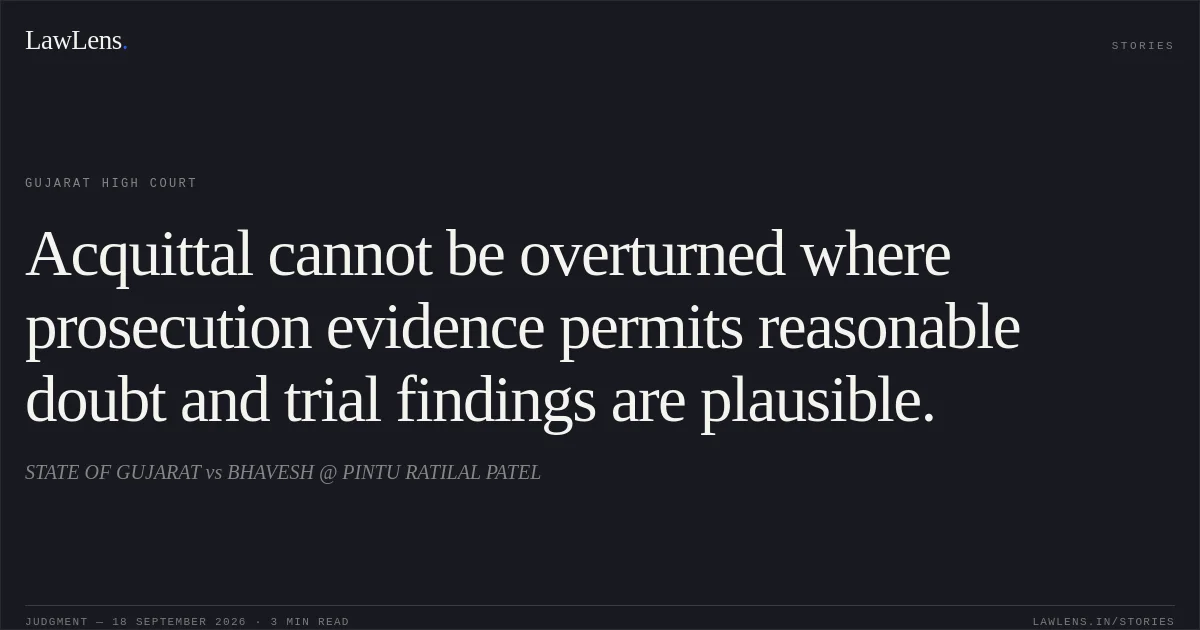
Source reference: p.8, paras.11–12The medical evidence recorded only simple injuries, did not establish injuries caused by stick blows, and indicated that the injuries could have resulted from a fall, collision with a wooden bench, or a stampede. Although the complainant was allegedly admitted for approximately eight days, the prosecution did not satisfactorily explain the discrepancy between that circumstance and the doctors’ evidence that the injuries were simple. The panch witnesses, the circus manager, and another material witness did not support the prosecution and were declared hostile. In light of these contradictions, omissions, inconsistent medical history, and lack of reliable corroboration, the Court held that the prosecution had failed to establish the identity and participation of the accused beyond reasonable doubt. Applying the restrained appellate standard applicable to acquittals, the Court found that the trial Court’s view was a reasonable view supported by the evidence and was neither perverse nor illegal.
Source reference: pp.8–14, paras.12.1–21Holding
The High Court answered the issues against the State. It held that the prosecution had not proved the alleged offences beyond reasonable doubt and that the trial Court had committed no error of fact or law in acquitting the accused.
The State’s appeal was dismissed, the judgment and order of acquittal dated 30 September 2009 were confirmed, the bail bonds were cancelled, and the record and proceedings were directed to be returned to the concerned trial Court.
Source reference: p.15, para.22Acts & Sections Cited
8 provisions across 3 statutes referred to in this judgment. Each provision opens on LawLens.
Code of Criminal Procedure, 19732
Indian Penal Code, 18605
Scheduled Castes and the Scheduled Tribes (Prevention of Atrocities) Act, 19891
Original Court PDF
STATE OF GUJARATvsBHAVESH @ PINTU RATILAL PATEL
Click to open original judgment
Original judgment, available to read, download and summarize on LawLens.in