Facts
On 3 September 2001, the de facto complainant alleged that accused No. 1, accompanied by his son (accused No. 2) and the complainant’s driver (accused No. 3), travelled in the complainant’s car.
Source reference: pp.2–3On the Modhera–Chanasma road, accused No. 1 allegedly assaulted the driver, threatened the complainant with a Rampuri knife, forcibly obtained cash of ₹36,000 and gold articles valued at approximately ₹7,10,000, and caused the complainant to jump from the moving vehicle near Karoda bus-stand.
Source reference: pp.2–3Accused Nos. 2 and 3 were subsequently found near the vehicle, while accused No. 1 had fled; an FIR was registered and the case was committed to the Sessions Court.
Source reference: pp.3–4The trial court examined ten prosecution witnesses and acquitted accused Nos. 2 and 3, although accused No. 1 was initially convicted.
Source reference: p.4The State preferred the present appeal under Section 378(1) and (3) of the Code of Criminal Procedure, 1973, challenging the acquittal of accused Nos. 2 and 3.
Source reference: para.1, p.1During the appeal, the High Court was informed that accused No. 1 had also been acquitted in a separate appeal.
Source reference: para.6.1(c), p.12Issues
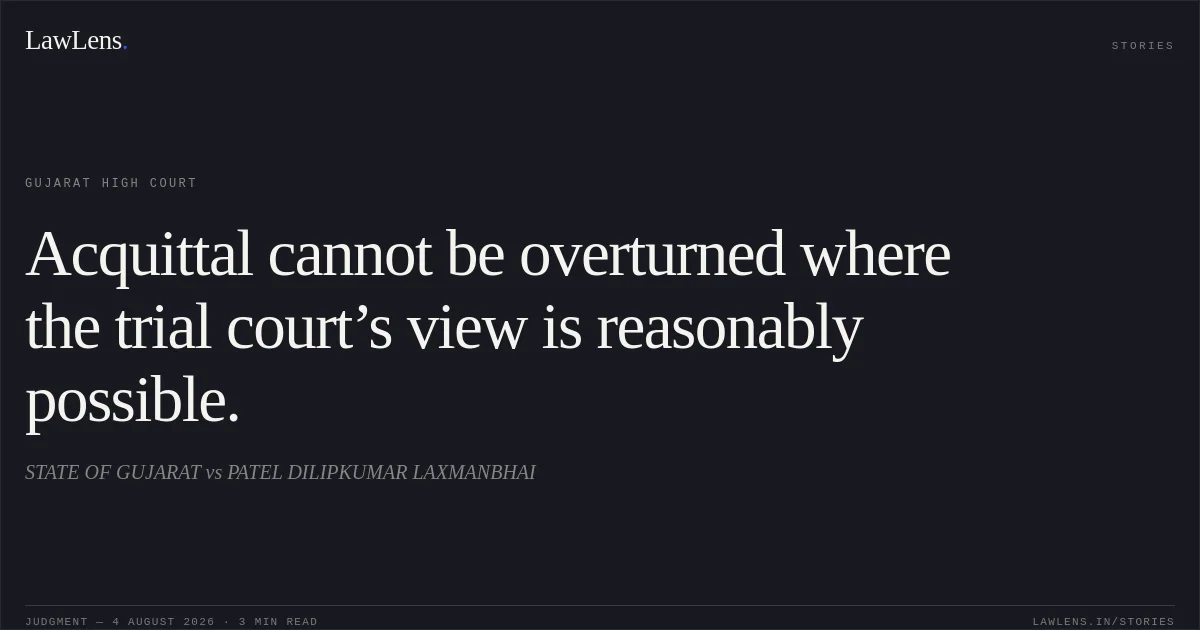
1. Whether the trial court’s acquittal of accused Nos. 2 and 3 was so perverse, illegal, or unsupported by the evidence as to warrant interference in a State appeal against acquittal under Section 378 CrPC.
Source reference: paras.1, 5.1, 6.3; pp.1, 6, 142. Whether the evidence established beyond reasonable doubt that accused Nos. 2 and 3 had actively participated in, aided, or abetted the alleged offence committed principally by accused No. 1.
Source reference: para.6.1(d)–(i), pp.12–14Law Applied
The Court applied Section 378(1) and (3) of the Code of Criminal Procedure, 1973, governing appeals against acquittal.
Source reference: para.1, p.1It relied on the principles in Chandrappa v. State of Karnataka, as reiterated in Rajesh Prasad v. State of Bihar and Babu Sahebagouda Rudragoudar v. State of Karnataka, that an appellate court may fully reappreciate the evidence but must recognise the strengthened or “double” presumption of innocence following acquittal; where two reasonable views are possible, the view favourable to the accused must prevail.
Source reference: para.5.1, pp.6–10The Court also relied on H.D. Sundara v. State of Karnataka, holding that interference is justified only where the trial court’s view is not a possible view and the evidence permits only a conclusion of guilt beyond reasonable doubt.
Source reference: para.5.1, pp.9–10It further referred to State of Karnataka v. Hemareddy @ Vemareddy for the principle that, where the appellate court agrees with the trial court’s appreciation of evidence, general agreement with the trial court’s reasons may ordinarily suffice.
Source reference: para.5.2–5.3, pp.10–11Reasoning
The High Court found that the FIR attributed the active criminal conduct—assault, threats and taking of the complainant’s property—to accused No. 1 alone, without assigning any overt act or specific role to accused Nos. 2 and 3.
Source reference: para.6.1(a), (d), (h), pp.12–14The complainant’s evidence, being the only direct evidence, did not establish that either respondent aided or abetted accused No. 1; in particular, the complainant stated that the driver was assaulted by accused No. 1.
Source reference: para.6.1(i), p.13The respondents did not flee: accused No. 3 remained with the vehicle and accused No. 2 was found after getting off an ST bus, while accused No. 1 had fled.
Source reference: para.6.1(e)–(f), p.13No recovery or discovery was made at their instance.
Source reference: para.6.1(g), p.13In these circumstances, the trial court’s conclusion that the prosecution had not proved the respondents’ participation was at least a reasonable view.
Source reference: no citationApplying the heightened restraint applicable to acquittal appeals, the High Court held that the finding was neither perverse nor based on a misreading or omission of material evidence.
Source reference: paras.5.1, 6.2–6.3; pp.6–11, 14Holding
The High Court answered the issues against the State and held that no legal flaw, perversity, or manifest illegality had been demonstrated in the acquittal of accused Nos. 2 and 3.
The State’s appeal was dismissed, and the trial court’s judgment and order of acquittal were confirmed insofar as they concerned the respondents.
Source reference: para.8, p.15The respondents’ bail bonds were ordered to stand cancelled, their sureties discharged, and the record and proceedings were directed to be returned to the trial court.
Source reference: para.8, p.15Acts & Sections Cited
4 provisions across 2 statutes referred to in this judgment. Each provision opens on LawLens.
Code of Criminal Procedure, 19731
Indian Penal Code, 18603
Original Court PDF
STATE OF GUJARATvsPATEL DILIPKUMAR LAXMANBHAI
Click to open original judgment
Original judgment, available to read, download and summarize on LawLens.in