Facts
The petitioner, a State Government employee, was arrested on 01 December 1999 in connection with Kadamkuan P.S. Case No. 650 of 1999 under Section 302 IPC and remained in judicial custody until 27 June 2000, a period of 210 days.
Source reference: p. 2, p. 7The criminal case, subsequently registered as Sessions Trial No. 242 of 2005, ended in his acquittal by judgment dated 06 July 2010.
Source reference: p. 3, p. 7After his superannuation on 31 January 2004, the petitioner sought salary and consequential benefits for the custody period.
Source reference: p. 3During the writ proceedings, the Department offered either to treat the period as extraordinary leave or to adjust it against the petitioner’s available earned leave; upon his refusal, the Department treated the 210-day period as extraordinary leave by Memo No. 2510 dated 27 September 2016.
Source reference: p. 3–4The petitioner challenged that order and claimed full salary with interest and consequential benefits, relying principally on Rule 99 of the Bihar Service Code and Rule 178 of the Bihar Board’s Miscellaneous Rules, 1958.
Source reference: p. 4–6Issues
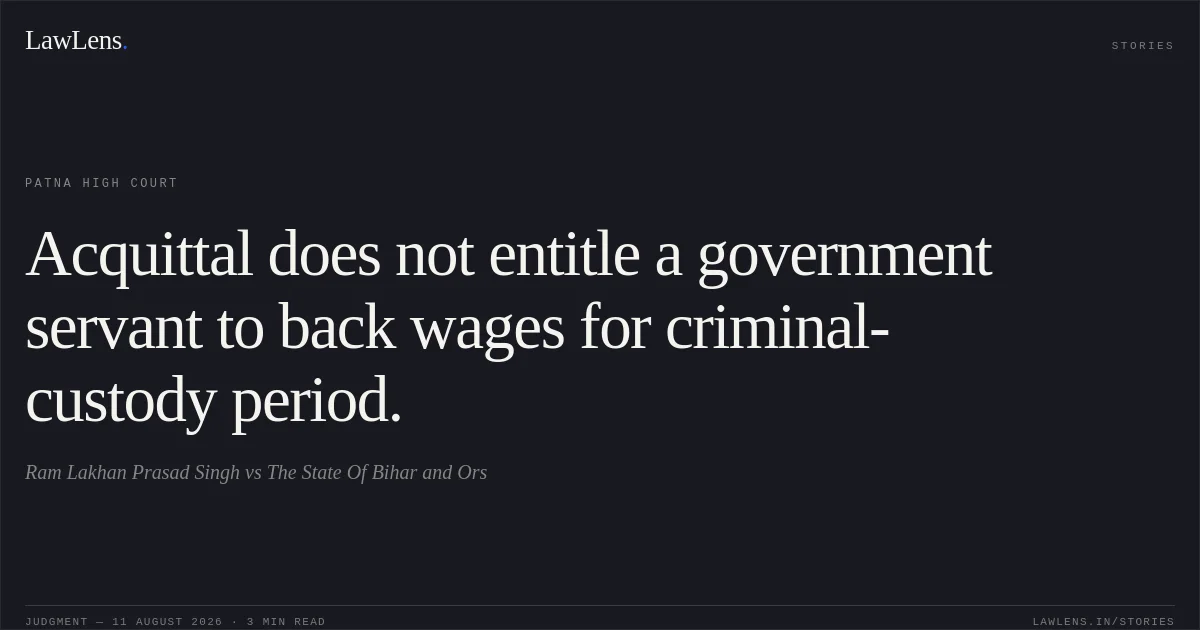
Whether the petitioner’s subsequent acquittal entitled him to full salary and consequential benefits for the period during which he remained in custody in a criminal case unrelated to his official duties.
Source reference: p. 7–12Whether the Department’s decision to treat the 210-day custody period as extraordinary leave was liable to be quashed.
Source reference: p. 3–4, p. 12–13Law Applied
Rule 99 of the Bihar Service Code and Rule 178 of the Bihar Board’s Miscellaneous Rules, 1958 provide that a government servant detained or imprisoned in connection with a criminal charge is deemed to be under suspension and is not entitled to pay and allowances during custody, subject to subsequent adjustment according to the circumstances of the case; full payment is contemplated where the employee is acquitted of blame.
Source reference: p. 4–6The Court also referred to Rules 99 and 100 of the Bihar Service Code as substantially analogous to Rules 9(2) and 9(3) of the CCA Rules, 2005, and recognised that custody results in deemed suspension.
Source reference: p. 7Applying the principle of “no work, no pay,” the Court relied on Ranchhodji Chaturji Thakore v. Superintendent Engineer, Gujarat Electricity Board, (1996) 11 SCC 603, Union of India v. Jaipal Singh, (2004) 1 SCC 121, and Baldeo Singh v. Union of India, (2005) 8 SCC 747, which hold that acquittal does not automatically confer a right to back wages where the employee was unavailable for work because of criminal proceedings or incarceration.
Source reference: p. 9–12The Court also relied on Sheo Nandan Singh v. State of Bihar, 2023 (1) PLJR 855, concerning regulation of the intervening period following conviction and subsequent acquittal.
Source reference: p. 12–13Reasoning
The Court held that the petitioner’s absence was not caused by an unlawful departmental suspension or any act of the State, but by his incarceration pursuant to the operation of criminal law.
Source reference: p. 8–9, p. 12Although the petitioner was ultimately acquitted, the acquittal did not retrospectively establish that the State had wrongfully prevented him from discharging his duties.
Source reference: p. 12Since the criminal case was unrelated to his official functions and the Department could not obtain his services during the custody period, the principle of “no work, no pay” applied.
Source reference: p. 12The Court distinguished the earlier decision in Muneshwar Mahto v. State of Bihar, C.W.J.C. No. 1386 of 2002, observing that it had not considered the subsequent Supreme Court authorities governing entitlement to back wages after acquittal.
Source reference: p. 6, p. 12Consequently, the petitioner was not entitled to full salary merely because he had been acquitted, and the Department’s treatment of the period as extraordinary leave was not found legally unsustainable.
Source reference: p. 12–13Holding
The Court answered both issues against the petitioner.
It held that the petitioner was not entitled to salary, interest, or consequential monetary benefits for the period from 01 December 1999 to 27 June 2000 because he had not worked during that period and his absence resulted from incarceration in a criminal case unrelated to his duties.
Source reference: p. 12The challenge to Memo No. 2510 dated 27 September 2016 was rejected.
Source reference: p. 13The writ petition was dismissed for lack of merit, and any pending applications were also disposed of.
Source reference: p. 13Acts & Sections Cited
1 provisions across 1 statute referred to in this judgment. Each provision opens on LawLens.
Indian Penal Code, 18601
Original Court PDF
Ram Lakhan Prasad SinghvsThe State Of Bihar and Ors
Click to open original judgment
Original judgment, available to read, download and summarize on LawLens.in