Facts
The respondent, a Grade II Police Constable in the Armed Reserve, Greater Chennai Police, was proceeded against under Rule 3(b) of the Tamil Nadu Police Subordinate Service (Discipline and Appeal) Rules.
Source reference: paras. 2–7; pp. 2–4, 7–10The charges alleged that, on 26 November 2003, he fraudulently represented white powder as heroin and attempted to cheat and extort money, and that he remained unauthorisedly absent from duty.
Source reference: paras. 2–7; pp. 2–4, 7–10A criminal case was also registered against him; he was acquitted by the criminal court on the ground of benefit of doubt on 4 May 2012.
Source reference: paras. 2–7; pp. 2–4, 7–10In the departmental enquiry, four summonses were served on him, but he did not appear.
Source reference: paras. 2–7; pp. 2–4, 7–10The Enquiry Officer consequently conducted an ex parte enquiry, examined three witnesses, considered five documents, and found the charges proved.
Source reference: paras. 2–7; pp. 2–4, 7–10After considering the respondent’s further representation, the disciplinary authority imposed the penalty of removal from service.
Source reference: paras. 2–7; pp. 2–4, 7–10The Single Judge allowed the respondent’s writ petition, principally relying on his acquittal in the criminal case.
Source reference: paras. 2–7; pp. 2–4, 7–10The State preferred the present intra-court appeal.
Source reference: paras. 2–7; pp. 2–4, 7–10Issues
Whether the pendency, and subsequent acquittal, of the criminal case barred the State from continuing or concluding the departmental disciplinary proceedings against the respondent.
Source reference: paras. 9–14; pp. 5–8Whether the ex parte departmental enquiry was vitiated for violation of natural justice when the respondent failed to appear despite receiving four summonses.
Source reference: paras. 13, 15–16; pp. 6–9Whether the punishment of removal from service was disproportionate to the proved misconduct of a police constable serving in a uniformed force.
Source reference: para. 17; pp. 9–10Law Applied
The Court applied Rule 3(b) of the Tamil Nadu Police Subordinate Service (Discipline and Appeal) Rules, which authorises departmental action for misconduct.
Source reference: paras. 9–16; pp. 5–9The principle that departmental and criminal proceedings are distinct, operate in different fields, and are governed by different standards of proof.
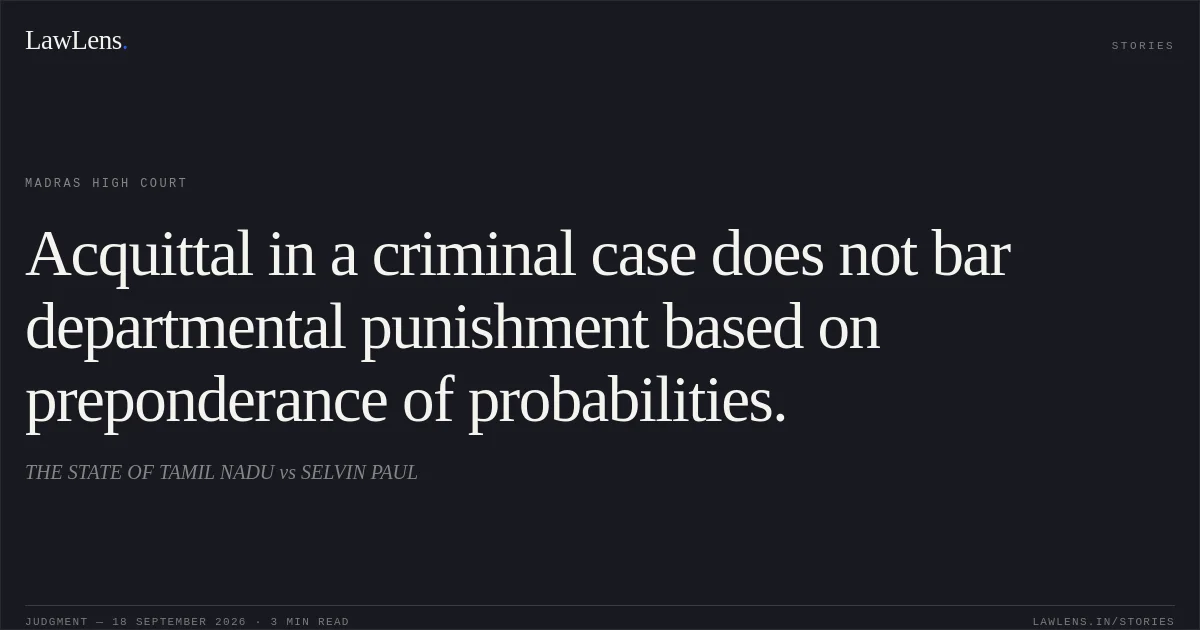
Source reference: paras. 9–16; pp. 5–9The rule that a criminal acquittal, particularly an acquittal on benefit of doubt, does not automatically exonerate a delinquent employee in departmental proceedings.
Source reference: paras. 9–16; pp. 5–9While criminal conviction requires proof beyond reasonable doubt, departmental misconduct may be established on a preponderance of probabilities.
Source reference: paras. 9–16; pp. 5–9The Court further applied the principles of natural justice, holding that an ex parte enquiry is permissible where adequate notice and reasonable opportunities to participate have been provided but not utilised.
Source reference: paras. 9–16; pp. 5–9In judicial review under Article 226, the Court examines the decision-making process and procedural legality, not the merits of the disciplinary decision as an appellate authority.
Source reference: paras. 9–16; pp. 5–9It also applied the proportionality principle in the context of discipline required in uniformed services.
Source reference: paras. 9–16; pp. 5–9Reasoning
The Court held that the criminal prosecution and departmental enquiry concerned different legal processes and standards of proof.
Source reference: paras. 9–17; pp. 5–10The respondent’s acquittal on benefit of doubt therefore did not, by itself, invalidate the departmental finding that he had engaged in conduct involving fraudulent representation of white powder as heroin.
Source reference: paras. 9–17; pp. 5–10The departmental authorities were also not required to defer the enquiry until conclusion of the criminal case, particularly since departmental witnesses and documents were available.
Source reference: paras. 9–17; pp. 5–10The respondent had acknowledged four summonses fixing dates for the oral enquiry but failed to attend; hence, the Enquiry Officer was justified in proceeding ex parte.
Source reference: paras. 9–17; pp. 5–10The finding of guilt was supported by the examination of three witnesses and production of five documents, and there was no procedural violation or perversity warranting interference under Article 226.
Source reference: paras. 9–17; pp. 5–10Given the respondent’s position as a police constable in a uniformed service, the Court considered the misconduct grave and held that leniency would undermine discipline and morale.
Source reference: paras. 9–17; pp. 5–10Holding
The Court answered all issues against the respondent.
It held that the criminal acquittal did not bar or nullify the departmental proceedings, that the ex parte enquiry was valid because adequate opportunities had been afforded, and that removal from service was not disproportionate considering the gravity of the proved misconduct and the respondent’s status in the uniformed police force.
Source reference: para. 18; p. 10The Single Judge’s order dated 14 July 2021 in WP No. 16230 of 2018 was set aside, the writ appeal was allowed, and the connected miscellaneous petition was closed without costs.
Source reference: para. 18; p. 10Acts & Sections Cited
2 provisions across 1 statute referred to in this judgment. Each provision opens on LawLens.
Indian Penal Code, 18602
Original Court PDF
THE STATE OF TAMIL NADUvsSELVIN PAUL
Click to open original judgment
Original judgment, available to read, download and summarize on LawLens.in