Facts
The deceased, Varshaben, married Respondent No. 1 in 2010. Respondent No. 2 is the mother-in-law. Due to alleged harassment and the mother-in-law’s quarrelsome nature, the couple resided separately for seven months prior to the incident.
Source reference: p. 6, 7On April 1, 2012, the complainant (father of the deceased) received a call from Varshaben alleging harassment by her husband under the influence of alcohol. Later that day, Respondent No. 1 informed the complainant that Varshaben had left on a bicycle. Her body was recovered from the Narmada Canal on April 4, 2012.
Source reference: p. 1, 2, 6The State appealed against the judgment dated November 26, 2013, passed by the 2nd Additional Sessions Judge, Gandhinagar, which acquitted the respondents of charges under Sections 498A, 306, and 114 of the IPC.
Source reference: p. 1Issues
1. Whether the trial Court was justified in passing the judgment and order of acquittal based on the evidence led by the prosecution.
Source reference: p. 52. Whether the prosecution proved beyond reasonable doubt that the accused subjected the deceased to cruelty and abetted her suicide.
Source reference: p. 83. Whether there is any manifest illegality, irregularity, or perversity in the trial Court's findings.
Source reference: p. 5Law Applied
The Court applied Sections 498A (cruelty), 306 (abetment of suicide), and 114 (abettor present when offense committed) of the Indian Penal Code.
Source reference: p. 1It further relied on Sections 113A and 113B of the Indian Evidence Act regarding the presumption of abetment of suicide and dowry death, noting that continuous cruelty must be proven.
Source reference: p. 9The Court cited Chandrappa v. State of Karnataka (2007) regarding the double presumption of innocence in acquittal appeals, Ramesh Kumar v. State of Chhattisgarh (2001), and Ram Pyarey v. State of Uttar Pradesh (2025) to define the requirements of abetment.
Source reference: p. 9, 11Reasoning
The Court observed that the prosecution’s case rested primarily on the testimony of the deceased’s parents and brother, which lacked corroboration from independent witnesses.
Source reference: p. 7Crucially, the landlady (PW-5) testified that Respondent No. 2 never visited the couple's separate residence, undermining the allegation of instigation by the mother-in-law.
Source reference: p. 7Regarding the husband, the Court found no medical evidence of physical violence (post-mortem showed death by drowning with no internal/external injuries) and no police record or independent testimony confirming his alleged habitual drunkenness or specific acts of cruelty "soon before death".
Source reference: p. 7, 8The trial Court’s decision was deemed a "possible view" as the ingredients of Section 306 (instigation or proximal act leading to suicide) were not satisfied.
Source reference: p. 8, 11Holding
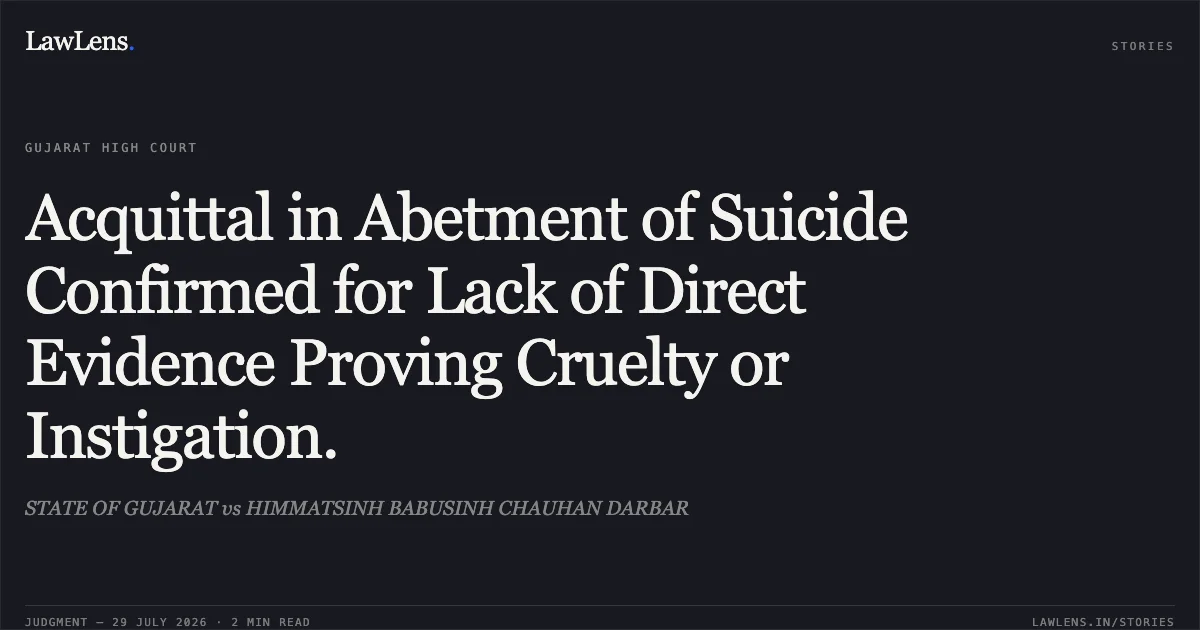
The High Court dismissed the appeals and confirmed the acquittal of the respondents. It held that the prosecution failed to prove the charges beyond reasonable doubt and that there was no "iota of evidence" linking the accused to the death as either an accident or suicide.
The Court reaffirmed the principle that an appellate court should not disturb an acquittal unless the trial court's view is perverse or suffers from manifest illegality, which was not the case here.
Source reference: p. 11, 14Acts & Sections Cited
4 provisions across 2 statutes referred to in this judgment. Each provision opens on LawLens.
Code of Criminal Procedure, 19732
Indian Penal Code, 18602
Original Court PDF
STATE OF GUJARATvsHIMMATSINH BABUSINH CHAUHAN DARBAR
Click to open original judgment
Original judgment, available to read, download and summarize on LawLens.in