Facts
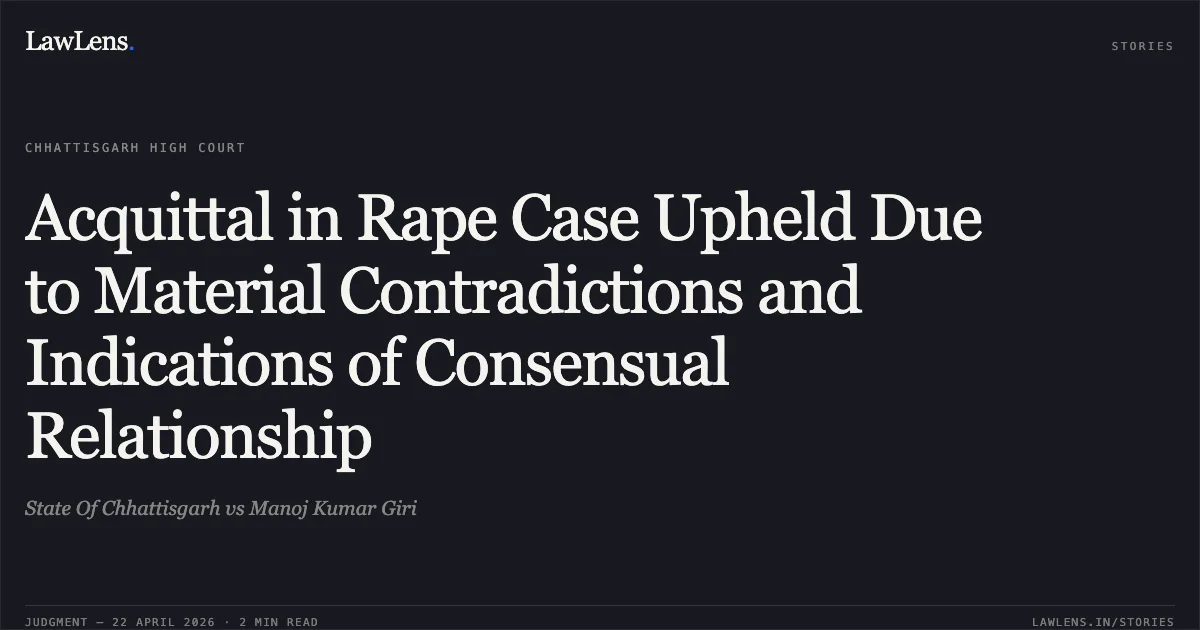
The State of Chhattisgarh appealed against the judgment dated 27.01.2017 passed by the Special Judge (SC/ST Act), Ambikapur, which acquitted the Respondent of charges under Sections 450, 376, and 506 (Part II) of the Indian Penal Code (IPC) and Section 3(2)(v) of the SC/ST (Prevention of Atrocities) Act.
Source reference: para 1The prosecutrix (PW-3), a 20-year-old married woman living separately from her husband, alleged that on 29.08.2015, the Respondent forcibly entered her house and raped her under threat of death.
Source reference: para 2-3The Trial Court acquitted the Respondent on the grounds that the sexual act appeared consensual.
Source reference: para 4Issues
1. Whether the sexual relationship between the Respondent and the prosecutrix was established without her consent, amounting to rape under Section 376 of the IPC.
Source reference: para 102. Whether the Trial Court’s findings of acquittal were perverse or contrary to the evidence on record, warranting interference by the Appellate Court.
Source reference: para 8, 14Law Applied
The Court applied Section 378(3) of the CrPC regarding appeals against acquittal.
Source reference: para 1It relied on the principles from Mallappa and others v. State of Karnataka (2024), which stipulate that if two views are possible, the view favoring the accused must be followed, and an acquittal should only be reversed in cases of manifest illegality or perversity.
Source reference: para 8Regarding the sole testimony of a prosecutrix, the Court applied Santosh Prasad @ Santosh Kumar v. State of Bihar (2020), holding that such testimony must be of "sterling quality," trustworthy, and unblemished to sustain a conviction without corroboration.
Source reference: para 11Reasoning
The Court observed that while the FSL report (Ex. P-15) confirmed the presence of human spermatozoa on the prosecutrix’s clothing—proving physical relations—it did not establish a lack of consent.
Source reference: para 9Upon reappreciating the evidence, the Court noted that the prosecutrix admitted the doors were kept open and she offered no physical resistance or outcry despite neighbors living in close proximity.
Source reference: para 6, 13Furthermore, a long-standing land dispute existed between the parties, suggesting a motive for false implication.
Source reference: para 4, 11The prosecutrix’s testimony failed the "sterling witness" test as her conduct (lack of resistance) and the surrounding circumstances indicated a consensual relationship rather than a forced encounter.
Source reference: para 13-14The court found that the Trial Court had taken a legally plausible view based on the evidence.
Source reference: para 14Holding
The High Court held that the prosecution failed to prove the charges beyond a reasonable doubt as the evidence pointed toward a consensual act.
Following the doctrine that an appellate court should not interfere with a plausible view of the Trial Court in an acquittal appeal, the Court dismissed the State's appeal. The acquittal of Manoj Kumar Giri was upheld.
Source reference: para 15Acts & Sections Cited
6 provisions across 3 statutes referred to in this judgment. Each provision opens on LawLens.
Code of Criminal Procedure, 19732
Scheduled Castes and the Scheduled Tribes (Prevention of Atrocities) Act, 19891
Indian Penal Code, 18603
Original Court PDF
State Of ChhattisgarhvsManoj Kumar Giri
Click to open original judgment
Original judgment, available to read, download and summarize on LawLens.in