Facts
On February 11, 2018, private complainants Deviprasad (PW-1) and Chirag Sharma (PW-2) intercepted the respondents near Wapra Road, alleging they were cruelly driving 15 agriculture-fit bulls toward a slaughterhouse in Maharashtra.
Source reference: para. 2The complainants took the accused and the cattle to the Katangi Police Station. A charge sheet was filed under the M.P. Govansh Vadh Pratishedh Adhiniyam, M.P. Pashu Krishak Parirakshan Adhniyam, and the Prevention of Cruelty to Animals Act.
Source reference: para. 2-3On August 23, 2022, the Judicial Magistrate First Class, Katangi, acquitted the respondents due to lack of evidence.
Source reference: para. 1The State filed this application seeking leave to appeal against that acquittal.
Source reference: para. 1Issues
1. Whether the prosecution proved beyond reasonable doubt that the respondents subjected the cattle to cruelty or intended to transport them for slaughter.
Source reference: para. 5-62. Whether the findings of the Trial Court were perverse or illegal so as to warrant interference by the High Court in an appeal against acquittal.
Source reference: para. 11-13Law Applied
The court applied Section 378(3) of the Cr.P.C. regarding leave to appeal against acquittal.
Source reference: para. 1It relied on the principle that the prosecution must prove guilt beyond reasonable doubt.
Source reference: para. 12Regarding appellate intervention, the court cited State of Gujarat v. Jayrajbhai Punjabhai Varu (2016), establishing that if two views are possible, the view favorable to the accused must be adopted.
Source reference: para. 12It further applied Nikhil Chandra Mondal v. State of W.B. (2023), holding that suspicion cannot replace proof.
Source reference: para. 12Mallappa v. State of Karnataka (2024), which mandates that an appellate court must demonstrate a specific illegality or perversity to reverse an acquittal.
Source reference: para. 13Reasoning
The Court observed fundamental flaws in the investigation and evidence. PW-4 (Investigating Officer) admitted he never visited the crime scene, prepared no spot map, and found no mention of injuries in the FIR or witness statements.
Source reference: para. 8Medical testimony from PW-3 (Veterinary Doctor) explicitly contradicted the complainants, stating there were no injury marks on the cattle.
Source reference: para. 10Furthermore, PW-1 and PW-2 admitted during cross-examination that they had no authority to stop the accused, did not witness any beating marks, and that the police did not conduct the seizure or arrest at the site of the alleged incident.
Source reference: para. 9-10The Court reasoned that the investigation was "faulty" and based merely on the unverified version of private individuals. Since the Trial Court’s view was a "legally plausible view," there was no ground for reversal.
Source reference: para. 10, 13-14Holding
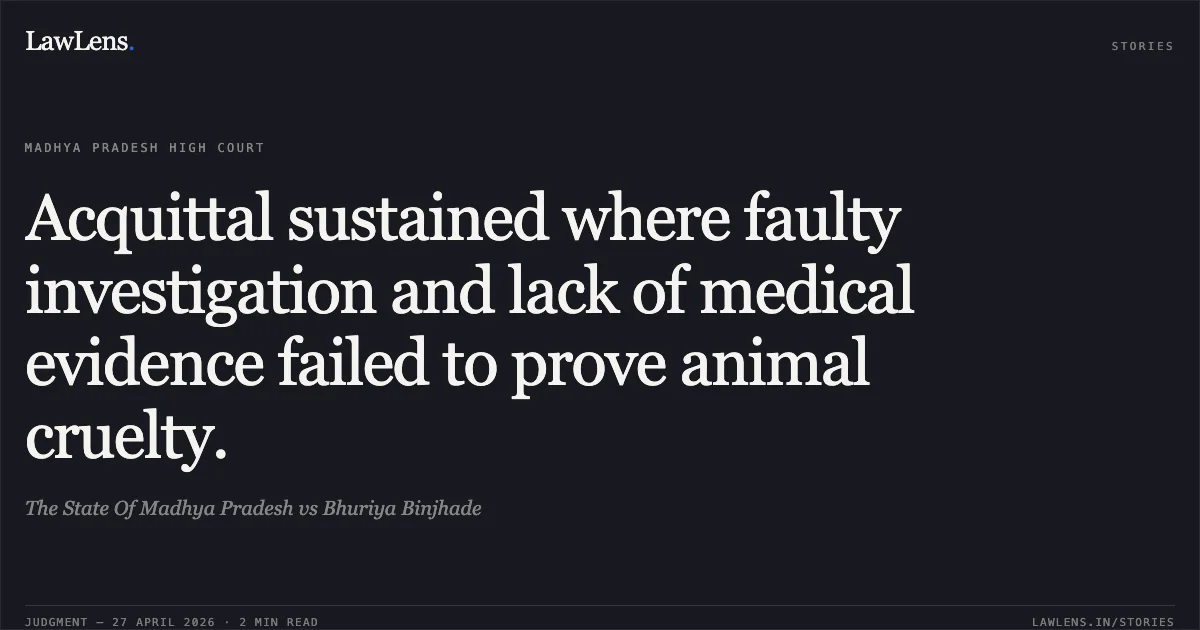
The High Court held that the prosecution failed to establish its case beyond reasonable doubt and the Trial Court's judgment was neither illegal nor perverse.
The court answered that interference is not permissible simply because a contrary view might be possible.
Source reference: para. 11-12Consequently, I.A. No. 23727/2022 (leave to appeal) was dismissed, and Criminal Appeal No. 11761/2022 was formally dismissed.
Source reference: para. 15Acts & Sections Cited
2 provisions across 2 statutes referred to in this judgment. Each provision opens on LawLens.
Code of Criminal Procedure, 19731
Prevention of Cruelty to Animals Act, 19601
Original Court PDF
The State Of Madhya PradeshvsBhuriya Binjhade
Click to open original judgment
Original judgment, available to read, download and summarize on LawLens.in