Facts
The husband appealed the Family Court’s dismissal of his petition for divorce, alleging cruelty, desertion and adultery by his wife.
Source reference: paras. 5–12The parties married in 2010 and began living separately that year.
Source reference: paras. 5–12The husband alleged that the wife had left without justification, had made false criminal allegations against him, and had entered into another marriage; the wife denied those allegations and maintained that she had been forced to leave and remained willing to resume cohabitation.
Source reference: paras. 5–12During the appeal, both parties sought to introduce documents under Order XLI Rule 27 of the Code of Civil Procedure, including criminal-court records and material relating to alleged compromise proceedings.
Source reference: paras. 16–21The High Court allowed the applications and considered the additional documents on appeal.
Source reference: paras. 34–40Issues
1. Whether the documents tendered under Order XLI Rule 27 CPC could be received as additional evidence.
Source reference: para. 23(i)2. Whether the husband established cruelty, desertion or adultery as grounds for divorce under Section 13 of the Hindu Marriage Act, 1955.
Source reference: paras. 23(ii)–(iii)Law Applied
Section 13 of the Hindu Marriage Act, 1955 provides the relevant grounds for divorce, including cruelty, desertion and adultery.
Source reference: paras. 23(ii)–(iii)Under Order XLI Rule 27 CPC, additional evidence may be admitted in the circumstances specified by the rule, including where the appellate court requires it to pronounce judgment or for another substantial cause.
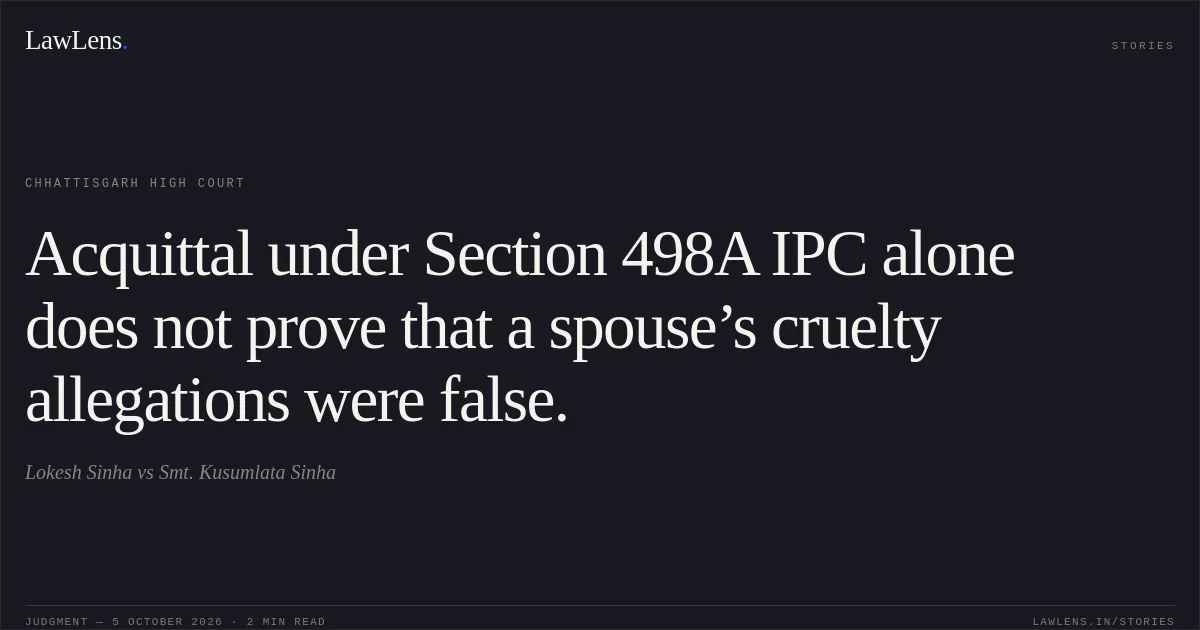
Source reference: paras. 35–38Matrimonial proceedings are assessed on the civil standard of proof, and the principles governing them differ from those governing criminal proceedings; an acquittal in a prosecution under Section 498A IPC does not, by itself, establish that the allegations were false or that matrimonial cruelty occurred.
Source reference: paras. 51–52Gopal Verma v. Poona Bai, 2017 SCC OnLine Chh 1092
Source reference: paras. 51–52Reasoning
The Court admitted the additional documents because they were relevant to adjudicating the appeal and fell within the appellate court’s power under Order XLI Rule 27(b) CPC.
Source reference: paras. 37–40On the merits, the husband’s witnesses lacked personal knowledge of events within the matrimonial home, while his own testimony did not establish that the wife had withdrawn from cohabitation without just cause.
Source reference: paras. 41–45His admission that he refused to resume cohabitation, together with the wife’s restitution-of-conjugal-rights proceeding, weighed against his desertion claim.
Source reference: paras. 41–45The documents concerning the alleged second marriage did not establish adultery; the relevant proceeding had been withdrawn on its first hearing, and the husband had not confronted the wife with the material.
Source reference: paras. 46–50Nor did his acquittal in the criminal case establish that the wife’s allegations were false.
Source reference: paras. 51–55The compromise-related material instead supported her account that he had promised to resume cohabitation but later refused.
Source reference: paras. 51–55The evidence therefore did not prove any pleaded ground for divorce.
Source reference: para. 56Holding
The Court held that the additional-evidence applications were admissible, but the husband failed to prove cruelty, desertion or adultery as grounds for divorce.
It found no error in the Family Court’s dismissal of the petition and dismissed the appeal.
Source reference: paras. 56–58Acts & Sections Cited
6 provisions across 4 statutes referred to in this judgment. Each provision opens on LawLens.
Family Courts Act, 19841
Indian Penal Code, 18602
Hindu Marriage Act, 19552
Code of Criminal Procedure, 19731
Original Court PDF
Lokesh SinhavsSmt. Kusumlata Sinha
Click to open original judgment
Original judgment, available to read, download and summarize on LawLens.in