Facts
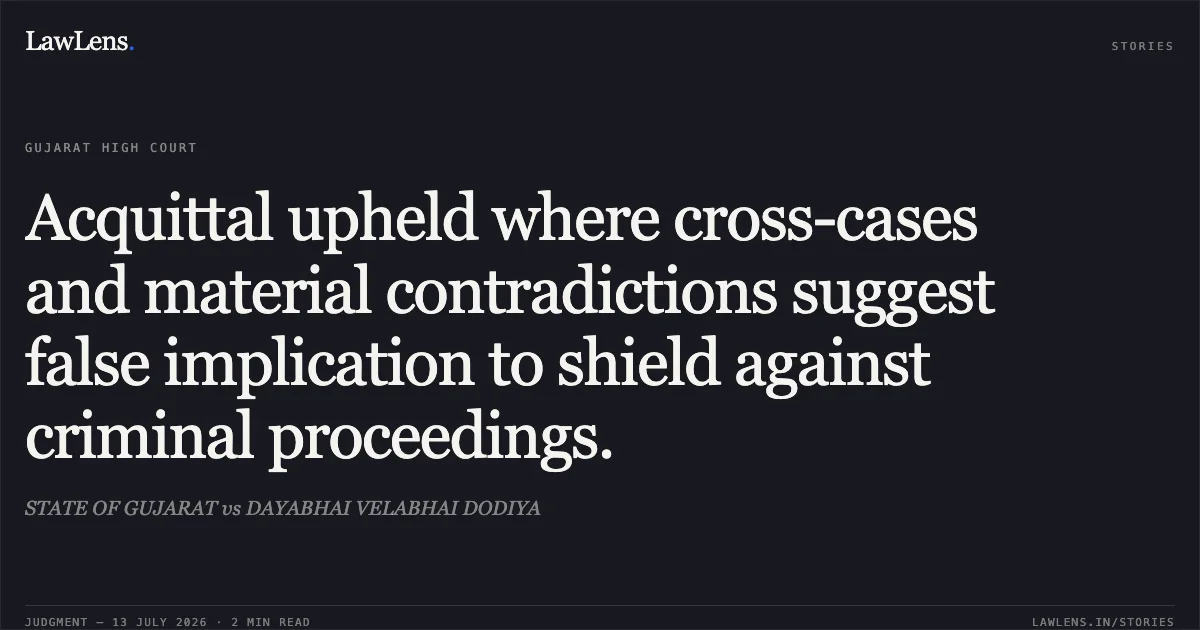
The State appealed an acquittal order dated 07.07.2009 involving charges under Sections 504, 323, and 114 of the IPC, Section 135 of the Bombay Police Act, and Section 3(1)(x) of the Atrocity Act
Source reference: p. 1-2The prosecution alleged that on 20.07.2000, the accused (including a village Sarpanch) assaulted the complainant’s brother following a dispute over signing loan forms and graveyard repairs
Source reference: p. 2evidence emerged of a cross-case where the complainant's brother was charged with public intoxication (Prohibition Act) and obstructing police (IPC Sections 186, 341) on the same evening
Source reference: p. 8The Trial Court acquitted the accused, citing material contradictions in witness testimonies and lack of proof regarding the caste status of the victims
Source reference: p. 7, 9Issues
1. Whether the Trial Court's appreciation of evidence was perverse, illegal, or contrary to the record, warranting interference in an appeal against acquittal
Source reference: p. 6 / para. 102. Whether the prosecution proved the essential ingredients of Section 3(1)(x) of the Atrocity Act, specifically intentional insult in public view and the caste status of the complainant
Source reference: p. 9 / para. 14Law Applied
The court applied Section 378 of the CrPC regarding appeals against acquittal, emphasizing the "double presumption of innocence" reinforced by an acquittal
Source reference: p. 10 / para. 15It relied on Chandrappa v. State of Karnataka (2007) 4 SCC 415 and Rajesh Prasad v. State of Bihar (2022) 3 SCC 471, which established that appellate courts should not disturb acquittals if two reasonable views are possible, unless the judgment is patently perverse
Source reference: p. 11-12For the Atrocity Act, it applied the principles from Naresh Kumar v. State of Haryana (2024) 3 SCC 573, requiring proof of intentional insult in public view
Source reference: p. 9Reasoning
The High Court found the prosecution's case riddled with inconsistencies. P.W.1 and P.W.2 provided conflicting motives for the assault—one citing a refusal to sign a certificate and the other citing a construction dispute
Source reference: p. 7The Court noted that the complainant bypassed the nearest police station to lodge the FIR in a different jurisdiction without explanation, suggesting the case was a "concocted version" designed to counter the criminal charges the complainant's brother already faced for intoxication and obstructing police
Source reference: p. 8-9Crucially, the prosecution failed to provide a valid caste certificate from a competent authority, relying instead on a certificate from a Talati/Sarpanch, which is legally insufficient to sustain a conviction under the Atrocity Act
Source reference: p. 9-10The Court determined that the Trial Court had taken a "reasonable view" based on these evidentiary gaps
Source reference: para 20Holding
The High Court dismissed the appeal and confirmed the judgment of acquittal
It held that the prosecution failed to prove its case beyond a reasonable doubt and failed to establish the mandatory requirements for offenses under the Atrocity Act
Source reference: p. 13The Court found no manifest illegality or perversity in the Trial Court’s findings to justify overturning the reinforced presumption of innocence
Source reference: p. 13-14Acts & Sections Cited
9 provisions across 4 statutes referred to in this judgment. Each provision opens on LawLens.
Code of Criminal Procedure, 19732
Indian Penal Code, 18605
Scheduled Castes and the Scheduled Tribes (Prevention of Atrocities) Act, 19891
Gujarat Prohibition Act, 1949.1
Original Court PDF
STATE OF GUJARATvsDAYABHAI VELABHAI DODIYA
Click to open original judgment
Original judgment, available to read, download and summarize on LawLens.in