01Facts
On 25 September 2010, police at Katargam Police Station, Surat, allegedly received secret information that the respondent, who was wanted in an earlier narcotics case, was carrying and intending to conceal ganja near an abandoned house in Shantinagar Slum.
pp. 2–3The respondent was intercepted while carrying a plastic sack. The prosecution alleged that the sack contained 10.275 kilograms of ganja, from which two samples of 100 grams each were drawn, sealed, and sent for forensic examination.
pp. 3–4The respondent was arrested and charged under Sections 8(c) and 20(b) of the Narcotic Drugs and Psychotropic Substances Act, 1985 (“NDPS Act”).
pp. 3–5The trial court acquitted him in N.D.P.S. Case No.18 of 2010 by judgment dated 1 June 2012. The State challenged the acquittal under Section 378(1) and (3) of the Code of Criminal Procedure, 1973.
¶ 102Issues
i.Whether the prosecution proved beyond reasonable doubt that the respondent was in conscious and unlawful possession of 10.275 kilograms of ganja, thereby committing offences under Sections 8(c) and 20(b) of the NDPS Act?
pp. 10–13ii.Whether the prosecution established compliance with the statutory safeguards under Sections 42, 43, 50, 55 and 57 of the NDPS Act?
pp. 10–13iii.Whether the trial court’s acquittal was perverse or manifestly illegal so as to warrant appellate interference?
¶ 13–18 · pp. 14–1703Law Applied
The Court applied Sections 8(c) and 20(b) of the NDPS Act, which prohibit unauthorised possession and dealing in cannabis and prescribe punishment for contravention.
pp. 10–13It considered the safeguards under Sections 42, 43, 50, 55 and 57 of the NDPS Act concerning recording and communication of prior information, search procedure, personal search, custody and sealing of seized articles, and reporting of the seizure.
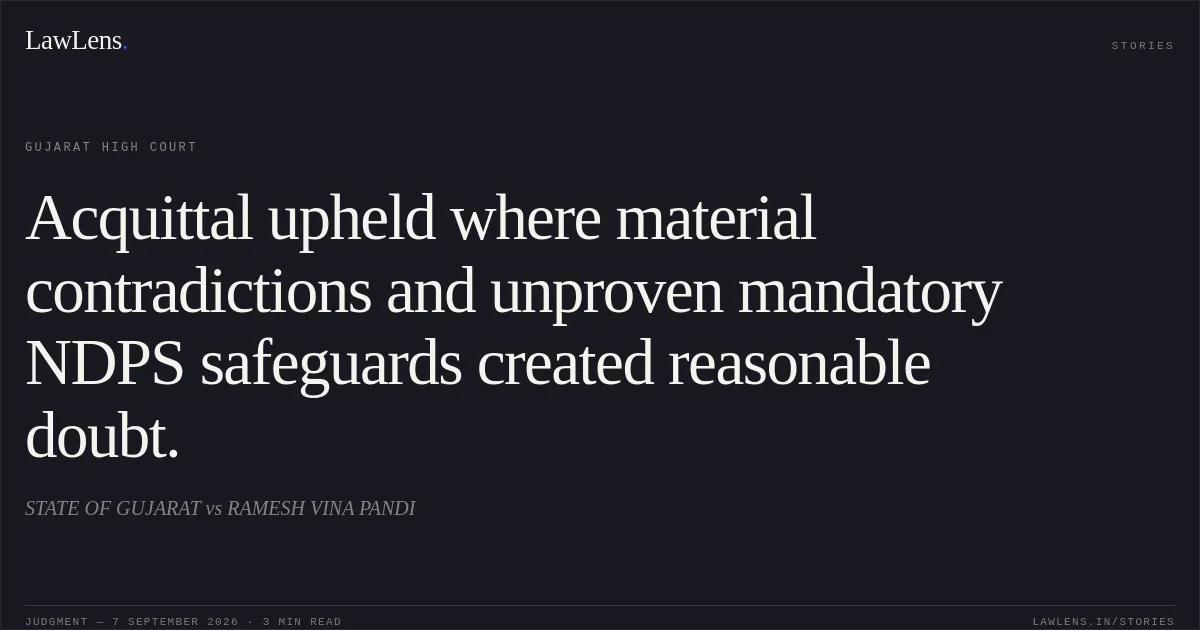
pp. 10–13The Court held that compliance with mandatory procedural safeguards must be established through cogent and reliable evidence.
pp. 10–13On appeals against acquittal, it applied the principles in Chandrappa v. State of Karnataka, (2007) 4 SCC 415; Rajesh Prasad v. State of Bihar, (2022) 3 SCC 471; Babu Sahebagouda Rudragoudar v. State of Karnataka, AIR 2024 SC 2252 / (2024) 8 SCC 149; and Ramesh v. State of Karnataka, (2024) 9 SCC 169: an appellate court may reappreciate the evidence, but the accused enjoys a strengthened or “double” presumption of innocence, and an acquittal should not be disturbed where two reasonable views are possible.
¶ 13–16Provisions in the judgment · 10 · Linked ones open on LawLens
Code of Criminal Procedure, 1973 Section 378Section 313
Narcotic Drugs and Psychotropic Substances Act, 1985 Section 8Section 20Section 42Section 2Section 43Section 50Section 57Section 55
04Reasoning
The High Court held that the prosecution evidence did not reliably establish the respondent’s possession of the seized ganja.
p. 10Although the police witnesses supported the raid, their accounts materially conflicted regarding the place and manner of weighing and seizure.
p. 10The independent weighing witness stated that he had been called to the police station area, had not separately weighed the sack, and had signed a blank paper, contradicting the police version and weakening the prosecution’s case.
p. 10The panch witnesses did not support the prosecution, while the prosecution failed to produce reliable evidence proving the chain of custody, sealing, sampling, and transmission of the samples to the FSL.
p. 11The Court also found that compliance with Sections 42, 43, 50, 55 and 57 had not been satisfactorily proved; the respondent allegedly did not understand Gujarati, yet no interpreter was shown to have explained the seizure and arrest documents, which he signed in the Odia language.
pp. 11–13The absence of independent witnesses in a densely populated area, the failure to establish ownership or connection with the alleged hut, and contradictions regarding the raid further created reasonable doubt.
p. 12Since the trial court’s view was a reasonable view of the evidence and was not perverse or manifestly illegal, the heightened standard applicable to an appeal against acquittal precluded interference.
¶ 13–1805Holding
The High Court answered the issues against the State and held that the prosecution failed to prove the respondent’s conscious and unlawful possession of ganja beyond reasonable doubt and failed to establish compliance with the mandatory safeguards under the NDPS Act.
¶ 17–18The State’s appeal was dismissed, and the trial court’s judgment acquitting the respondent was confirmed.
¶ 20The respondent’s bail bond was cancelled, the record and proceedings were directed to be returned to the trial court, and a copy of the judgment was directed to be forwarded to the Director of Prosecution for appropriate action concerning the alleged corruption-related proceedings referred to in the judgment.
¶ 19–20Original Court PDF
STATE OF GUJARATvsRAMESH VINA PANDI
Click to open original judgment
Original judgment, available to read, download and summarize on LawLens.in