Facts
During a Janmashtami celebration at Bhoyna Dhaliya, Jamnagar, an altercation allegedly occurred between Vijaybhai Bhimjibhai, Jitendra Nanji, and Bhagwanjibhai’s group regarding a water-distribution stall and the breaking of an earthen pot.
Source reference: pp.2, 8–9; paras.2, 11–12On 26 August 2008, the complainant, Bipinbhai, allegedly encountered Vijaybhai and Jitendra near Ashok Hotel/vegetable market.
Source reference: pp.2, 8–9; paras.2, 11–12Jitendra allegedly assaulted him with a knife, an iron knuckle (“muth”), and a wooden object, while Vijaybhai allegedly assaulted him with fists, kicks, and a wooden stick, causing injuries to his hand and head.
Source reference: pp.2, 8–9; paras.2, 11–12The complainant first approached the police and was allegedly directed to obtain medical treatment before lodging the FIR.
Source reference: pp.8–9; para.11After treatment, FIR C.R. No. I-268 of 2008 was registered for offences under Sections 323, 324, 325 and 114 of the IPC and Section 135(1) of the Bombay Police Act.
Source reference: pp.8–9; para.11The trial Court acquitted Vijaybhai of all charges.
Source reference: p.1; paras.1, 5–6The State preferred the present appeal under Section 378(1) and (3) of the Code of Criminal Procedure, 1973.
Source reference: p.1; paras.1, 5–6The High Court also noted that the complainant was facing a murder prosecution in a cross-case concerning Jitendra’s death, which raised the defence allegation that the present FIR was a counterblast.
Source reference: pp.6, 11; paras.9.1, 13Issues
1. Whether the trial Court was justified in acquitting the respondent-accused of the offences alleged against him?
Source reference: p.7; para.10(1)2. Whether the trial Court properly appreciated the oral, medical, and documentary evidence produced by the prosecution?
Source reference: p.7; para.10(2)3. Whether the impugned acquittal suffered from any illegality, irregularity, perversity, or manifest error warranting appellate interference?
Source reference: p.7; para.10(3)Law Applied
The Court considered the alleged offences under Sections 323, 324, 325 and 114 of the Indian Penal Code and Section 135(1) of the Bombay Police Act, together with the State’s appellate power under Section 378(1) and (3) of the Code of Criminal Procedure.
Source reference: p.1; para.1It applied the settled principles governing appeals against acquittal: an appellate court may fully review and reappreciate the evidence, but an acquittal carries a strengthened or “double” presumption of innocence; where two reasonable views are possible, the view favouring the accused should not ordinarily be disturbed.
Source reference: pp.12–14; paras.14–17These principles were drawn from Chandrappa v. State of Karnataka, (2007) 4 SCC 415, reaffirmed in Rajesh Prasad v. State of Bihar, (2022) 3 SCC 471, Babu Sahebagouda Rudragoudar v. State of Karnataka, AIR 2024 SC 2252; (2024) 8 SCC 149, and Ramesh v. State of Karnataka, (2024) 9 SCC 169.
Source reference: pp.12–14; paras.16–17The Court further applied the requirement that criminal charges must be proved beyond reasonable doubt and that interference with an acquittal requires firm, weighty grounds demonstrating perversity or manifest illegality.
Source reference: pp.11–14; paras.13–17Reasoning
The High Court found that the prosecution evidence did not reliably establish Vijaybhai’s criminal participation beyond reasonable doubt.
Source reference: p.9; para.12The specific allegation against him was limited principally to his presence with Jitendra and the infliction of fist and kick blows; no particular injury was clearly attributed to him, while the more serious weapon-related acts were alleged against Jitendra.
Source reference: p.9; para.12The medical evidence recorded injuries caused by a hard and blunt object, but the doctor’s evidence did not conclusively corroborate the alleged knife assault and the medical history was recorded without a police requisition, based only on the complainant’s account.
Source reference: pp.9–10; para.12The Court also found the explanation for the delay in registering the FIR unconvincing, despite the complainant allegedly having approached the police immediately after the incident.
Source reference: p.10; para.13Further, the complainant’s involvement in the cross-case arising from Jitendra’s death, his alleged suppression of that fact, and his initial denial followed by admission of prior criminal cases materially affected his credibility and supported the possibility that the FIR was lodged as a counterblast.
Source reference: pp.10–11; para.13In light of these circumstances, the trial Court’s view that the prosecution evidence was doubtful was held to be a reasonable view, not a perverse or legally impermissible one.
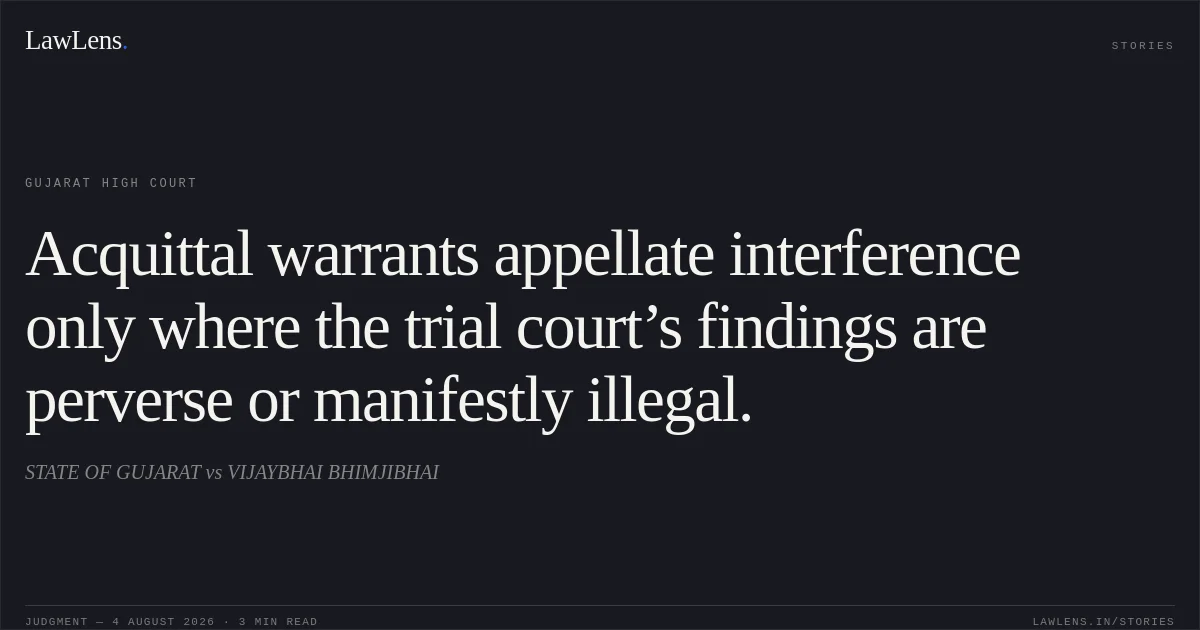
Source reference: pp.11–14, 15; paras.13–19Applying the restrictive standard for appellate interference with acquittals, the High Court declined to substitute its own view.
Source reference: pp.11–14, 15; paras.13–19Holding
The High Court answered all issues against the State.
It held that the prosecution had failed to prove Vijaybhai’s guilt beyond reasonable doubt and that the trial Court had committed no illegality, irregularity, or perversity in acquitting him.
Source reference: pp.11, 15; paras.13, 18–19The State’s appeal was therefore dismissed, the trial Court’s judgment and order of acquittal were confirmed, the respondent’s bail bond was cancelled, and the record and proceedings were directed to be returned to the concerned trial Court.
Source reference: p.15; para.20Acts & Sections Cited
7 provisions across 2 statutes referred to in this judgment. Each provision opens on LawLens.
Code of Criminal Procedure, 19732
Indian Penal Code, 18605
Original Court PDF
STATE OF GUJARATvsVIJAYBHAI BHIMJIBHAI
Click to open original judgment
Original judgment, available to read, download and summarize on LawLens.in