Facts
The petitioner had been engaged as a Home Guard under the competent police authority from February 2005.
Source reference: p. 2Following his implication in Golanthara P.S. Case No. 161 dated 10 October 2017, registered under Sections 457, 380 and 34 of the IPC, he was issued a show-cause notice and discharged from engagement by order dated 12 February 2018.
Source reference: pp. 2–4The petitioner was subsequently acquitted in the criminal case by judgment dated 9 May 2018.
Source reference: pp. 2, 4After his acquittal, the petitioner sought re-engagement, but his request was not accepted.
Source reference: pp. 2–4Pursuant to an order passed in W.P.(C) No. 16411 of 2018, he approached the competent authority for consideration of his grievance.
Source reference: pp. 2–4The authority rejected his claim for re-engagement by order dated 29 April 2019.
Source reference: pp. 2–4The petitioner consequently filed the present writ petition challenging both the discharge order and the rejection of his claim for re-engagement.
Source reference: pp. 2–3The State opposed the petition, contending that the petitioner’s involvement in a criminal case justified the rejection of his claim notwithstanding his acquittal.
Source reference: pp. 3–4Issues
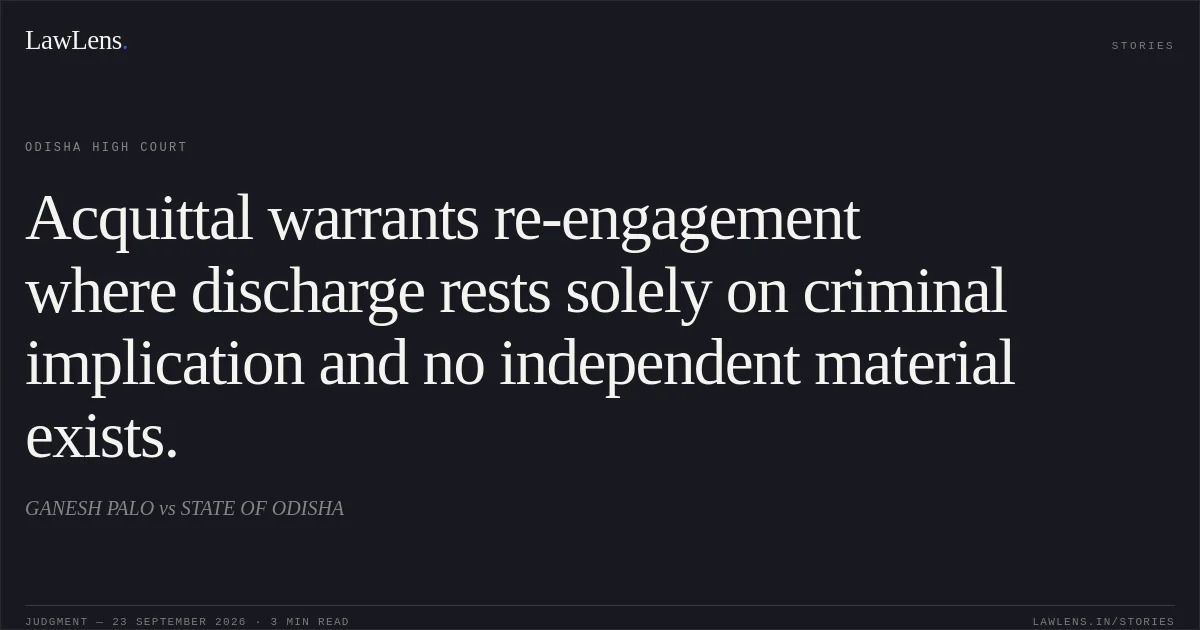
Whether the petitioner’s discharge from engagement as a Home Guard, having been based on his implication in the criminal case, could be sustained after his acquittal in that proceeding, in the absence of any independent material against him?
Source reference: pp. 4–5Whether the order rejecting the petitioner’s claim for re-engagement was legally sustainable?
Source reference: pp. 4–5Whether the petitioner was entitled to re-engagement in light of the principles governing the effect of acquittal where the criminal and departmental allegations arise from the same facts?
Source reference: pp. 5–9Law Applied
The Court applied the principle that an acquittal in a criminal case does not automatically invalidate disciplinary action; however, where the criminal and departmental proceedings involve identical or substantially similar charges, evidence, witnesses and circumstances, and the acquittal follows a substantive failure of the prosecution to establish the allegations, continuation of adverse action may become unjust, unfair and oppressive.
Source reference: p. 5The Court relied on Ram Lal v. State of Rajasthan & Others, Civil Appeal No. 7935 of 2023, which held that the substance of the acquittal must be examined rather than merely the labels “benefit of doubt” or “honourably acquitted”.
Source reference: pp. 5–6It further relied on Maharana Pratap Singh v. State of Bihar & Others, Civil Appeal No. 5497 of 2025, reaffirming that disciplinary consequences may not stand where the acquittal demonstrates that the prosecution failed to prove the allegations and no independent material supports the adverse action.
Source reference: pp. 6–7The Court also followed State of Odisha & Others v. Bansidhar Barik, W.A. No. 589 of 2025, where reinstatement was upheld after an acquittal based on the prosecution’s failure to establish the employee’s involvement and in the absence of independent evidence justifying disciplinary punishment.
Source reference: pp. 7–9Reasoning
The Court found that the petitioner’s discharge was directly attributable to his implication in the criminal proceeding and that no other material against him was shown after his acquittal.
Source reference: pp. 4–5Applying the principles in Ram Lal and Maharana Pratap Singh, the Court treated the acquittal as substantively significant rather than as a mere technical acquittal.
Source reference: pp. 5–7Since the basis of the discharge was the same criminal allegation and the authorities failed to demonstrate any independent justification for continuing the adverse action, rejection of re-engagement was considered unsustainable.
Source reference: pp. 5–7The reasoning was reinforced by the decision in Bansidhar Barik, which recognised that continuation of disciplinary consequences without independent evidence, after an acquittal showing failure of the prosecution case, would be unjust and oppressive.
Source reference: pp. 7–9Holding
The High Court allowed the writ petition by quashing the order dated 29 April 2019 rejecting the petitioner’s claim for re-engagement and the discharge order dated 12 February 2018.
It directed the competent authority to re-engage the petitioner as a Home Guard by passing an appropriate order within three weeks from receipt of the judgment.
Source reference: p. 9The writ petition and pending interlocutory application were accordingly disposed of.
Source reference: p. 9Acts & Sections Cited
5 provisions across 2 statutes referred to in this judgment. Each provision opens on LawLens.
Indian Penal Code, 18603
Narcotic Drugs and Psychotropic Substances Act, 19852
Original Court PDF
GANESH PALOvsSTATE OF ODISHA
Click to open original judgment
Original judgment, available to read, download and summarize on LawLens.in