Facts
The appellant was convicted by the Sessions Court of kidnapping under Section 363, rape under Section 376, and criminal intimidation under Section 506 of the Indian Penal Code (IPC), and sentenced to imprisonment and fines
Source reference: para. 1, 5The prosecution alleged that he took the complainant’s daughter from her home and raped and threatened her.
Source reference: no citationThe High Court noted inconsistencies about the victim’s age, including that the complaint described her as about 16 and that the school-age certificate was not supported by production of the underlying admission-register extract
Source reference: para. 3, 14–16On appeal under Section 374(2) of the Code of Criminal Procedure, the appellant challenged the proof of age and the sufficiency of the evidence
Source reference: para. 1, 6Issues
Whether the prosecution proved beyond reasonable doubt that the victim was below 16 years of age on the date of the alleged offence
Source reference: para. 9(i)Whether the appellant had established grounds to interfere with the convictions and sentences imposed by the trial court
Source reference: para. 9(ii)Law Applied
The Court applied Section 363 IPC, which requires proof of the statutory elements of kidnapping, including taking or enticing a minor out of the keeping of a lawful guardian without that guardian’s consent
Source reference: para. 19–20It considered the age-determination procedure in Rule 12 of the Juvenile Justice (Care and Protection of Children) Rules, 2007, which sets out a hierarchy of documentary evidence and, in its absence, medical opinion; relying on Jarnail Singh v. State of Haryana, (2013) 7 SCC 263, the Court treated that procedure as applicable to determining the age of a child victim as well
Source reference: para. 17–18It also invoked Section 114, Illustration (g), of the Indian Evidence Act, 1872, under which a court may draw an adverse inference where relevant, available evidence is withheld
Source reference: para. 16The Court assessed the charges under Sections 376 and 506 IPC by reference to the evidence on the record
Source reference: para. 22–27Reasoning
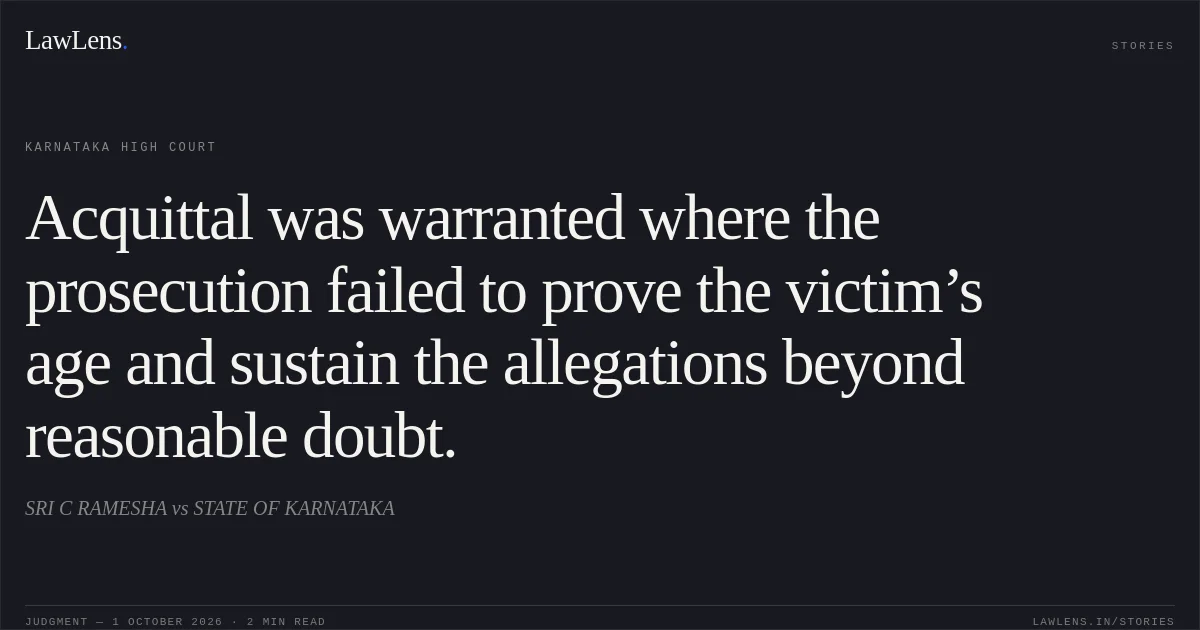
The Court found the victim’s age insufficiently established: the complaint and testimony differed, and although the prosecution relied on a school certificate, it did not produce the admission-register extract or explain its non-production.
Source reference: para. 14–18The Court therefore considered the age evidence unreliable and drew an adverse inference from the absence of the underlying record
Source reference: para. 14–18It also found insufficient proof of kidnapping under Section 363 IPC
Source reference: para. 19–21As to rape and intimidation, the victim stated in cross-examination that the accused had not kidnapped or raped her; the Court also noted that her parents denied having complained to police that the accused had taken her, several witnesses did not support the prosecution, and the medical and forensic evidence did not indicate forcible intercourse.
Source reference: para. 22–27It further criticised the prosecution’s questioning of the victim after cross-examination without the court’s permission
Source reference: para. 22–27Holding
The Court answered the age issue in the negative and held that the prosecution had not proved the offences beyond reasonable doubt.
It allowed the appeal, set aside the convictions and sentences, and acquitted the appellant of offences under Sections 363, 376, and 506 IPC.
Source reference: para. 27–28The bail bond was cancelled, and the trial court was directed to refund any fine deposited
Source reference: para. 27–28Acts & Sections Cited
5 provisions across 2 statutes referred to in this judgment. Each provision opens on LawLens.
Indian Penal Code, 18603
Code of Criminal Procedure, 19732
Original Court PDF
SRI C RAMESHAvsSTATE OF KARNATAKA
Click to open original judgment
Original judgment, available to read, download and summarize on LawLens.in