01Facts
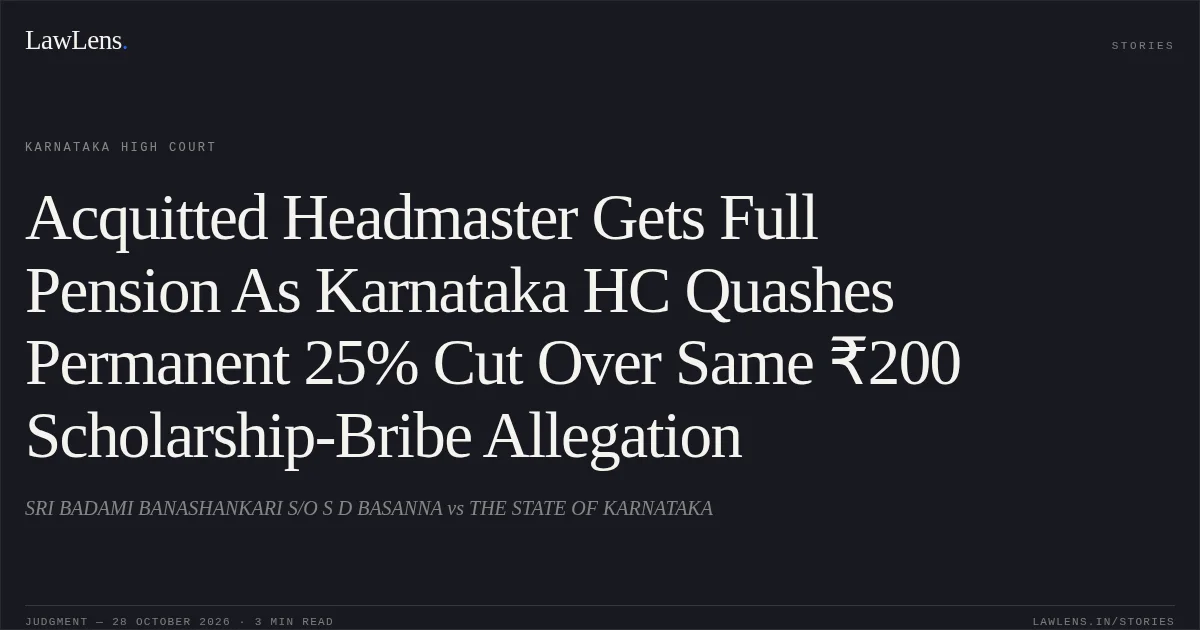
The petitioner, a retired headmaster, faced criminal and departmental proceedings arising from an allegation that he demanded ₹200 to facilitate a student scholarship.
The Special Court acquitted him in 2005, finding that the complainant and shadow witness did not establish demand or acceptance, and that the money was not recovered from his possession.
pp. 7–15A departmental penalty of permanent reduction of 25% of his pension was imposed after successive remittals and was challenged in several rounds before the Karnataka State Administrative Tribunal.
pp. 18–24The Tribunal ultimately dismissed his application on 6 April 2026, prompting this writ petition.
pp. 18–2402Issues
i.1. Whether the permanent reduction of the petitioner’s pension could be sustained when the criminal and departmental proceedings arose from the same incident and the criminal court acquitted him after finding demand and acceptance unproved.
pp. 24–25, 52–58ii.2. Whether the Tribunal’s dismissal of the petitioner’s challenge warranted interference under Articles 226 and 227 of the Constitution.
pp. 2, 22–2403Law Applied
Acquittal in a criminal case does not automatically invalidate a departmental penalty; however, where the charges, evidence, witnesses and circumstances in both proceedings are identical or substantially similar, and the criminal court has considered the evidence and found the prosecution case unproved, sustaining a contrary departmental finding may be unjust, unfair and oppressive.
pp. 24–35, 52–54The court relied principally on G.M. Tank v. State of Gujarat, (2006) 5 SCC 446; Ram Lal v. State of Rajasthan, (2024) 1 SCC 175; and Maharana Pratap Singh v. State of Bihar, 2025 SCC OnLine SC 890, which require the substance of the acquittal judgment—not labels such as “benefit of doubt” or “honourable acquittal”—to be examined.
pp. 24–35, 52–54It also considered the distinction between criminal and departmental standards of proof and the limited scope of judicial review, as discussed in State of Karnataka v. Umesh, (2022) 6 SCC 563, and Karnataka Power Transmission Corpn. Ltd. v. C. Nagaraju, (2019) 10 SCC 367.
pp. 36–43The Court exercised its jurisdiction under Articles 226 and 227 to review the Tribunal’s decision.
p. 2Provisions in the judgment · 7 · Linked ones open on LawLens
Prevention of Corruption Act, 1988 Section 13Section 7
Code of Criminal Procedure, 1973 Section 235
Indian Penal Code, 1860 Section 420Section 467Section 468Section 471
04Reasoning
The criminal and departmental proceedings arose from the same alleged demand for ₹200 and substantially relied on the same incident and witnesses.
The criminal court’s findings went to the substance of the allegation: the complainant and shadow witness did not prove demand or acceptance, and the money was found under a book rather than in the petitioner’s possession.
pp. 7–15The Court therefore treated the acquittal as a merits-based failure of proof, not as a merely technical outcome.
In contrast to the general rule that departmental proceedings are independent, the Court found no materially distinct evidentiary basis identified to sustain the penalty.
Given the repeated imposition of the same penalty despite earlier Tribunal remittals, allowing the permanent pension reduction to stand would be unjust and oppressive.
pp. 23–24, 52–5805Holding
The High Court allowed the writ petition and set aside the Tribunal’s order dated 6 April 2026.
pp. 58–59It allowed the petitioner’s challenge to the penalty of permanent 25% reduction of pension and directed that he receive the consequential benefits, including full pension from the date the penalty took effect.
pp. 58–59The pension was to be recalculated and paid within 12 weeks of receipt of the order.
pp. 58–59Original Court PDF
SRI BADAMI BANASHANKARI S/O S D BASANNAvsTHE STATE OF KARNATAKA
Click to open original judgment
Original judgment, available to read, download and summarize on LawLens.in