Facts
The Petitioner, a director/associate of a company (Respondent No. 2), filed an application under Section 94(1) of the Insolvency and Bankruptcy Code, 2016 (IBC) before the NCLT, Bengaluru, seeking to initiate the insolvency resolution process in his capacity as a "personal guarantor".
Source reference: para. 2He claimed his guarantee was invoked via a SARFAESI notice issued by Respondent No. 1.
Source reference: para. 2The NCLT dismissed the application on 30.03.2026, ruling that the Petitioner lacked locus standi because transaction documents (Sanction Letter and Facility Agreement) described him as a "co-borrower," not a "personal guarantor".
Source reference: para. 3, 9, 15.5The Petitioner challenged this via a writ petition, bypassing the statutory appellate remedy (NCLAT), arguing that the NCLT exceeded its jurisdiction by adjudicating his status at the threshold stage rather than appointing a Resolution Professional (RP).
Source reference: para. 4, 13, 14Issues
1. Whether the NCLT is empowered to determine the locus standi of an applicant at the threshold stage under Section 94 of the IBC, or if it must mechanically appoint a Resolution Professional.
Source reference: para. 172. Whether the determination of a jurisdictional fact (status as a guarantor) constitutes an impermissible adjudication on the merits of the insolvency application.
Source reference: para. 17, 27Law Applied
Section 94 of the IBC, which restricts the right to initiate insolvency processes to a "debtor" who satisfies specific statutory conditions and is not hit by disqualifications under sub-sections (2) to (6).
Source reference: para. 18, 19Principle of "Jurisdictional Facts," holding that a court or tribunal must satisfy itself of foundational facts before assuming jurisdiction.
Source reference: para. 21Distinction between a threshold jurisdictional inquiry (maintainability) and adjudication on merits (substantive rights).
Source reference: para. 24, 25Standard for writ jurisdiction under Articles 226/227 of the Constitution of India when an alternative efficacious remedy exists.
Source reference: para. 4, 49Reasoning
The Court rejected the Petitioner's argument that the NCLT must function as a "post office" and automatically appoint an RP under Section 97 upon the mere filing of an application.
Source reference: para. 15.1, 33The Court reasoned that since Section 94 triggers an interim moratorium under Section 96—which impacts third-party creditor rights—the Tribunal must ensure the applicant is legally entitled to invoke such protection.
Source reference: para. 34, 36, 37The Court found that the Petitioner’s status as a "personal guarantor" was a jurisdictional fact.
Source reference: para. 22Upon reviewing the evidence, the Court observed that the Facility Agreement and Sanction Letter consistently labeled the Petitioner a "co-borrower," and no deed of guarantee was produced despite opportunities.
Source reference: para. 40, 42, 43A demand notice describing him as a guarantor was held insufficient to override the absence of a contractual guarantee instrument.
Source reference: para. 45, 46The NCLT’s inquiry was a valid exercise of its gatekeeping function to prevent abuse of the process.
Source reference: para. 37, 48Holding
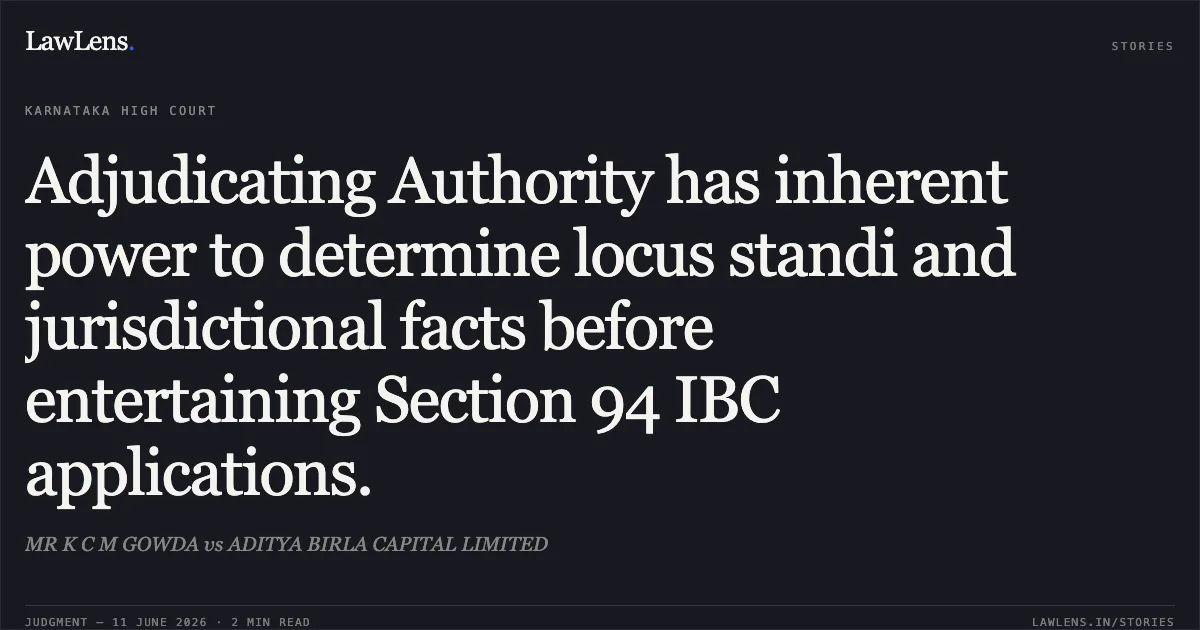
The Court answered that the NCLT has the inherent power to determine locus standi and jurisdictional facts at the threshold under Section 94.
The Court held that the Petitioner failed to establish his status as a personal guarantor.
Source reference: para. 48The Writ Petition was dismissed, and the NCLT's order was upheld.
Source reference: para. 49Due to the Petitioner's insistence on bypassing the statutory appellate remedy and the lack of foundational facts, the Court imposed exemplary costs of ₹1,00,000/- to be paid to the Karnataka State Legal Services Authority.
Source reference: para. 50, 51Acts & Sections Cited
6 provisions across 2 statutes referred to in this judgment. Each provision opens on LawLens.
Insolvency and Bankruptcy Code, 2016.5
Securitisation and Reconstruction of Financial Assets and Enforcement of Security Interest Act, 20021
Original Court PDF
MR K C M GOWDAvsADITYA BIRLA CAPITAL LIMITED
Click to open original judgment
Original judgment, available to read, download and summarize on LawLens.in