Facts
The Petitioners, BAMCEF and Bharata Mukti Morcha, sought to hold their 42nd National Convention and 15th BMM Convention at Lower Baliyatra Ground, Cuttack, from 26 to 30 December 2025.
Source reference: p.3The Collectorate issued provisional permission on 4 October 2025, subject to requisite no-objection certificates, and the Deputy Commissioner of Police issued a corresponding provisional permission/NOC on 1 November 2025.
Source reference: p.3; p.10The Petitioners deposited various statutory fees and incurred expenditure for the proposed event.
Source reference: p.4; p.11Subsequently, following circulation of a social-media video allegedly containing provocative and communally divisive statements, the Deputy Commissioner of Police cancelled the provisional permission by order dated 21 December 2025.
Source reference: pp.4–6As the scheduled dates had passed, the Petitioners sought permission to hold the convention from 26 to 30 December 2026 and submitted a fresh application to the Collector, which remained pending.
Source reference: pp.5–6, 12Issues
1. Whether the cancellation of the provisional permission for the proposed convention, on the ground of potential breach of communal peace and public order, was arbitrary or unlawful
Source reference: pp.10–122. Whether the Petitioners acquired an enforceable right to hold the convention on the basis of the permissions/NOC issued by the Collectorate and Deputy Commissioner of Police
Source reference: pp.4–5, 10–113. Whether the Petitioners were entitled to a direction permitting the convention in December 2026, notwithstanding the applicable standard operating procedure governing public gatherings
Source reference: pp.12–13Law Applied
The Court applied Articles 19(1)(a) and 19(1)(b) of the Constitution, which protect freedom of speech and expression and the right to assemble peacefully without arms, subject to reasonable restrictions, including in the interests of public order.
Source reference: pp.7–10Relying on Himat Lal K. Shah v. Commissioner of Police, Ahmedabad, (1973) 1 SCC 227, the Court held that the State may regulate assemblies in aid of the right and impose reasonable restrictions in the interest of public order, while distinguishing reasonable regulation from arbitrary exclusion.
Source reference: p.7; p.9It also relied on Amit Sahni v. Commissioner of Police, (2020) 10 SCC 439, which recognises the right to peaceful protest or assembly but permits regulation to balance that right against public order and the rights of other citizens.
Source reference: pp.7–10The Court further held that the permissions in question were provisional and conditional; the Collector-cum-District Magistrate remained the final authority, and the applicable SOP governed any fresh application for a public gathering.
Source reference: pp.10–13Reasoning
The Court found that the orders issued by the Collectorate and the Deputy Commissioner of Police did not constitute final permission.
Source reference: p.10The Collectorate’s order was expressly conditional upon obtaining NOCs from relevant authorities, while the Deputy Commissioner of Police’s order operated as such an NOC; final permission was yet to be granted by the Collector-cum-District Magistrate.
Source reference: p.10Accordingly, the Petitioners had no absolute right to conduct the convention merely because provisional permission had been granted.
Source reference: p.10The Court accepted that the viral video was not disowned by the Petitioners and that the district authorities had assessed it as provocative and capable of disturbing communal harmony.
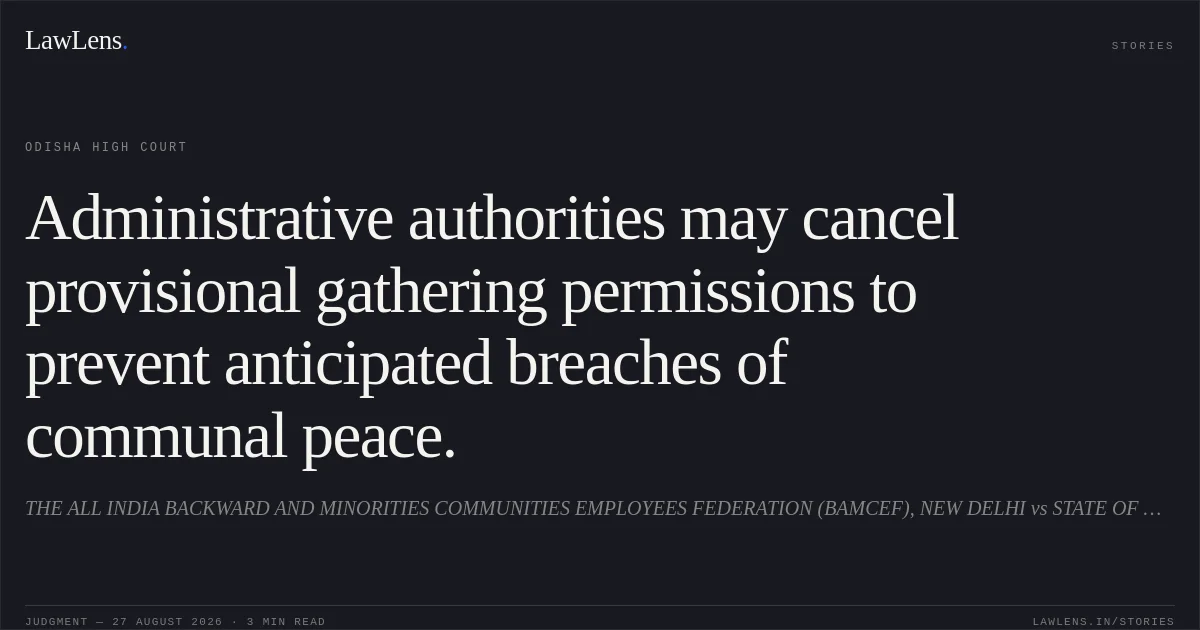
Source reference: pp.11–12Given the authorities’ responsibility to prevent breach of peace and maintain public order, the Court declined to substitute its view for that of the administrative authorities and held that cancellation of the provisional permission was neither illegal nor arbitrary.
Source reference: pp.11–12With respect to the proposed 2026 convention, the Court held that the pending application had to be considered under the SOP dated 7 March 2026, which prescribed the procedure and conditions for private gatherings at Baliyatra Ground and similar venues.
Source reference: pp.12–13Holding
The Court upheld and confirmed the impugned orders, including the cancellation order dated 21 December 2025 and the Collector’s consequential communication.
It rejected the challenge to the cancellation and did not grant an unconditional direction permitting the 2026 convention.
Source reference: p.13The Petitioners were permitted to submit or pursue a fresh application in accordance with the applicable SOP and guidelines, which the competent authority was directed to consider in accordance with law.
Source reference: p.13The Court further directed that fees already deposited before the relevant statutory authorities could be adjusted against the fresh permission process.
Source reference: p.13Original Court PDF
THE ALL INDIA BACKWARD AND MINORITIES COMMUNITIES EMPLOYEES FEDERATION (BAMCEF), NEW DELHIvsSTATE OF ODISHA
Click to open original judgment
Original judgment, available to read, download and summarize on LawLens.in
![Courts will not interfere with transfers absent mala fides or violation of statutory rules.. M Ramya vs EMPLOYEES STATE INSURANCE CORPORATION (ESIC). CAT - ['Chennai']. LawLens](/stories/thumbnails/courts-will-not-interfere-with-transfers-absent-mala-fides-or-violation-of-statutory-rules-a6845e9ca6f548fca284c51c8351957f.webp)
![Courts cannot direct one-time recruitment age relaxation absent authority in the governing rules or advertisement.. UT OF PUDUCHERRY vs M ANDAL. CAT - ['Chennai']. LawLens](/stories/thumbnails/courts-cannot-direct-one-time-recruitment-age-relaxation-absent-authority-in-the-governing-895d78fde47143e2a8ed0207c4b6a44f.webp)
![A review cannot correct an allegedly erroneous decision absent an error apparent on the record.. Ajit Kumar Jha vs RAILWAY BOARD. CAT - ['Delhi']. LawLens](/stories/thumbnails/a-review-cannot-correct-an-allegedly-erroneous-decision-absent-an-error-apparent-on-the-re-8ac952fd4eba470c92f7da20af72a220.webp)