Facts
The Madhya Pradesh Government initiated recruitment in 1998 for 207 Shikshak Karmi Grade-III posts in Sanwer Janpad Panchayat. Out of 2,539 applications, 1,796 candidates were interviewed, following which a final merit list of 207 selected candidates was prepared.
Source reference: para. 4–5The Lokayukta alleged that members of the selection committee—Mukesh Chauhan, Ramesh Borwal and Manohar Patel—used their positions to award maximum interview marks to their relatives, while Sohanlal Patel, Kesar Singh, Omprakash Yadav, Prahlad Dabi, CEO Ashok Kumar Pandey and BEO Vijay Rege allegedly assisted in the process.
Source reference: para. 6–8A charge-sheet was filed under Section 13(1)(d) read with Section 13(2) of the Prevention of Corruption Act, 1988, and Section 109 of the Indian Penal Code. The First Additional Sessions Judge, Indore, convicted all the appellants and sentenced each to two years’ rigorous imprisonment, a fine of ₹10,000, and, in default, six months’ rigorous imprisonment by judgment dated 12 August 2010 in Special Case No. 22/2004.
Source reference: para. 1–2The accused preferred appeals under Section 374(2) of the Code of Criminal Procedure.
Source reference: para. 1Issues
1. Whether Mukesh Chauhan, Manohar Patel and Ramesh Borwal, despite knowing that their relatives were candidates, abused their official positions by awarding them higher interview marks and securing their appointments?
Source reference: para. 22(i)2. Whether Sohanlal Patel, Kesar Singh, Vijay Rege, Omprakash Yadav, Prahlad Dabi and Ashok Kumar Pandey misused their positions by awarding higher marks to the relatives of other selection committee members and thereby facilitated their appointments?
Source reference: para. 22(ii)3. Whether the prosecution established the essential ingredients of criminal misconduct under Section 13(1)(d) of the Prevention of Corruption Act, including actual obtainment of a valuable thing or pecuniary advantage?
Source reference: para. 234. Whether the prosecution sanction granted against Ashok Kumar Pandey and Vijay Rege was valid and reflected proper application of mind?
Source reference: para. 30Law Applied
The Court applied Section 13(1)(d) read with Section 13(2) of the Prevention of Corruption Act, 1988, under which criminal misconduct requires proof that a public servant, by corrupt or illegal means, by abuse of position, or without public interest, obtained for himself or another person a valuable thing or pecuniary advantage; actual obtainment is necessary, and mere administrative irregularity or suspicion is insufficient.
Source reference: para. 23Relying on Neeraj Dutta v. State (NCT of Delhi) and Subash Parbat Sonvane v. State of Gujarat, the Court held that the statutory presumption under Section 20 does not apply to Section 13(1)(d), and that mere acceptance, attempt or procedural deviation cannot substitute proof of actual obtainment.
Source reference: para. 23The Court also considered Section 40(c) of the Madhya Pradesh Panchayat Raj Evam Gram Swaraj Adhiniyam, 1993, which concerns the use of office by a panchayat office-bearer to secure employment for a relative, and Section 19 of the Prevention of Corruption Act concerning valid prosecution sanction.
Source reference: paras. 25, 30, 32Criminal conspiracy requires proof of a prior agreement or meeting of minds; coincidence or parallel conduct, without more, is inadequate.
Source reference: para. 39Reasoning
The Court held that the prosecution failed to prove that the appellants obtained, or caused another person to obtain, any valuable thing or pecuniary advantage through corrupt or illegal means.
Source reference: no citationAs regards CEO Ashok Pandey and BEO Vijay Rege, neither had a relative participating in the recruitment, and the rules did not require them to obtain “no-relative” declarations or prescribe a rigid allocation of interview marks.
Source reference: paras. 25–27Their varied marks, together with the testimony of independent subject experts that the process was transparent and free from pressure, did not establish conspiracy or dishonest abuse of office.
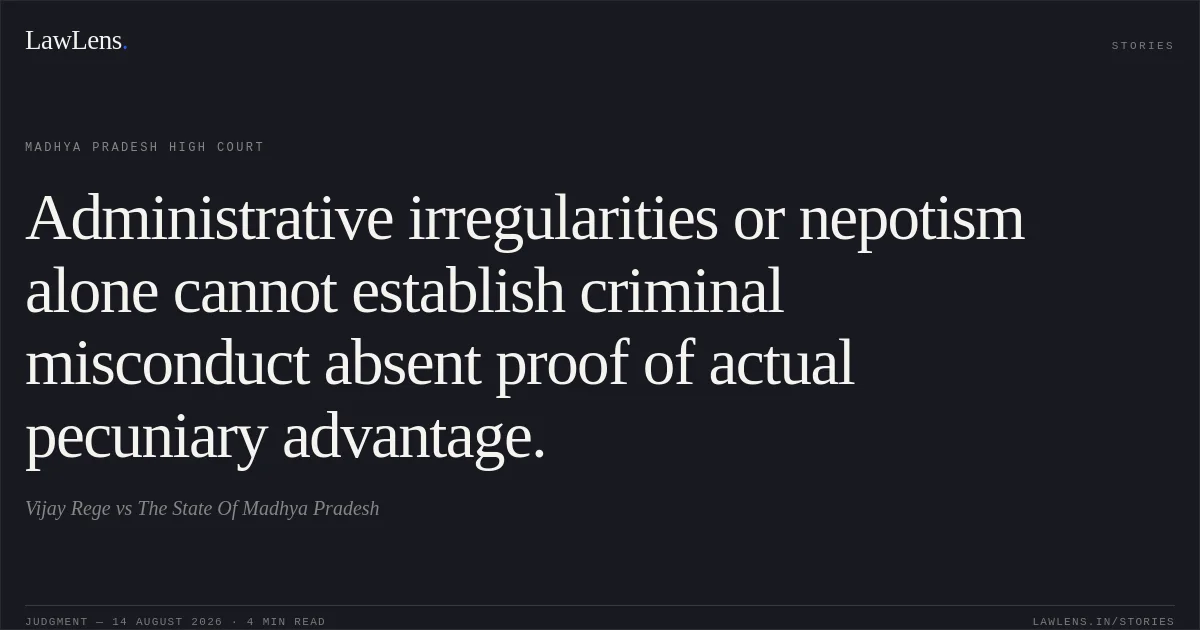
Source reference: paras. 27–29As regards Mukesh Chauhan, Ramesh Borwal and Manohar Patel, the alleged failure to disclose their relationships could constitute an administrative or disciplinary lapse under the Panchayat law, but did not by itself establish criminal misconduct under Section 13(1)(d), particularly in the absence of proof of financial gain or dishonest intention.
Source reference: paras. 32–36The evidence concerning the alleged family relationships was also weakened because it relied on photocopies and hostile or non-supporting witnesses.
Source reference: paras. 37–38With respect to Sohanlal Patel, Kesar Singh, Omprakash Yadav and Prahlad Dabi, the alleged uniform award of 15 marks did not independently prove a prior meeting of minds.
Source reference: para. 39The altered documents in File No. 9 and Ex. P/62 were not supported by handwriting or forensic evidence, while the preliminary inquiry report was rendered unreliable by the Inquiry Officer’s admissions regarding the manner and place of its preparation.
Source reference: paras. 39–42Receipt of a recommendation letter by Sohanlal and Prahlad Dabi’s failure to sign the final proceedings were insufficient to establish individual criminal liability or conspiracy.
Source reference: para. 43The Court further found the sanction in Ex. P/1 to have been issued mechanically, without proper application of mind.
Source reference: para. 30Holding
The Court answered the issues in favour of the appellants and held that the prosecution had failed to establish criminal misconduct, dishonest intention, actual pecuniary advantage, conspiracy, or a legally sustainable evidentiary foundation.
All the appeals were allowed; the conviction and sentence dated 12 August 2010 in Special Case No. 22/2004 were set aside, and all appellants were acquitted of the charges.
Source reference: paras. 45–47Their bail bonds were discharged, and any deposited fines were directed to be refunded. The trial-court record was ordered to be returned for necessary compliance.
Source reference: para. 47Acts & Sections Cited
8 provisions across 3 statutes referred to in this judgment. Each provision opens on LawLens.
Code of Criminal Procedure, 19732
Prevention of Corruption Act, 19885
Indian Penal Code, 18601
Original Court PDF
Vijay RegevsThe State Of Madhya Pradesh
Click to open original judgment
Original judgment, available to read, download and summarize on LawLens.in