Facts
The petitioner was appointed as a Community Organiser in 2005 on consolidated pay under the SJSRY scheme and was later regularised in the time scale of ₹3,200–4,900.
Source reference: p. 3–5After transfers to various municipal corporations, her pay was revised pursuant to G.O. (Ms.) No. 77, Finance (Pay Cell) Department, and the One Man Commission’s recommendations.
Source reference: p. 3–5She alleged that monetary benefits, including arrears, remained unpaid despite representations.
Source reference: p. 3–5The fourth respondent stated that settlement was impeded by the loss of records in the MTC-70 Register; the respondents also stated that pay had been refixed and some amounts sanctioned but not settled.
Source reference: p. 3–5She sought a mandamus for pay revision and arrears from 1 July 2011, with interest.
Source reference: p. 2–3Issues
1. Whether the petitioner was entitled to have her monetary dues settled in accordance with the pay revisions already sanctioned, including the revision under G.O. (Ms.) No. 77.
Source reference: p. 5–72. Whether the loss of administrative records justified the continued non-payment of the petitioner’s dues.
Source reference: p. 63. Whether interest should be awarded on the unpaid dues and, if so, at what rate.
Source reference: p. 7Law Applied
The Court exercised its jurisdiction under Article 226 of the Constitution to consider the petitioner’s request for mandamus.
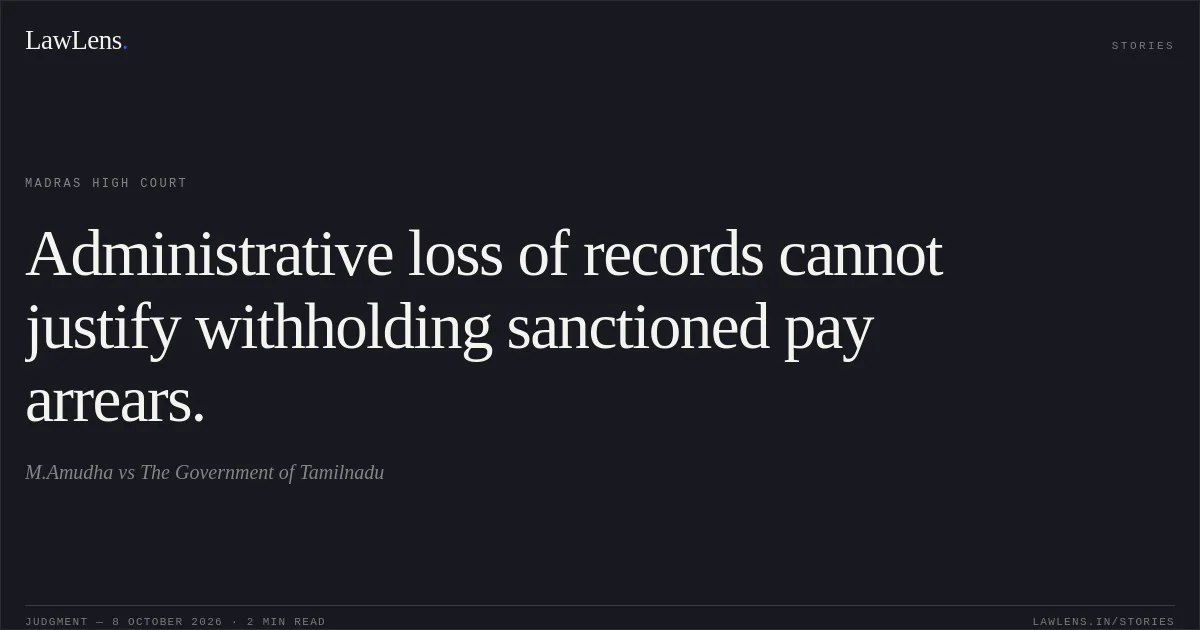
Source reference: p. 2, 6–7It applied the principle that, where pay revisions and amounts due have been sanctioned, the authorities must settle the employee’s dues; administrative difficulties, including misplaced records, do not by themselves justify indefinite non-payment.
Source reference: p. 6–7The Court relied on G.O. (Ms.) No. 77, Finance (Pay Cell) Department, dated 20 February 2021, and the One Man Commission’s recommendations as the basis for the applicable pay revision.
Source reference: p. 2, 6–7No judicial precedents were cited.
Source reference: no citationReasoning
The Court found no serious dispute as to the petitioner’s entitlement to increments and pay revision under the One Man Commission’s recommendations.
Source reference: p. 5–7The respondents’ position was that amounts had been sanctioned or pay refixed, but settlement remained pending; the fourth respondent also relied on missing records.
Source reference: p. 5–7The Court held that the authorities could determine the petitioner’s pay, including by reference to her immediate junior if necessary, and that record loss did not warrant withholding her dues indefinitely.
Source reference: p. 5–7Given the prolonged delay and the petitioner’s repeated efforts to obtain payment, the Court found grounds to issue mandamus.
Source reference: p. 5–7Holding
The petition was disposed of with a direction to the respondents to settle the petitioner’s monetary dues in accordance with the pay revisions already sanctioned and G.O. (Ms.) No. 77, within eight weeks of receipt of the order.
Interest at 6% per annum was awarded from the date of filing the writ petition; any amount already sanctioned could be deducted.
Source reference: p. 7No costs were awarded, and the connected miscellaneous petition was closed.
Source reference: p. 7Original Court PDF
M.AmudhavsThe Government of Tamilnadu
Click to open original judgment
Original judgment, available to read, download and summarize on LawLens.in