Facts
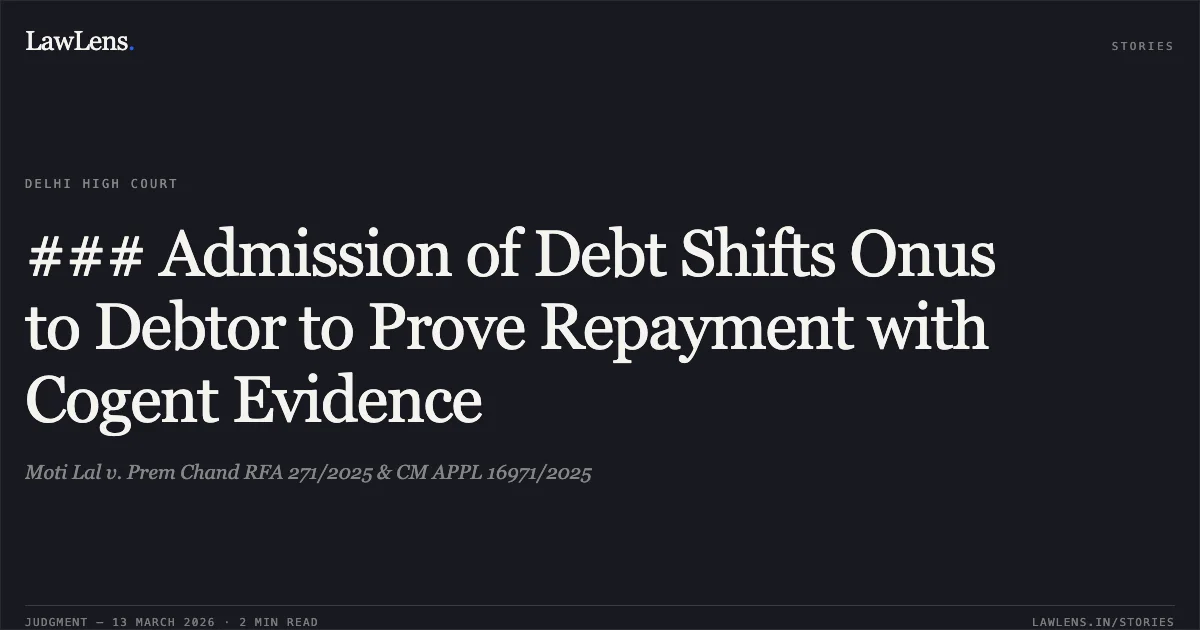
The Appellant (Plaintiff) filed a suit for recovery of ₹4,90,000/- (₹3,00,000/- principal plus interest) alleging he advanced a cash loan of ₹7,00,000/- to the Respondent in May 2017.
Source reference: p. 2The Respondent admitted receiving the loan and executing an undertaking/receipt dated 02.06.2017, but contended he repaid the entire amount in cash in July 2017.
Source reference: p. 2-3The Trial Court dismissed the suit on 22.11.2024, holding that while the Defendant failed to prove repayment, the Plaintiff also failed to adduce evidence to prove his case or put documents to the Defendant.
Source reference: p. 3-4The Appellant challenged this dismissal on the ground that admitted facts do not require proof.
Source reference: p. 4Issues
1. Whether the foundational fact of the loan advancement required independent proof by the Plaintiff despite the Defendant's admission.
Source reference: p. 5-6 / para. 222. Whether the Respondent discharged the burden of proving the repayment of the loan.
Source reference: p. 6 / para. 22-233. Whether the suit could be dismissed solely because the transaction involved large cash amounts in potential violation of Income Tax laws.
Source reference: p. 3, 9 / para. 8, 31Law Applied
The Court primarily applied Section 58 of the Indian Evidence Act, 1872, which stipulates that facts admitted by parties or their agents need not be proved.
Source reference: p. 5It further relied on Section 103 of the Indian Evidence Act, 1872, which places the burden of proof as to any particular fact on the person who wishes the Court to believe in its existence—in this case, the plea of discharge/repayment.
Source reference: p. 4Additionally, the Court addressed the principle that while cash transactions exceeding statutory limits may attract penalties under the Income-tax Act, such procedural non-compliance does not render a proved civil transaction void or unenforceable.
Source reference: p. 9Reasoning
The Court reasoned that since the Respondent categorically admitted receiving ₹7,00,000/- and executing the receipt, the Trial Court erred in demanding the Plaintiff prove the advancement of the loan.
Source reference: p. 5-6Under Section 58, the "foundational fact" stood established, shifting the entire onus to the Defendant to prove the "plea of discharge" (repayment).
Source reference: p. 6Upon evaluating the evidence, the Court found the Respondent’s testimony (DW-1) unreliable as he could not provide a specific date of repayment and lacked any documentary acknowledgement despite having executed a receipt for the initial loan.
Source reference: p. 7The testimony of the Respondent’s wife (DW-2) was deemed contradictory and improbable, as she claimed to have handed over the cash without counting it or knowing the denominations.
Source reference: p. 8The Court concluded that the Respondent "miserably failed" to discharge his burden of proof, and the lack of Plaintiff’s evidence was immaterial given the judicial admissions.
Source reference: p. 9Holding
The Court answered that admitted facts require no proof and the burden of proving repayment lay solely on the Respondent.
The High Court set aside the Trial Court’s Judgment and Decree dated 22.11.2024.
Source reference: p. 9The Appeal was allowed, and the suit was decreed in favor of the Appellant for ₹4,90,000/- along with interest @ 6% per annum from the date of filing until realization, plus costs.
Source reference: p. 9Acts & Sections Cited
2 provisions across 1 statute referred to in this judgment. Each provision opens on LawLens.
Code of Civil Procedure, 19082
Original Court PDF
Moti Lal v. Prem Chand RFA 271/2025 & CM APPL 16971/2025
Click to open original judgment
Original judgment, available to read, download and summarize on LawLens.in